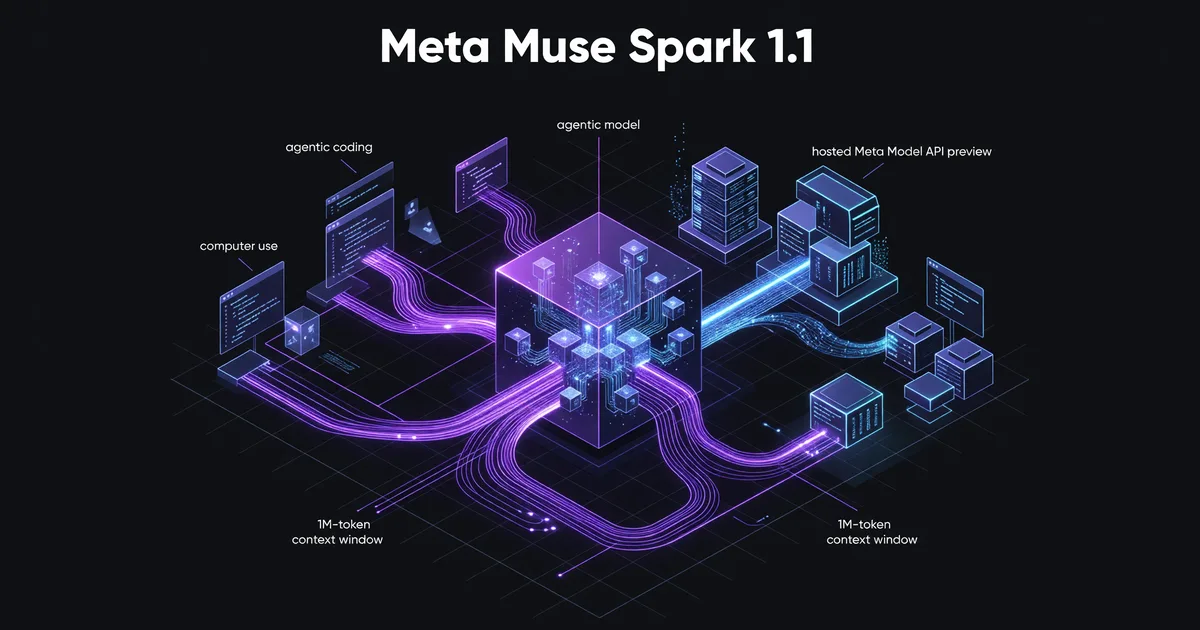
Meta Muse Spark 1.1: Agentic Model & New API
Meta's Muse Spark 1.1 brings agentic coding, computer use, and a 1M-token context — plus a hosted Meta Model API preview. What's real and what's not.
On July 9, 2026, Meta shipped Muse Spark 1.1, a multimodal reasoning model built for agentic work — coding, tool-calling, and computer control — and, more surprisingly, put it behind a hosted Meta Model API in public preview. Per Meta's launch post and a same-day Reuters report, developers can now hit the model directly through a metered endpoint. That second part is the actual story. Meta has spent years being the "we release the weights" company. A paid, hosted API is a different posture entirely.
Mark Zuckerberg amplified the release personally on X, leaning on coding and agentic performance as the pitch. When the CEO promotes a mid-point version bump (1.0 → 1.1) himself, it's a tell about where Meta thinks the competitive fight is right now: not chat, but agents that write code and drive software.
What Muse Spark 1.1 actually is
Muse Spark 1.1 is Meta's reasoning-and-agents tier, sitting above the general-purpose Llama family. It is not an open-weights checkpoint you pull from Hugging Face and self-host — it's a model you reach through Meta's endpoints or the consumer Meta AI app. That distinction is the whole point of this launch, and I'll come back to it.
The headline specs, from Meta's announcement:
- 1M-token context window — enough to hold a large codebase, a long execution trace, or a stack of reference docs in a single request without leaning on external retrieval.
- Agentic tool use — optimized for the plan → call a function → read the result → continue loop that underpins coding agents.
- Computer interaction — Meta positions the model to operate software interfaces, targeting browser and desktop automation rather than text-only output.
- Multimodal reasoning — it reasons across mixed inputs (screenshots, diagrams, code-plus-image context), not just plain text.
If that feature list sounds familiar, it should. It's the same four-part spec sheet — long context, tool use, computer use, multimodality — that Claude, OpenAI's GPT-5.x line, and Gemini have all converged on. The agentic-coding model has become a category with a standard shape, and Meta is now shipping to that shape.
The API is the news, not the model
Here's what makes this launch worth your attention even if you never touch Muse Spark: Meta is now running a hosted, metered inference API.
For a decade, Meta's AI strategy was "commoditize the model, own the ecosystem." Open weights, free downloads, let everyone build on Llama. The Meta Model API preview is the first serious crack in that philosophy — Meta selling access to a model it isn't giving away.
My read: this is Meta admitting that open weights alone don't capture the developers who want frontier agentic performance without standing up their own inference. Those developers are already paying Anthropic, OpenAI, and Google by the token. If Meta wants that revenue and that usage data, it needs an endpoint, not just a download link. Muse Spark 1.1 being API-first (and app-first for consumers) rather than weights-first tells you Meta decided the hosted market is too big to cede.
It also reframes the Llama story. Llama stays open and general-purpose; Muse Spark becomes the closed, premium, agentic tier. That's a two-track strategy that mirrors what you see elsewhere — an open base to seed the ecosystem, a hosted flagship to monetize the frontier.
What we don't know yet — and why it matters
Be careful with the launch narrative. Two big gaps were open at release, and both should shape how you evaluate the model.
1. No API pricing
Meta had not published per-token or tier pricing for the Meta Model API preview at launch. That's not a footnote — it makes any real cost comparison against competitors impossible right now. You can't decide whether Muse Spark 1.1 is worth switching to if you don't know what a million-token request costs. Until Meta posts numbers, treat "free in the Meta AI app" as the only confirmed price, and the API as a preview you can test but not budget around.
2. The benchmarks are Meta's own
The coding, tool-use, and computer-control claims are, so far, vendor-reported. Independent third-party benchmarks — the SWE-bench-style agentic evals, the LMArena-style head-to-heads — weren't available at launch. That's normal for day-one releases, but it means the performance story is Meta's framing until outside labs weigh in. I'd hold off on treating any "beats GPT-5.x" or "matches Claude" claim as settled until you see it on a leaderboard someone other than Meta runs.
The honest take: a 1M-token context window is a verifiable spec. "Best-in-class agentic coding" is a marketing claim. Keep those two categories separate when you read the launch coverage.
How it stacks up against the July field
Muse Spark 1.1 dropped into an absurdly crowded window. July 2026 has already seen OpenAI's GPT-5.6 Sol line go public, Gemini 3.5 releases from Google, and a steady stream of agentic-coding entrants from xAI's Grok to open-weight challengers. Here's the positioning as it stands on public information:
| Dimension | Muse Spark 1.1 | Frontier peers (Claude, GPT-5.x, Gemini) |
|---|---|---|
| Context window | 1M tokens | Comparable — 1M-class is now the top tier |
| Access model | Free in Meta AI app; hosted API in preview | Established, priced, production-grade APIs |
| Pricing transparency | Not disclosed at launch | Published per-token pricing |
| Independent benchmarks | None yet — vendor claims only | Extensively benchmarked by third parties |
| Ecosystem maturity | Brand new; SDKs and tooling thin | Deep SDK, framework, and integration support |
Where Muse Spark plausibly wins is the free consumer tier — everyday Meta AI app users get a frontier-class agentic model at no cost, which is a genuinely aggressive move against paid chat assistants. Where it's behind is everything a developer needs to commit: known pricing, independent performance data, and a mature SDK ecosystem. Those gaps close over weeks, not months, but they're real today.
Should you build on it right now?
My advice, split by who you are:
- Casual users: Just use it in the Meta AI app. It's free, it's frontier-tier for agentic tasks, and there's no commitment. Easy call.
- Developers evaluating for production: Kick the tires on the preview API, but don't migrate anything critical yet. Without disclosed pricing you can't model costs, and without third-party benchmarks you're trusting Meta's framing. Prototype, benchmark it yourself on your real workloads, and wait for pricing before committing.
- Teams already deep on Claude, GPT-5.x, or Gemini: There's no urgent reason to switch. The peers have priced, benchmarked, production-hardened APIs. Watch for Meta's pricing announcement — if it undercuts the field meaningfully, that's the moment to re-evaluate, not now.
The bigger signal
Strip away the spec sheet and Muse Spark 1.1 is a strategy announcement dressed as a model release. The specs — 1M context, agentic tool use, computer control — put Meta at parity with the standard frontier feature set. The delivery mechanism — a hosted, metered API alongside a free consumer tier — is Meta declaring it wants a piece of the paid inference market it previously tried to commoditize out from under its rivals.
Whether Muse Spark 1.1 is actually as good as Claude or GPT-5.6 Sol at agentic coding, we genuinely don't know yet — and anyone claiming certainty at this stage is reading Meta's marketing back to you. What we do know is that Meta just changed how it goes to market. For a company whose entire AI identity was "open and free," standing up a paid API is the more consequential headline than any benchmark. The performance data will come. The strategic shift already happened.
Bottom line: a capable-looking agentic model with a real 1M-token context, free for consumers, and a preview API that matters more for what it says about Meta's direction than for what you can build on it today. Test it, don't bet on it yet, and watch for the pricing page.
Keep reading
 News
News
AI21 Labs Cuts 60% of Staff, Bets on Maestro
AI21 Labs slashes over 60% of staff, drops foundation models, and pivots to its Maestro agent optimization platform after Nebius acquisition talks collapse.
 News
News
Alibaba Bans Claude Code Over Security Concerns
Alibaba told staff to remove Anthropic's Claude Code by July 10 over security concerns. Here's what triggered the ban and what it signals.
 News
News
Anthropic Acquires Stainless: What It Means for AI
Anthropic bought Stainless, the SDK generator behind OpenAI and Cloudflare's client libraries. Here's the strategic play for AI agents.