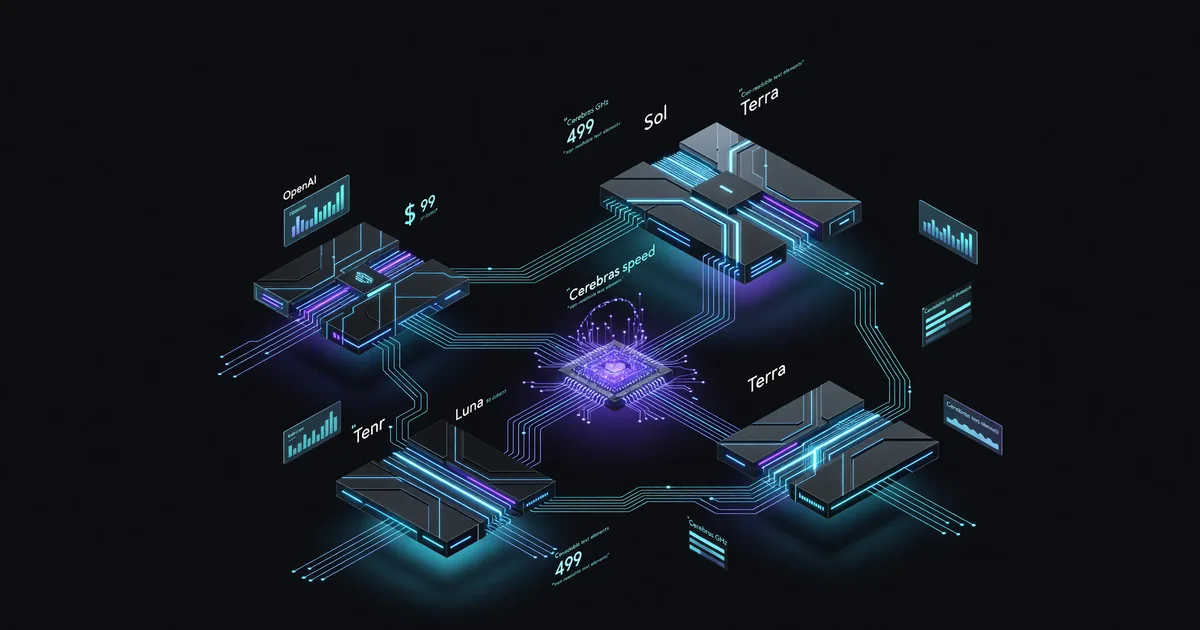
GPT-5.6 Sol Goes Public: Pricing, Speed & Access
OpenAI opens GPT-5.6 Sol, Terra, and Luna to everyone on July 9 — here's the confirmed pricing, Cerebras speed, and who each tier is for.
As of today, July 9, GPT-5.6 Sol is no longer a government-only preview. OpenAI has flipped the switch on public availability for the whole GPT-5.6 family — Sol, Terra, and Luna — moving it from the limited, US-government-coordinated preview it announced on June 26 into general access for developers and API customers. Reuters reported the launch approval, and Engadget covered the July 9 rollout window.
The headline isn't just "it shipped." It's three things landing at once: a three-tier pricing structure that undercuts GPT-5.5 on the cheaper tiers, a serving-speed jump via a Cerebras inference partnership, and the end of one of the stranger gating stories in recent model launches. Here's what's actually confirmed versus what's still fuzzy.
The three-model family, quickly
GPT-5.6 isn't a single model. It's a generation split into three tiers that share the same underlying architecture but trade capability against cost — the now-standard frontier-lab playbook, closely mirroring Anthropic's Opus/Sonnet/Haiku split for Claude.
- Sol — the flagship. This is the frontier-reasoning tier OpenAI is pointing at hard problems: long-horizon agentic workflows, software engineering, and cybersecurity. OpenAI claims new state-of-the-art on Terminal-Bench, the benchmark that measures how reliably a model completes real terminal and coding tasks end to end.
- Terra — the balanced mid-tier, and the one most teams will actually default to. It sits at roughly half the flagship's token cost while keeping most of the reasoning quality.
- Luna — the cost-efficient tier, built for high-volume, latency-sensitive, or "easy" calls where you don't want to pay flagship rates.
The practical point of the split is routing: send trivial calls to Luna, mid-difficulty work to Terra, and reserve Sol for the genuinely hard problems. If you architect your app to route by difficulty, the blended cost can be dramatically lower than running everything through the flagship.
Confirmed pricing
Per OpenAI's announcement, the API pricing per million tokens (input / output) is:
| Model | Input (per 1M) | Output (per 1M) | Positioning |
|---|---|---|---|
| Sol | $5.00 | $30.00 | Flagship reasoning |
| Terra | $2.50 | $15.00 | Balanced default |
| Luna | $1.00 | $6.00 | Cost-efficient / high-volume |
Two things stand out. First, Sol lands in the same premium bracket as other flagship reasoning models — this is not commodity pricing, and OpenAI isn't pretending it is. At $5/$30 it's priced like a model you reach for when the task justifies it, not one you point all your traffic at by default.
Second, Terra is the interesting number. OpenAI positions it as roughly 2x cheaper than GPT-5.5 for comparable work, which reframes the upgrade math: this isn't only "the new model is smarter," it's "the tier you'll actually use costs less than what you're running now." My read: Terra, not Sol, is the tier that moves the most production traffic. Most real workloads don't need frontier reasoning on every call, and a cheaper-than-5.5 middle tier is exactly what makes teams switch generations.
The Cerebras speed angle
The genuinely new part of this launch — versus the June preview — is serving speed. OpenAI is leaning on a Cerebras inference partnership to hit reported throughput around 750 tokens per second. For context, typical GPU-served frontier models often land in the tens-to-low-hundreds of tokens per second range for interactive use, so if that figure holds up in production it's a meaningful step change for anything where output latency is the bottleneck.
Where fast token generation actually matters: agentic loops that make many sequential model calls, streaming UIs where users wait on long outputs, and code-generation tools that emit large diffs. In those, throughput is the felt experience, not a spec-sheet footnote.
The honest caveat: 750 tok/sec is a headline number, and headline numbers are measured under favorable conditions. Real-world throughput depends on context length, load, batching, and which tier you're on. Treat it as "notably faster than GPU-served baselines," not as a guarantee you'll see 750 on every call. We don't yet have independent third-party latency benchmarks across the three tiers — when Artificial Analysis or similar publish, that's the number to trust.
What changed from the government-only preview
The rollout story here is unusual and worth understanding, because it explains why "public launch" is itself the news. GPT-5.6 debuted in a limited preview that OpenAI described as coordinated with the US government — a framing tied directly to the family's cybersecurity capabilities. In plain terms: the model is good enough at security-relevant tasks that OpenAI gated early access rather than shipping it wide on day one.
That dual-use tension is the throughline. Stronger cybersecurity capability means better defensive tooling — vulnerability discovery, code auditing, incident triage — but the same capability is exactly what you don't want handed to everyone without guardrails. Today's public launch means OpenAI has decided its safety mitigations and monitoring are ready for general availability. It doesn't mean the concern evaporated; it means the company judged the tradeoff acceptable.
What that means for you: expect the safety layer to be more visible on this family than on older models — more refusals around clearly offensive security use, more logging, and enterprise controls around the cybersecurity features. If you're building legitimate defensive tooling, budget time to work through access and usage policies rather than assuming an instant green light.
Capabilities: what OpenAI is claiming
OpenAI is positioning GPT-5.6 around three areas, in roughly this order of emphasis:
- Agentic tasks — long-horizon workflows where the model plans, calls tools, and works through multi-step problems without constant hand-holding. This is where the industry's competitive pressure is highest right now, and where the Terminal-Bench claims are aimed.
- Software engineering — the Terminal-Bench SOTA claim is specifically about completing real coding and terminal tasks reliably, not just producing plausible-looking code. That reliability gap is what separates a demo from a tool you'd actually put in a CI loop.
- Cybersecurity — the headline capability and the reason for the cautious preview. OpenAI reports major gains on cybersecurity benchmarks.
One thing to keep in perspective: benchmark SOTA is a claim, not a lived experience. Terminal-Bench is a good signal because it measures completion of realistic tasks rather than trivia, but no single benchmark predicts how a model behaves on your codebase and your agent harness. The teams that get value fastest will run their own eval suite against Terra and Sol before rewiring anything.
How it stacks up against the field
GPT-5.6 lands into a crowded flagship moment. Anthropic has been shipping fast on the Claude side, and Google's Gemini 3.5 line is competing directly on agentic and coding workloads. The differentiators OpenAI is betting on here are the cost curve (a cheaper-than-5.5 middle tier) and raw serving speed (the Cerebras partnership), rather than a single dramatic capability leap over its own prior generation.
The honest take: for most developers, the decision won't be "Sol versus a competitor's flagship" — it'll be "does Terra at its price and speed beat what I'm already paying for on GPT-5.5 or a rival mid-tier?" That's a spreadsheet question, and it's a good sign for buyers that the answer increasingly comes down to price-performance rather than which lab has the single smartest model.
What to do today
- If you're on GPT-5.5: price out moving your default traffic to Terra. The 2x cost claim is the whole reason to look, and if your workloads don't need flagship reasoning, this is a straightforward win. Run your own evals first.
- If latency is your pain point: the Cerebras-backed speed is the reason to test now rather than wait. Benchmark it on your actual prompt shapes, not the marketing figure.
- If you're doing security work: expect access gating and policy friction. Plan for it; don't assume instant production access to the cybersecurity capabilities.
- Everyone else: wait for independent latency and quality benchmarks before rewiring anything. Launch-day claims are a starting point, not a verdict.
The short version: GPT-5.6's public launch matters less for a single dazzling capability and more for the structure of the offering — a genuinely cheaper middle tier, a real speed story, and the end of an unusually cautious rollout. Whether it earns your traffic is a question your own evals will answer better than any benchmark chart. What's clear is that OpenAI is competing on price-performance and speed as much as raw intelligence — and for the people paying the bills, that's the healthier fight to be having.
Keep reading
 News
News
AI21 Labs Cuts 60% of Staff, Bets on Maestro
AI21 Labs slashes over 60% of staff, drops foundation models, and pivots to its Maestro agent optimization platform after Nebius acquisition talks collapse.
 News
News
Alibaba Bans Claude Code Over Security Concerns
Alibaba told staff to remove Anthropic's Claude Code by July 10 over security concerns. Here's what triggered the ban and what it signals.
 News
News
Anthropic Acquires Stainless: What It Means for AI
Anthropic bought Stainless, the SDK generator behind OpenAI and Cloudflare's client libraries. Here's the strategic play for AI agents.