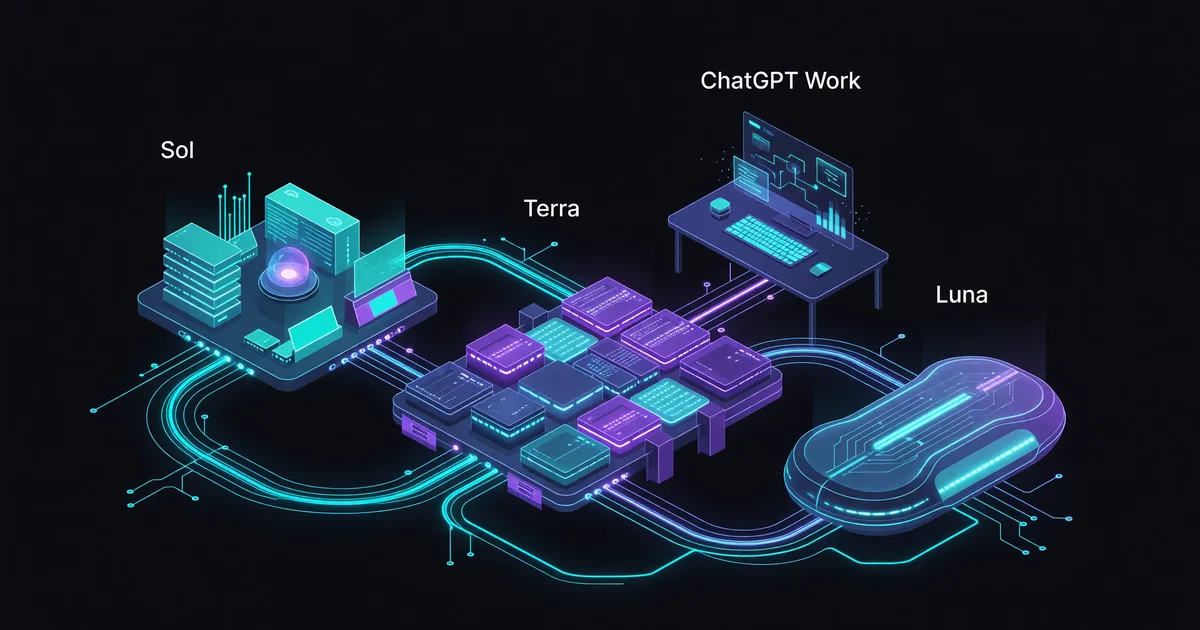
OpenAI GPT-5.6 Launches: Sol, Terra, Luna Explained
OpenAI's GPT-5.6 family goes public with Sol, Terra, and Luna tiers plus ChatGPT Work — here's how the three models split and who gets each.
OpenAI moved the entire GPT-5.6 lineup out of restricted preview and into general availability on July 9–10, 2026 — not just GPT-5.6 Sol, but the two siblings that shipped alongside it: Terra and Luna. Reuters and OpenAI's own launch post both frame this as the moment the family stops being a government-and-enterprise early-access curiosity and becomes the default stack inside ChatGPT, Codex, and the API. It arrived on a loud day — Meta pushed Muse Spark 1.1, xAI shipped Grok 4.5, and Anthropic launched Reflect, all within roughly 48 hours — but the OpenAI release is the one with the widest blast radius, because it quietly changes which model you're talking to whether or not you asked.
We've covered Sol's public pricing and speed separately. This piece is about the shape of the family: what Sol, Terra, and Luna are each for, what ChatGPT Work adds on top, and why OpenAI split one version number into three named models instead of shipping a single flagship.
The three-model split, decoded
OpenAI's naming has drifted away from the old "GPT-4o / o3 / mini" grid toward celestial names that map to a capability-and-cost axis. Based on the launch materials and OpenAI's positioning, here's how the three break down:
| Model | Positioning | Best for |
|---|---|---|
| Sol | The flagship. Deepest reasoning, longest effective context, the tier that gets the benchmark headlines. | Hard agentic tasks, long multi-step coding, research-grade reasoning. |
| Terra | The workhorse middle tier — balanced cost and latency, tuned for everyday production traffic. | Most app integrations, chat, RAG, moderate agent loops. |
| Luna | The efficiency tier — fastest and cheapest, built for high-volume and latency-sensitive calls. | Classification, routing, autocomplete, cheap sub-agent steps. |
If that structure feels familiar, it should: it's the same tiering logic every major lab has converged on. Anthropic has Opus/Sonnet/Haiku; Google has Pro/Flash/Flash-Lite for Gemini. My read: the interesting move here isn't that OpenAI copied the ladder — it's that they gave each rung a proper product name instead of a suffix. Naming Terra and Luna as first-class models (rather than "GPT-5.6-mini") signals OpenAI wants developers to choose a tier deliberately rather than defaulting everyone to the flagship and eating the cost. That's an economics play dressed up as branding.
Why three models, and why now
The efficiency framing is the throughline in OpenAI's messaging. The pitch across the launch AMA and blog post is that GPT-5.6 delivers better reasoning per dollar and per second than the 5.5 generation — and the cleanest way to prove that is to hand developers a model whose entire job is being cheap and fast (Luna) alongside one whose job is being smart (Sol). One flagship can't credibly claim both.
The timing is the other half of the story. The GPT-5.6 family spent weeks in a limited preview gated to government and select enterprise partners while U.S. approval was pending — we wrote about that preview phase and the awkward "gov and big labs get frontier AI first" dynamic it created. The July 9–10 general release is the resolution of that: with the regulatory hold lifted, OpenAI could finally flip the switch for everyone. That's why the launch reads less like a surprise drop and more like a dam breaking. The models were done; the paperwork wasn't.
The GPT-5.6 preview was rationed by policy, not by readiness. The public launch is what happens when the policy constraint clears — everything ships at once.
ChatGPT Work: the agent layer on top
The launch isn't only new weights. OpenAI paired it with a broader rollout of ChatGPT Work, positioned as an agent surface for complex, multi-step business workflows rather than single-turn chat. The framing is that GPT-5.6's stronger agentic reasoning is the enabling ingredient — the model can now hold a longer task together (pull data, call tools, draft, revise, hand off) without a human babysitting every hop.
This matters because it's where the model-tier split pays off in practice. A real agent workflow doesn't need Sol for every step. A well-built agent routes: Luna handles the cheap classification and routing decisions, Terra does the bulk drafting, and Sol gets reserved for the genuinely hard reasoning moments. OpenAI shipping the whole ladder at once is what makes that routing economically sane. If you only had the flagship, every trivial sub-step would cost flagship money.
The honest take: ChatGPT Work is the part I'd watch most skeptically. "Agent for complex workflows" is a claim every lab is making right now, and the gap between a good demo and a reliable production agent is enormous. OpenAI hasn't published hard reliability numbers on multi-step task completion at launch, and until independent reviewers stress it on messy real-world workflows, treat the agent claims as promising rather than proven.
Where you can actually use it
Availability is unusually broad for a launch day, which is the tell that this was a held-back release finally uncorked. Per OpenAI's rollout notes, GPT-5.6 shows up across three surfaces:
- ChatGPT — the family becomes the backing model for the assistant, with tier selection handled behind the scenes for most users and exposed for Plus/Pro/enterprise where relevant.
- Codex — OpenAI's coding agent picks up GPT-5.6's improved agentic reasoning, which is arguably where the reasoning gains are most visible (long, tool-heavy coding loops).
- API — Sol, Terra, and Luna are individually addressable so developers can pin a tier per call and route by task difficulty.
There's also an ecosystem signal worth flagging: Perplexity announced GPT-5.6 integration essentially in lockstep with the launch. When a major third-party surface lights up a new model on day one, it usually means OpenAI gave partners preview access under the same hold — another sign the "launch" was really a coordinated unhold.
How it stacks against the field
GPT-5.6 didn't launch into a vacuum. The same 48-hour window brought xAI's Grok 4.5 and Anthropic's Reflect, and Google's Gemini 3.5 line is already in market. Here's the competitive frame, keeping to what's publicly known rather than head-to-head numbers OpenAI hasn't released:
| Lab | Recent flagship | Tiering approach |
|---|---|---|
| OpenAI | GPT-5.6 Sol | Sol / Terra / Luna (named tiers) |
| Anthropic | Claude (Opus/Sonnet/Haiku) | Three-tier by size/cost |
| Gemini 3.5 Pro/Flash | Pro / Flash / Flash-Lite | |
| xAI | Grok 4.5 | Single flagship + fast variant |
I'm deliberately not putting benchmark scores in that table. OpenAI's launch post makes efficiency and agentic-reasoning claims, but the credible third-party comparisons — Artificial Analysis, SWE-bench runs, independent agent evals — take days to weeks to appear after a release this fresh. Anyone showing you a confident "GPT-5.6 vs Grok 4.5" leaderboard on launch week is extrapolating. What's underappreciated here: the more meaningful comparison isn't Sol vs. some rival flagship, it's whether Terra and Luna undercut the competition's mid and low tiers on price-performance, because that's where the volume — and the revenue — actually lives.
What we still don't know
A few gaps are worth stating plainly, because launch-day coverage tends to paper over them:
- Exact per-tier pricing across all three. Sol's pricing is public; the precise Terra and Luna rates and context limits are the numbers to confirm against OpenAI's API pricing page before you architect around them.
- Real agent reliability. ChatGPT Work's multi-step completion rates on messy tasks aren't published. That's the number that decides whether it's a product or a demo.
- How much is genuinely new vs. unblocked. Because this was a held preview, some of what feels like "launch day gains" is capability that already existed and simply couldn't ship. That's not a knock — but it means the 5.5 → 5.6 jump may be smaller in raw capability than the fanfare implies, with the real story being access, not a leap.
Who should care, and what to do
If you build on OpenAI, the actionable move is to stop treating "GPT-5.6" as one thing. Audit your calls and route by difficulty: default to Terra, drop to Luna for anything mechanical, and escalate to Sol only where reasoning depth actually changes the output. That's where the efficiency story turns into a real bill reduction rather than a marketing line.
If you're a ChatGPT user, you likely already got upgraded without doing anything — the family is the new backing model. The place to poke is ChatGPT Work, if it's available on your plan: give it a genuinely multi-step task and watch where it breaks, because that's the honest test of whether the agent claims hold.
And if you're just tracking the AI race: the headline isn't "OpenAI shipped a smarter model." It's that OpenAI, Meta, xAI, and Anthropic all shipped frontier updates inside one 48-hour window. The cadence is compressing. GPT-5.6's real significance may be less about Sol's benchmark line and more about confirming that the labs are now releasing on a near-weekly drumbeat — and that the preview-then-unblock pattern, driven by regulatory sign-off, is becoming a normal part of how frontier models reach the public.
Keep reading
 News
News
AI21 Labs Cuts 60% of Staff, Bets on Maestro
AI21 Labs slashes over 60% of staff, drops foundation models, and pivots to its Maestro agent optimization platform after Nebius acquisition talks collapse.
 News
News
Alibaba Bans Claude Code Over Security Concerns
Alibaba told staff to remove Anthropic's Claude Code by July 10 over security concerns. Here's what triggered the ban and what it signals.
 News
News
Anthropic Acquires Stainless: What It Means for AI
Anthropic bought Stainless, the SDK generator behind OpenAI and Cloudflare's client libraries. Here's the strategic play for AI agents.