GPT-5.6 Goes Global — Plus ChatGPT Work Explained
OpenAI moved GPT-5.6 Sol, Terra and Luna out of limited preview into a global launch and shipped ChatGPT Work. Here's what changed.
On July 9, 2026, OpenAI did two things at once: it lifted GPT-5.6 out of its government-first limited preview and made the model family broadly available, and it announced ChatGPT Work, a new enterprise surface aimed squarely at agentic workplace tasks. TechCrunch covered the model rollout the same day, and OpenAI's own posts on X (@OpenAI) went out alongside the updated ChatGPT release notes.
We've already written plenty about the GPT-5.6 preview — Sol, Terra and Luna, the government early-access mechanics, the benchmark leaks. So this post isn't a re-run of "here's the model family." It's about what actually changed on launch day: who can use it now, and what ChatGPT Work is for. That second part is the genuinely new thing, and it's the piece most of the day-one coverage buried under the model headline.
What flipped from "preview" to "public"
The short version: the gate came down. For weeks, GPT-5.6 Sol was a limited preview reserved for government partners and a narrow set of early-access accounts (we covered the "who gets in" mechanics when it was still gated). As of the July 9–10 rollout, the three-tier family is generally available across OpenAI's products rather than behind an application form.
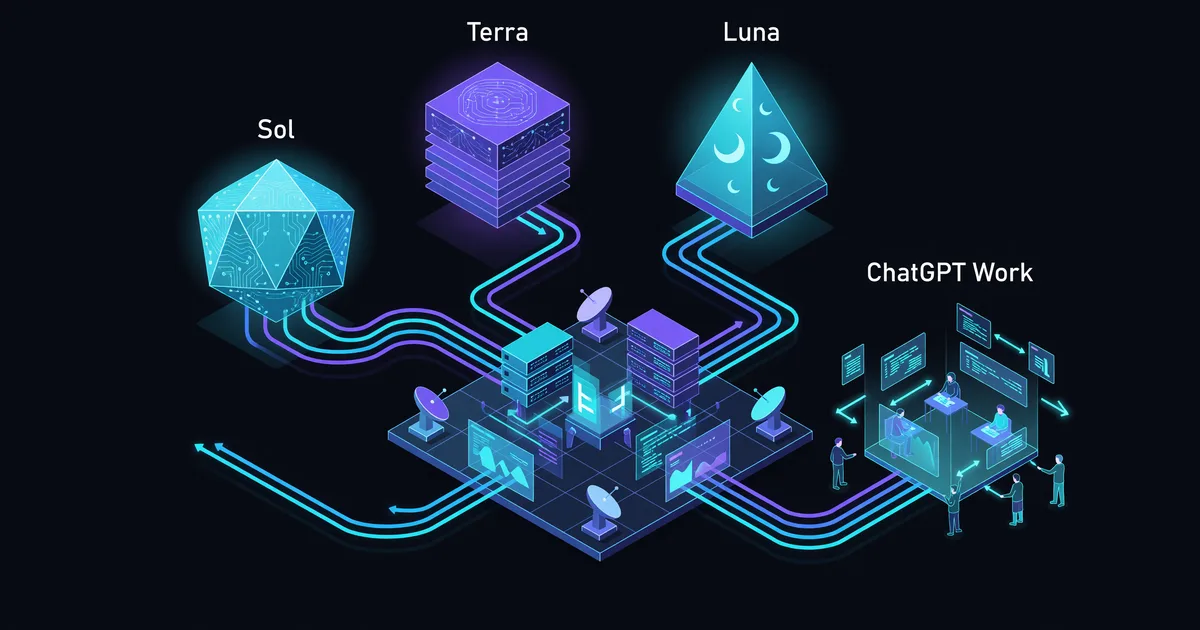
Here's the family as OpenAI has positioned it publicly, and how each tier is meant to be used:
| Model | Positioning | Who it's for |
|---|---|---|
| GPT-5.6 Sol | Flagship reasoning tier | Hard, multi-step reasoning; agentic workflows; the "think longer" default |
| GPT-5.6 Terra | Balanced workhorse | Everyday chat and production apps that need speed without dropping to a mini model |
| GPT-5.6 Luna | Fast / low-latency tier | High-volume, cost-sensitive calls where latency matters more than deep reasoning |
If you've followed the naming, this is OpenAI's clearest three-rung ladder yet — a reasoning flagship, a balanced middle, and a speed tier — mapped onto the same product so you can trade cost against capability without switching model families. My read: the interesting move isn't the models, it's that OpenAI shipped them and a new agent product on the same day. That's a deployment story, not just a model story.
ChatGPT Work: the actual news
ChatGPT Work is OpenAI's push to make ChatGPT a place where employees hand off multi-step tasks rather than just ask questions. Think of it as the enterprise-facing home for agentic work — connected to a company's tools and data, and able to take actions across them, not just draft text about them.
Based on OpenAI's public materials, here's what ChatGPT Work is reaching for:
- Connected data and tools. The value of an enterprise agent is proportional to what it can see and touch — internal docs, calendars, ticketing systems, code, CRM records. ChatGPT Work is framed around bringing those connectors into a governed workspace.
- Task hand-off, not just chat. The pitch is that you describe an outcome ("reconcile these two reports," "draft the QBR from these dashboards," "triage this inbox") and the agent executes across steps.
- Admin and governance controls. Enterprise buyers care about who can connect what, where data flows, and audit trails. This is the part OpenAI has to get right for regulated buyers, and it's the part that's least visible from a launch post.
- GPT-5.6 underneath. ChatGPT Work rides the newly-public model family, with Sol available for the reasoning-heavy jobs where a cheaper model would stall.
OpenAI has been building toward this for a while — we've covered its Workspace Agents tooling and the $4B "deployment company" it stood up to actually get this stuff into large organizations. ChatGPT Work reads like the productized front-end of that whole strategy: the consulting arm lands the account, and ChatGPT Work is what the account logs into.
The honest take: the model family is table stakes now. Every frontier lab has a three-tier ladder. The competitive question in mid-2026 is who wins the enterprise workflow layer — and that's a distribution and trust fight, not a benchmark fight.
What we don't know yet
I want to be straight about the gaps, because launch-day posts love to paper over them.
- Exact ChatGPT Work pricing and packaging. OpenAI positions it as an enterprise/Business-tier capability, but the specific seat pricing, which plans include it, and any usage metering weren't fully spelled out in the day-one materials. Treat any hard per-seat number you see as unconfirmed until it's on OpenAI's pricing page.
- API price points for the 5.6 tiers. The family is public, but if you're budgeting an app, pull the current per-token rates straight from OpenAI's API pricing rather than trusting a screenshot — launch-week numbers move.
- Regional availability nuances. "Global" launches rarely mean literally everywhere on day one. Data-residency and enterprise-compliance rollouts often lag consumer access by weeks.
- How autonomous ChatGPT Work really is. The demo framing and the day-90 reality of enterprise agents are usually different animals. We'll believe the "hands-off task execution" story when independent enterprise users report it.
How this compares to the preview
The limited preview was about proving the models to trusted partners — governments and vetted early accounts — while OpenAI cleared U.S. approval hurdles. The July 9 launch is about distribution. Two concrete shifts:
- Access model. Preview = application/allowlist. Launch = generally available across ChatGPT and the API.
- Surface area. Preview = mostly raw model access for evaluation. Launch = the models plus ChatGPT Work as a packaged way to actually deploy them inside a company.
If you read our earlier "GPT-5.6 Sol vs GPT-5.5" benchmark coverage, nothing about the models' underlying capability claims changed on launch day — what changed is that you can now put them to work without an invite.
Where this leaves the competition
The timing is not subtle. This lands in a stretch where Claude shipped Sonnet 5 and Anthropic is pushing hard on agentic and enterprise use, and Gemini 3.5 is fanning out across Google's surfaces. All three are converging on the same bet: the frontier model is necessary but no longer sufficient, and the money is in the workflow layer that sits on top of it.
OpenAI's edge here is reach — ChatGPT is already inside a staggering number of companies as shadow IT. ChatGPT Work is, in part, an attempt to convert that unofficial usage into governed, paid, admin-controlled deployments before a competitor does. Anthropic's counter is a strong enterprise-security reputation and deep coding/agent credibility; Google's is that Gemini is already wired into Workspace, where the work actually happens.
What's underappreciated here: the winner of the enterprise-agent race probably isn't decided by whose model reasons best. It's decided by whose agent an IT admin trusts to connect to the CRM. That's a governance and integration problem, and it favors whoever ships the most credible controls — not the highest MMLU.
What to do with this today
If you're an individual user, the practical change is modest: you get the newer model family in ChatGPT without an invite, and you can pick the tier that fits your task — Sol when you need it to actually think, Luna when you're doing something high-volume and simple.
If you're evaluating this for a team, here's the honest checklist before you get excited:
- Confirm pricing from the source. Don't commit budget off a launch tweet — check OpenAI's enterprise pricing directly.
- Map the connectors you actually need. ChatGPT Work is only as useful as the systems it can reach. If your critical tool isn't supported yet, the agent story stays theoretical.
- Pressure-test governance. Ask what the admin controls, audit logging, and data-handling guarantees are. This is the make-or-break for anyone in a regulated industry.
- Run a bounded pilot. Pick one repetitive, low-risk workflow and measure whether the agent actually completes it end-to-end. Enterprise-agent demos are easy; reliability is where they live or die.
The bottom line
GPT-5.6 going public was expected — the preview always read like a staging area, not a destination. The real signal is ChatGPT Work landing on the same day. OpenAI is telling you where it thinks the next phase of competition is: not "whose model is smartest," but "whose agent your company will actually deploy." That's a harder, slower, trust-driven fight than a benchmark race — and it's the one that decides who owns the workplace AI layer for the rest of 2026.
We'll update our coverage as OpenAI publishes firm ChatGPT Work pricing and as independent enterprise reports come in on how well the agent holds up outside the demo. Until then, treat the model launch as confirmed and the workplace-agent promise as promising-but-unproven.
Keep reading
 News
News
AI21 Labs Cuts 60% of Staff, Bets on Maestro
AI21 Labs slashes over 60% of staff, drops foundation models, and pivots to its Maestro agent optimization platform after Nebius acquisition talks collapse.
 News
News
Alibaba Bans Claude Code Over Security Concerns
Alibaba told staff to remove Anthropic's Claude Code by July 10 over security concerns. Here's what triggered the ban and what it signals.
 News
News
Anthropic Acquires Stainless: What It Means for AI
Anthropic bought Stainless, the SDK generator behind OpenAI and Cloudflare's client libraries. Here's the strategic play for AI agents.