Muse Spark 1.1
Meta's multimodal reasoning model built for agentic coding, tool use, and computer control, with a 1M-token context window.
Updated 2026-07-10
Yes, within limits. Muse Spark 1.1 runs a free tier with paid plans above it.
Listed pricing: Free in Meta AI app; API in public preview (pricing not yet disclosed).
Overview
Muse Spark 1.1 is Meta's multimodal reasoning model aimed squarely at agentic workloads — writing and debugging code, chaining tool calls, and driving a computer through multi-step tasks. Announced on July 9, 2026 alongside a public preview of the Meta Model API, it ships with a 1M-token context window, which is the headline spec for developers who want to feed whole repositories, long logs, or multi-document task histories into a single request. Unusually for a model release, Mark Zuckerberg amplified the launch personally on X, framing coding and agentic performance as the differentiators.
The model sits in Meta's lineup above the general-purpose Llama family, positioned as the reasoning-and-agents tier rather than an open-weights checkpoint you self-host. Everyday users get it free inside the Meta AI app, while developers reach it through the Meta Model API — a notable shift for Meta, whose reputation has been built on open-weight releases rather than a hosted, metered API. That makes Muse Spark 1.1 as much a strategic statement as a technical one: Meta competing directly on the same agentic-coding turf as Anthropic's Claude, OpenAI's GPT-5.x, and Google's Gemini, through a paid endpoint.
What's still unknown matters here. Meta has not published API pricing, and independent benchmarks for the coding and computer-use claims weren't available at launch — the performance narrative so far is Meta's own. For teams evaluating it against established agentic coders, that means treating the launch numbers as vendor-reported until third parties weigh in.
Is Muse Spark 1.1 free?
Yes, within limits. Muse Spark 1.1 runs a free tier with paid plans above it.
What the free tier covers: Free access to the model inside the Meta AI app; API is in public preview.
Listed pricing: Free in Meta AI app; API in public preview (pricing not yet disclosed).
Pricing on this page has not been re-verified. The entry was last edited on , and no separate pricing check has been run since. Treat the figures as a record of what was published then and confirm on the official site.
What the free tier leaves out
Read straight off the plan list below. Vendors move features between tiers, so check the current split before you pay.
- Meta Model API (Preview) Not yet disclosed Public preview API access for developers; Meta had not published per-token or tier pricing at launch. Check website for current pricing.
Muse Spark 1.1 pricing
| Plan | Price | What's included |
|---|---|---|
| Meta AI app | Free | Access to Muse Spark 1.1 through the consumer Meta AI app at no cost. |
| Meta Model API (Preview) | Not yet disclosed | Public preview API access for developers; Meta had not published per-token or tier pricing at launch. Check website for current pricing. |
Access to Muse Spark 1.1 through the consumer Meta AI app at no cost.
Public preview API access for developers; Meta had not published per-token or tier pricing at launch. Check website for current pricing.
One plan carries no published number: Meta Model API (Preview), recorded as “Not yet disclosed”. Nothing is estimated in its place. The vendor's own pricing page is the only source for those figures.
Pricing on this page has not been re-verified. The entry was last edited on , and no separate pricing check has been run since. Treat the figures as a record of what was published then and confirm on the official site.
Is Muse Spark 1.1 worth it?
Worth it for Developers building agentic coding and computer-use tools who need a large context window for whole codebases or long tool-call traces.
You can test that on the free tier before paying anything. The recorded trade-offs are listed below, and any one of them can settle the question on its own.
The 8.2/10 AI Score is an editorial read of published capability, price and shipping pace. Nobody here has hands-on hours with Muse Spark 1.1. How we verify.
Worth it if
The strengths recorded against this entry.
- 1M-token context window rivals the largest available, fitting whole repos or long agent traces in one request
- Purpose-built for agentic coding and tool use rather than retrofitted from a chat model
- Free to use in the Meta AI app, lowering the barrier for casual evaluation
- Multimodal input plus computer-interaction targeting suits browser and desktop automation
Not worth it if
Any one of these blocks your use case.
- API pricing was not disclosed at launch, making cost comparison against Claude, GPT-5.x, or Gemini impossible for now
- Performance claims are vendor-reported — no independent coding or computer-use benchmarks available yet
- A hosted, metered API is a departure from Meta's open-weight track record, so you can't self-host this tier
- Brand-new (launched July 9, 2026), so ecosystem support, SDKs, and real-world reliability data are thin
What sets Muse Spark 1.1 apart
- 1M-token context window fits whole repos or long agent execution traces
- Built for agentic tool use and computer interaction, not retrofitted from a chat model
- Multimodal reasoning supports screenshots and diagrams alongside code
- Free in the Meta AI app, with a metered API a departure from Meta's usual open-weight releases
Key features
1M token context
Handles up to a million tokens in a single request, enough to hold large codebases, long execution traces, or stacks of reference docs in context without external retrieval.
Agentic tool use
Optimized for multi-step tool-calling and orchestration, so it can plan a task, invoke functions or APIs, read the results, and continue — the core loop behind coding agents.
Computer interaction
Meta positions the model for computer-use tasks, letting it operate software interfaces rather than only generate text, which targets browser and desktop automation workflows.
Multimodal reasoning
Reasons across multiple input types rather than text alone, useful for agentic tasks that involve screenshots, diagrams, or mixed code-and-image context.
How it compares
| Tool | Best for | Pricing | Score |
|---|---|---|---|
| Muse Spark 1.1 | Developers building agentic coding and computer-use tools who need a large context window for whole codebases or long tool-call traces. | Free in Meta AI app; API in public preview (pricing not yet disclosed) | 8.2/10 |
| Cursor vs Cursor → | Professional developers handling complex, multi-file refactors who want AI built into a familiar VS Code-based editor. | Free Hobby + Individual $20/mo + Teams $40/user/mo + Enterprise Custom | 9.5/10 |
| GPT-5.5 vs GPT-5.5 → | Developers and teams needing a frontier reasoning model for agentic coding workflows and large-codebase context handling. | API: $5/$30 per 1M tokens (in/out). ChatGPT Plus $20/mo, Pro $200/mo | 9.4/10 |
| Claude Code vs Claude Code → | Developers who want an agent that works inside an existing repo and toolchain rather than in a hosted editor, and who already pay for a Claude plan. | Included with Claude Pro $17/mo, Max 5x $100/mo, Max 20x $200/mo, Team and Enterprise plans | 9.3/10 |


Compare head-to-head
Related reading

Meta Muse Spark 1.1 Ships With a Paid Model API
Meta launched Muse Spark 1.1 on July 9 with a public developer API preview, pushing into agentic coding against OpenAI and Anthropic.
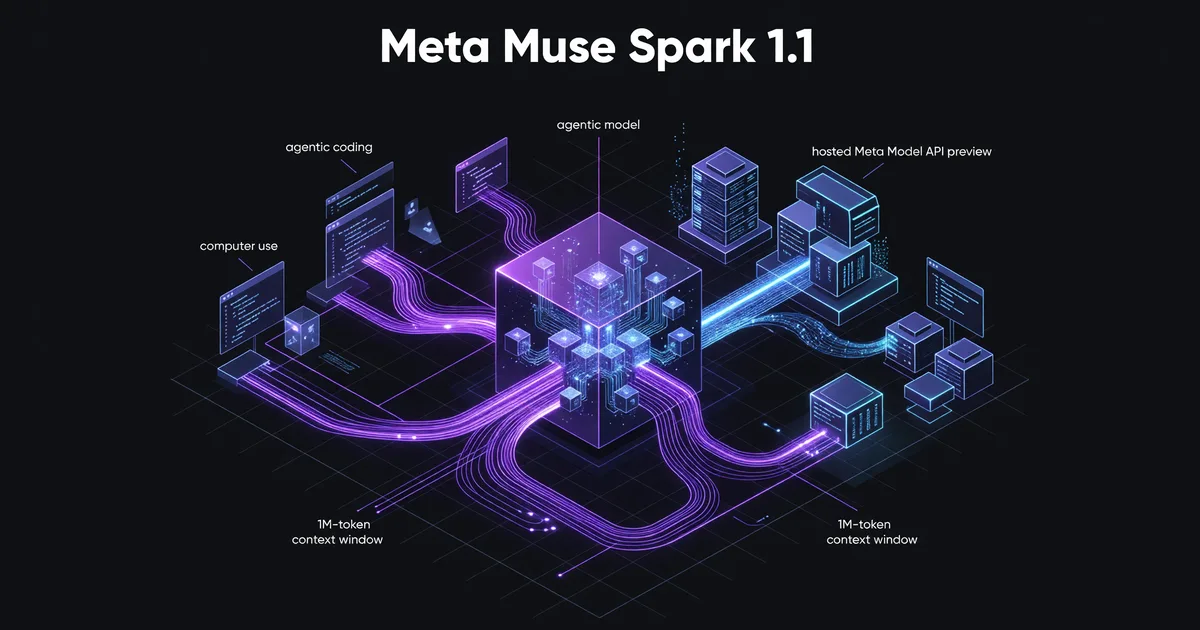
Meta Muse Spark 1.1: Agentic Model & New API
Meta's Muse Spark 1.1 brings agentic coding, computer use, and a 1M-token context — plus a hosted Meta Model API preview. What's real and what's not.

Claude Haiku 5.5 Ships With a 75% API Price Cut
Anthropic launched Claude Haiku 5.5 on October 7, 2026 with a ~75% average API cut, 1M context, an effort control, and a public Index score of 43.
Ready to try Muse Spark 1.1?
Head to the official site to start with Muse Spark 1.1 — pricing and plans are listed above.
Visit Muse Spark 1.1