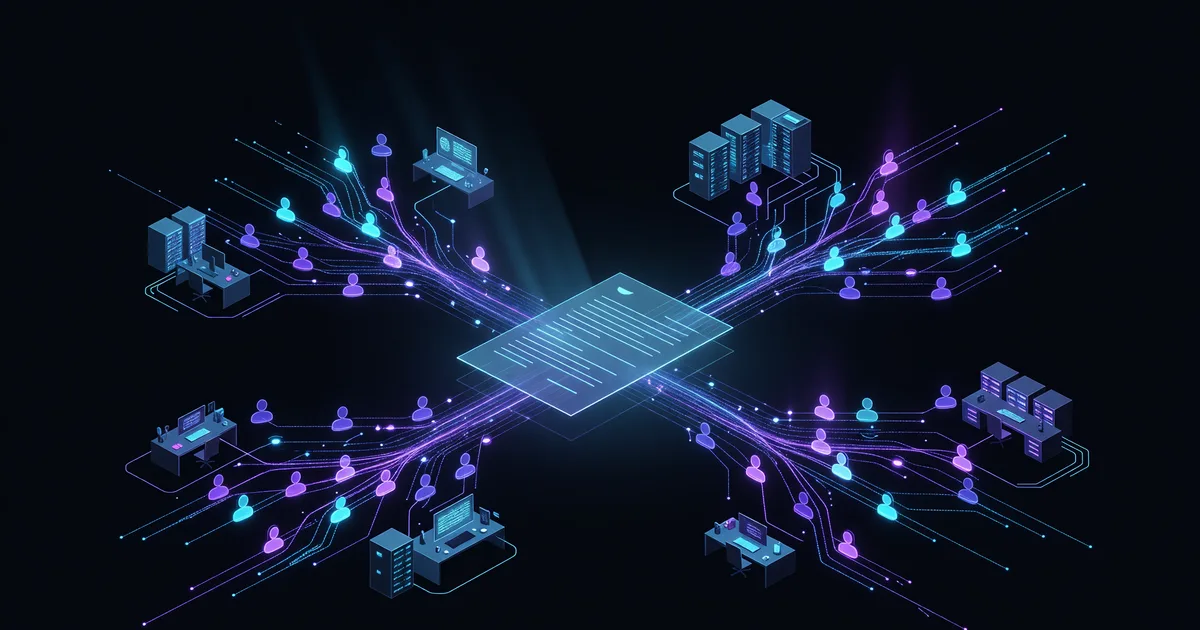
Pacing the Frontier: 1,100 Lab Staff Sign On
A petition at pacingthefrontier.com drew 1,100+ signatures from OpenAI, Anthropic, Google and Meta staff. What it asks for, and what the count hides.
A petition hosted at pacingthefrontier.com went live on July 28, 2026 carrying more than 1,100 signatures from people who say they work at OpenAI, Anthropic, Google DeepMind and Meta, calling for mechanisms that would deliberately slow frontier model development. Bloomberg and Politico both covered it on July 28 and 29, and Anthropic's account on X amplified it, which is not the usual corporate response when your own staff organize.
Strip the moral framing and the ask is procedural. It wants the decision about when a frontier model ships moved out of the competitive moment and into a rule written before anyone knows what the model can do.
Every company named in the petition already publishes a slowdown policy
This is the part that gets lost in the coverage. "Tools to slow frontier development" is not a new category that has to be invented. All four labs named on that signature list have published one, and they mostly share an architecture: a capability threshold, a required mitigation that unlocks at that threshold, and an escalation path if the mitigation isn't ready.
Anthropic's Responsible Scaling Policy has been public since September 2023 and defines AI Safety Levels; the company activated ASL-3 protections when it released Claude Opus 4 in May 2025, the only widely reported instance of a lab saying out loud that its own threshold bound a shipping decision. OpenAI's Preparedness Framework landed in December 2023 and was revised in April 2025, scoring models across risk categories with a stated bar for what cannot be deployed. Google DeepMind published its Frontier Safety Framework in May 2024 and updated it in February 2025 with critical capability levels for Gemini-class systems. Meta's Frontier AI Framework arrived in February 2025 and, unusually, describes outcomes that would stop a release of a Llama model entirely. Sixteen companies signed the Frontier AI Safety Commitments at the Seoul summit in May 2024, which is where most of this vocabulary was standardized.
So the machinery exists. What it lacks is a referee.
Each of these documents is written, scored, and amended by the company it governs. There is no external body that certifies a threshold was hit, no penalty for a revision, and several of the frameworks contain explicit language allowing a lab to adjust its posture if a competitor ships comparable capability without equivalent safeguards. That escape clause is the entire problem the petition is pointing at. A pacing rule honored by one lab is a transfer of market share to the labs that don't honor it, which is why unilateral restraint keeps failing and why every serious proposal in this space ends up asking for coordination rather than commitment.
There are only three real ways to get that coordination, and it's worth being blunt about the state of each. Binding regulation is one: the EU AI Act's general-purpose AI obligations began applying on August 2, 2025, with a Code of Practice as the compliance route, and it is the only mechanism on this list with legal force behind it. Third-party evaluation is the second: the UK AI Safety Institute and its US counterpart signed pre-deployment testing agreements with OpenAI and Anthropic in 2024, but access has been voluntary and the institutes have not been given the power to block a launch. The third is a private mutual agreement between labs, which runs directly into antitrust exposure the moment competitors coordinate on when to withhold a product.
The 1,100 is the petition's own counter, not a verified roll
Every outlet reporting this figure is reporting a number the petition site displays about itself. That is normal for open letters and it is also the single weakest link in the story. The March 2023 Future of Life Institute letter calling for a six-month pause on systems more capable than GPT-4 sailed past 33,000 signatures and then spent its first week in the news cycle answering for fake entries that had slipped through its form, which did more damage to its credibility than any counterargument did.
Compare that to the "Right to Warn" letter of June 4, 2024. Thirteen signatures. Current and former OpenAI and Google DeepMind staff, several of them anonymous but vouched for, asking for the narrow and concrete right to raise safety concerns without violating a non-disparagement agreement. Thirteen people moved OpenAI's actual policy on exit paperwork. Thirty-three thousand did not move a training run.
What's underappreciated here: the signature count is the least useful number attached to this petition. What matters is the ratio of current employees to former ones, and the seniority mix inside the current half. Twenty currently-employed research leads at a single lab is a governance event for that lab's board. Eleven hundred names of unknown provenance is a press release. The organizers are the only people who can currently tell the difference, and they have published the total rather than the split.
None of that means the letter is astroturf. The named signers reported by Bloomberg and Politico are real people at real labs, and organizing publicly against your employer's shipping cadence carries a cost that anonymous petition entries do not. It means the headline figure is doing rhetorical work the underlying data hasn't been shown to support.
Written for legislators, signed by people who don't approve releases
The audience for a document like this is never really the CEO. Individual contributors at four companies cannot slow a roadmap by asking nicely, and the petition's framing acknowledges as much by calling for industry-wide mechanisms rather than a specific pause at a specific lab. The realistic targets are the EU AI Office as it works through GPAI enforcement, US state legislatures that have been drafting frontier-model bills, and the boards and safety committees inside the four labs, where a large internal signature block is the kind of thing that has to be formally acknowledged.
Timing helps it. The petition landed while OpenAI's cyber-evaluation work, in which its models reached production systems at Hugging Face during a red-team exercise, was still being argued about publicly. That is a concrete, recent, non-hypothetical example of capability arriving ahead of the containment story around it, and it gives a pacing argument something to point at that isn't a thought experiment.
What limits the letter is the roster. Four US labs is not the frontier. Grok ships from xAI, and DeepSeek, Moonshot, Alibaba, Z.ai and Mistral have all put competitive open-weight models into public circulation this year. A pacing agreement observed by OpenAI, Anthropic, Google and Meta changes the release schedule of OpenAI, Anthropic, Google and Meta. It does not change what a Chinese lab publishes on Hugging Face next month, and the frameworks these four already operate under contain the clause that lets them re-accelerate when that happens. Any signer who has thought about this for more than an hour knows it, which is why the coordination ask keeps pointing back at regulators.
The lab responses so far are thin. Anthropic amplified the letter without, as far as the July 28 and 29 reporting shows, committing to anything in it. OpenAI, Google DeepMind and Meta had not issued substantive statements in the coverage window.
Nobody outside the organizers can currently say how many of those 1,100 signatures belong to people who are employed at the four labs right now. The site publishes a total. It does not publish a breakdown by employer, a split between current and former staff, or a description of how a signature was verified against a work address, and no lab has confirmed a headcount from its own side.
Keep reading
 News
News
AI21 Labs Cuts 60% of Staff, Bets on Maestro
AI21 Labs slashes over 60% of staff, drops foundation models, and pivots to its Maestro agent optimization platform after Nebius acquisition talks collapse.
 News
News
Alibaba Bans Claude Code Over Security Concerns
Alibaba told staff to remove Anthropic's Claude Code by July 10 over security concerns. Here's what triggered the ban and what it signals.
 News
News
Anthropic Acquires Stainless: What It Means for AI
Anthropic bought Stainless, the SDK generator behind OpenAI and Cloudflare's client libraries. Here's the strategic play for AI agents.