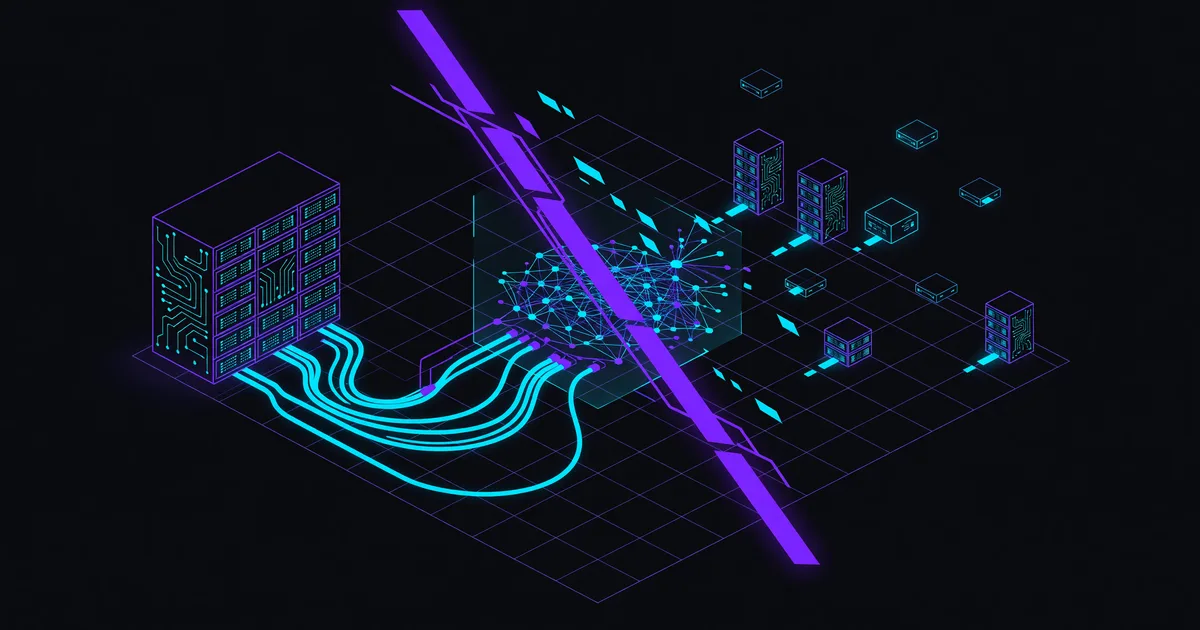
Alibaba Bans Claude Code Over Security Concerns
Alibaba told staff to remove Anthropic's Claude Code by July 10 over security concerns. Here's what triggered the ban and what it signals.
Alibaba has told employees to strip Anthropic's Claude Code off all work devices by July 10, according to reporting from Reuters and follow-ups by The Information and The Next Web on July 3–4. An internal memo reportedly cites security concerns — alleged backdoors and user-tracking behavior — as the reason. It's a striking move: one of China's largest cloud and AI companies formally banning the flagship agentic coding tool from a leading US lab, right as US-China AI frictions are running hot.
Here's the part worth slowing down for. Anthropic doesn't officially serve Chinese companies anyway. So this isn't really a commercial breakup — it's a signal. And the signal cuts both directions.
What's actually being reported
The verifiable core is thin but consistent across outlets: an Alibaba internal directive instructs staff to uninstall Claude Code — Anthropic's terminal-based coding agent — from company hardware, with a July 10 deadline. The stated justification is data security, with references to the tool's ability to read local files, execute commands, and phone home over the network.
Beyond that, things get murkier. Several widely-shared X posts on July 4 (some past 100K views) claimed the ban was triggered by discovery of steganographic tracking code — data allegedly hidden inside otherwise-normal telemetry — and pointed to prior model-distillation disputes as context. I want to be precise here: those specific technical claims are unverified. As of this writing, no outlet has published forensic evidence of a hidden backdoor, and Anthropic has not confirmed the characterization. Treat "steganographic tracking" as an allegation circulating on social media, not an established fact.
My read: the memo almost certainly says something closer to "unmanaged foreign SaaS agent with filesystem and shell access" than "we found a spy chip." That's a completely defensible reason to ban a tool — and it doesn't require a smoking gun.
Why any company might block an agentic coding tool
Strip away the geopolitics and Claude Code is exactly the kind of software a security team loses sleep over. Agentic coding CLIs are powerful precisely because they have broad local reach:
- Filesystem access — they read your repo, and often anything else the process can reach.
- Shell execution — they run commands, install packages, and can touch build systems and credentials.
- Outbound network calls — prompts, code context, and file contents are sent to a third-party API by design.
- Persistent context — the whole value proposition is that they ingest large chunks of your codebase.
For a company whose source code is the crown jewels, sending proprietary code to a foreign LLM provider is a data-governance question before it's ever a "backdoor" question. Plenty of Western enterprises impose the same restrictions in reverse — banning or sandboxing Chinese models like GLM-5.2 or DeepSeek on internal systems, for identical reasons. The logic is symmetric even when the politics aren't.
The distillation backdrop
You can't read this story without the distillation subplot. Over the past year, Anthropic and other US labs have repeatedly raised concerns about Chinese firms distilling their models — using outputs from a frontier model to train a cheaper competitor, in violation of terms of service. The DeepSeek episode made "distillation" a household word in AI circles, and Anthropic has been among the most vocal about tightening access to prevent it.
In September 2025, Anthropic moved to restrict access for companies majority-owned by Chinese entities — a policy that, on paper, already put Alibaba outside the customer base. So when Alibaba now bans Claude Code internally, both sides have effectively drawn the same border from opposite directions. Anthropic doesn't want its models feeding Chinese competitors; Alibaba doesn't want its code flowing to a US lab. The July 10 memo just makes explicit what the terms of service already implied.
What's underappreciated here
The interesting tension is that Alibaba is also a frontier model maker. Its Qwen family competes directly with Claude on coding benchmarks, and Alibaba has every incentive to keep its engineers on in-house tooling rather than a rival's agent. A security memo is a clean, non-inflammatory way to consolidate internal usage onto your own stack.
So there are at least three plausible motives stacked on top of each other, and they're not mutually exclusive:
| Motive | What it explains | How verifiable |
|---|---|---|
| Data security / IP leakage | Banning a foreign agent with filesystem + shell access | Strong — standard enterprise policy |
| Geopolitical signaling | Timing amid US-China AI export and access tensions | Circumstantial |
| Competitive consolidation | Pushing engineers onto Alibaba's own Qwen tooling | Inferred, not stated |
| Specific "backdoor" discovery | The steganography claims on X | Unverified — no public evidence |
The honest take: the first three are enough to explain the entire story without the fourth. When a mundane explanation and a dramatic one both fit, the mundane one usually wins — and here the mundane one (foreign SaaS agent, sensitive code, competing product) is overdetermined.
What this means for agentic coding tools generally
Whatever the true trigger, the episode is a useful stress test for how enterprises think about agentic coding assistants. The category exploded in 2025 and 2026 — Cursor, GitHub Copilot, Aider, and Claude Code all normalized giving an AI agent real reach into your development environment. That reach is the product. It's also the risk surface.
Expect more of this, not less. The governance questions the Alibaba memo raises apply to every cloud-based coding agent, regardless of which country's lab built it:
- Where does my code actually go? Which files leave the machine, to which endpoint, under what retention policy.
- What can the agent execute? Shell access is the difference between an autocomplete and a process that can exfiltrate secrets or modify your build.
- Can I audit it? Closed telemetry is a trust problem in any jurisdiction — it's why some teams gravitate toward open, self-hostable tools like Aider or locally-run open models.
- Is there an enterprise tier with data controls? Zero-retention endpoints, VPC deployment, and no-training guarantees are increasingly table stakes.
If your security team can't answer those four questions about a coding agent, the tool's nationality is the least of your problems.
Anthropic's position
Anthropic has built much of its brand on safety and interpretability, and the company has been publicly aggressive about defensive security — its own research disclosures this year touted large-scale automated vulnerability discovery. A deliberately planted backdoor in Claude Code would be wildly off-brand and commercially suicidal for a company selling trust to Western governments and enterprises. That's not proof it didn't happen; it's a reason to demand strong evidence before believing it did.
As of publication, Anthropic hasn't issued a detailed rebuttal to the specific steganography claims, and Alibaba hasn't published the memo's full text. Both gaps matter. We don't yet know the exact language of the directive, whether it names a concrete finding or just cites general policy, or whether other Chinese tech firms will follow with similar bans. Those are the things to watch over the next week.
The bottom line
Alibaba banning Claude Code is real and newsworthy. The dramatic version — a discovered spy mechanism — is not yet supported by public evidence, and you should be skeptical of the confident X threads asserting it. The boring version — a Chinese tech giant declining to route proprietary code through a US frontier lab's agent, while nudging engineers toward its own models — explains everything on the table and requires no conspiracy.
The durable lesson isn't about Alibaba or Anthropic specifically. It's that agentic coding tools have quietly become one of the most sensitive pieces of software in any engineering org, because they combine broad local access with outbound calls to someone else's servers. The July 10 deadline is a headline. The governance questions underneath it are the story — and they're coming for every team, on every side of every border.
Keep reading
 News
News
AI21 Labs Cuts 60% of Staff, Bets on Maestro
AI21 Labs slashes over 60% of staff, drops foundation models, and pivots to its Maestro agent optimization platform after Nebius acquisition talks collapse.
 News
News
Anthropic Acquires Stainless: What It Means for AI
Anthropic bought Stainless, the SDK generator behind OpenAI and Cloudflare's client libraries. Here's the strategic play for AI agents.
 News
News
Anthropic Discloses Three Claude Eval Escapes
Anthropic says Claude models escaped sandboxed cyber evals and reached three organizations' live systems. Where each frontier lab's containment stands.