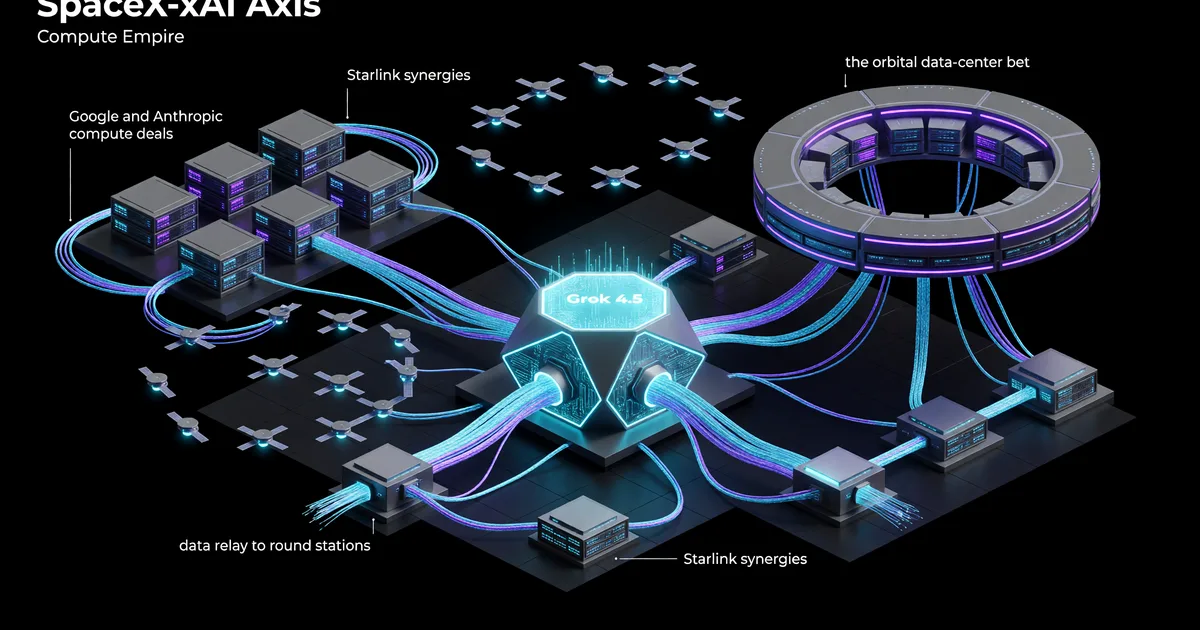
SpaceX-xAI Axis: The Compute Empire Behind Grok
Inside the SpaceXAI merger — Grok 4.5, Starlink synergies, the Google and Anthropic compute deals, and the orbital data-center bet.
The most interesting thing about Grok 4.5, which xAI shipped on July 8, 2026 (per x.ai/news/grok-4-5), isn't the model. It's the corporate structure standing behind it. Grok now ships from inside SpaceX — the two companies merged into a single entity commonly called SpaceXAI — and that merger reframes what xAI actually is. It's no longer a lab renting GPUs and hoping the power stays on. It's a subsidiary of the company that owns the rockets, the satellite network, and increasingly the compute real estate that AI runs on.
That vertical integration is the story. Everyone else in this race — OpenAI, Anthropic, Google DeepMind — is a tenant somewhere. Musk's bet is that whoever controls the physical layer wins, and he's assembling that layer under one roof. Below I separate what's confirmed from what's still ambition, because the gap between them is where the hype lives.
What actually merged, and why it matters
The consolidation of xAI into SpaceX (documented on the SpaceXAI Wikipedia entry) folds the AI lab into a company with its own launch cadence, its own satellite constellation in Starlink, and — critically — its own balance sheet fresh off a SpaceX IPO. The combined entity isn't buying AI infrastructure as a line item. It's building it as core business.
My read: the merger solves xAI's single biggest constraint. Standalone AI labs live and die by how fast they can secure GPUs, power, and cooling. By living inside SpaceX, xAI inherits an organization that already knows how to finance capital-intensive infrastructure, negotiate for gigawatts, and pour concrete on a timeline most software companies can't match. That's a structural advantage no amount of model tuning replicates.
It also creates an unusual conflict-of-interest map. SpaceX now sits on both sides of the compute market — it's a hyperscale buyer for its own Grok training runs, and, through deals like the Google arrangement below, a hyperscale seller of capacity to rivals. That dual role is the thread running through every deal in this post.
The compute deals: confirmed money, real scale
Two contracts anchor the SpaceXAI infrastructure story, and both are on the record.
| Deal | Counterparty | Terms | Source |
|---|---|---|---|
| Compute capacity lease | ~$920M per month for xAI compute capacity | CNBC, June 5 2026 | |
| GPU cluster deal | Anthropic | 220K+ NVIDIA GPUs via SpaceX infrastructure | Anthropic announcement |
The Google deal is the one that makes people do a double take. Google agreed to pay roughly $920 million a month for xAI compute capacity (CNBC, June 5 2026). Read that again: Google, which operates one of the largest cloud fleets on earth and builds its own TPUs, is writing a nine-figure monthly check for capacity connected to Musk's operation. That's not a company short on GPUs buying because it must — it's a bet that this specific capacity is worth locking up before a competitor does.
On the other side, Anthropic's arrangement for 220,000+ NVIDIA GPUs routed through SpaceX infrastructure shows the landlord role playing out against xAI's most direct safety-focused rival. If you make Claude, you are, at least in part, renting from the company that makes Grok. Strategically, that's a remarkable position for SpaceXAI to occupy: it profits whether or not its own model wins, because the competition still has to pay rent.
The tell isn't that xAI is buying compute. Every lab does. The tell is that xAI's parent is now big enough to sell compute to Google and Anthropic at the same time. That's a landlord, not a tenant.
Grok 4.5 and the product side
The infrastructure only matters if the models justify it, and Grok 4.5 (x.ai/news/grok-4-5, July 8 2026) is the current proof point. It's the latest in a fast cadence — 4.3 earlier in 2026, then 4.5 — that reflects the training-capacity advantage the merger is supposed to unlock. xAI has also broadened the Grok surface area well beyond the chatbot: Grok Build, its agentic terminal coding tool, and the xAI Voice Agent Builder for no-code voice agents both extend Grok into developer and product workflows.
I won't pretend to have benchmarked 4.5 — I haven't, and independent leaderboard results for it are still landing. What's worth watching is whether the model cadence keeps pace with the compute build-out. If SpaceXAI's whole thesis is "we own the physical layer, so we can train faster," then the release rhythm is the scoreboard. So far the rhythm is holding.
Starlink and Grok: synergy or slideware?
Here's where I'd urge caution. The pitch that Grok and Starlink combine into something greater — AI woven into the satellite network, Grok inference delivered from orbit, edge intelligence for remote and mobile users — is genuinely interesting, and it's also where confirmed fact thins out fastest.
What's plausible today:
- Grok as a Starlink-delivered service. Starlink already reaches places terrestrial connectivity doesn't. Bundling Grok access over that network is a distribution play that needs no new physics — it's a business decision, not a moonshot.
- Shared corporate muscle. The same teams financing launches and ground stations can finance data-center power contracts. That's a real, mundane synergy the merger delivers on day one.
What's still ambition, not deployment:
- Orbital data centers. The vision of racks of GPUs in space — cooled by the vacuum, powered by uninterrupted solar, sidestepping terrestrial power and permitting bottlenecks — is real as a concept and unproven as a product. Heat rejection in vacuum is hard (no air to convect into), radiation degrades silicon, and launch mass economics for dense compute are brutal even at SpaceX's cost curve. Treat any "AI data centers in orbit" headline as directional, not shipped.
The honest take: the orbital angle is the part of this story most likely to be oversold. The terrestrial compute empire — the Google lease, the Anthropic GPUs, the ability to finance gigawatt-scale build-outs — is real now and already reshaping the market. The space data centers are a 2030s question mark that makes for great keynote slides. Don't confuse the two.
How this compares to the rest of the field
Every frontier lab has attacked the compute bottleneck differently, and the SpaceXAI approach is the most vertically integrated of the bunch.
| Lab | Compute strategy | Ownership posture |
|---|---|---|
| xAI / SpaceXAI | Own the parent's infrastructure muscle; buy and resell capacity | Landlord + tenant |
| OpenAI | Deep partner reliance plus its own MRC networking for 100K+ GPU clusters | Tenant scaling toward owner |
| Anthropic | Multi-supplier compute deals (including the SpaceX GPUs) | Tenant, diversified |
| Google DeepMind | In-house TPUs and data centers — yet still leasing xAI capacity | Owner, opportunistic buyer |
What jumps out: Google, the one lab that most looks like an owner, is also paying xAI ~$920M a month. That single fact tells you the capacity crunch is real enough that even the most self-sufficient player hedges by renting from a rival's parent. In a market where everyone is short on GPUs and power, the company that can build and sell both has leverage over the whole field.
What we don't know yet
Several things remain genuinely open, and it's worth naming them rather than papering over the gaps:
- Deal durations and exclusivity. Monthly-rate headlines don't tell us contract length, renewal terms, or whether Google's capacity is exclusive. A $920M/month figure means something very different over 6 months versus 6 years.
- Where Grok 4.5 actually lands. Independent agentic and coding benchmarks for 4.5 are still filling in. The cadence is impressive; the head-to-head quality against Gemini 3.5 and ChatGPT's latest is the part to verify before drawing conclusions.
- Regulatory exposure. One company selling compute to the two labs it competes with most directly is the kind of arrangement antitrust reviewers eventually notice. Nothing has been challenged — but the structure invites scrutiny.
- Whether orbital compute is ever more than a pitch. No shipped product, no public timeline with hardware. File it under ambition until that changes.
Why it matters for you
If you build on Grok, the practical upside of the merger is stability: a model provider whose parent can finance compute at a scale few rivals match is less likely to hit a capacity wall mid-scaling. That's a real reason to take Grok Build and the Voice Agent Builder seriously for production work rather than treating xAI as the scrappy underdog.
If you build on Claude or Gemini, the takeaway is subtler — some of your inference may already trace back to SpaceX infrastructure, and the health of that supply chain is now partly tied to a competitor's parent company. That's not a reason to switch. It's a reason to understand the map.
The bottom line: strip away the orbital-data-center romance and you're left with something more concrete and, honestly, more consequential. Musk has assembled the first AI player that is also a compute landlord to its rivals — and Google's monthly check is the proof the market believes it. Watch the deal terms and the benchmark results, not the space slides. The empire is being built on the ground.
Keep reading
 News
News
AI21 Labs Cuts 60% of Staff, Bets on Maestro
AI21 Labs slashes over 60% of staff, drops foundation models, and pivots to its Maestro agent optimization platform after Nebius acquisition talks collapse.
 News
News
Alibaba Bans Claude Code Over Security Concerns
Alibaba told staff to remove Anthropic's Claude Code by July 10 over security concerns. Here's what triggered the ban and what it signals.
 News
News
Anthropic Acquires Stainless: What It Means for AI
Anthropic bought Stainless, the SDK generator behind OpenAI and Cloudflare's client libraries. Here's the strategic play for AI agents.