Palantir and Nvidia Expand Their Sovereign AI Deal
Palantir and Nvidia are extending their sovereign AI partnership around open Nemotron models and Palantir's Ontology. Here's what it means.
Palantir and Nvidia said this week they're expanding their collaboration to build sovereign AI systems for US government agencies and critical infrastructure operators — anchored on Nvidia's open Nemotron models running inside Palantir's data platform. The pitch, in one line: open-weight models you can host yourself, wired into Palantir's Ontology, so a federal agency or a utility never has to ship sensitive data to a third-party API to get frontier-class AI.
This isn't the two companies meeting for the first time. They announced an operational AI partnership back in 2025 around Nvidia's accelerated computing and Palantir's AIP/Foundry stack. What's new here is the framing and the center of gravity: open models as a national-security architecture, positioned explicitly against the closed frontier APIs from Anthropic, OpenAI, and Google. That shift is the actual story, and it's worth unpacking.
What was actually announced
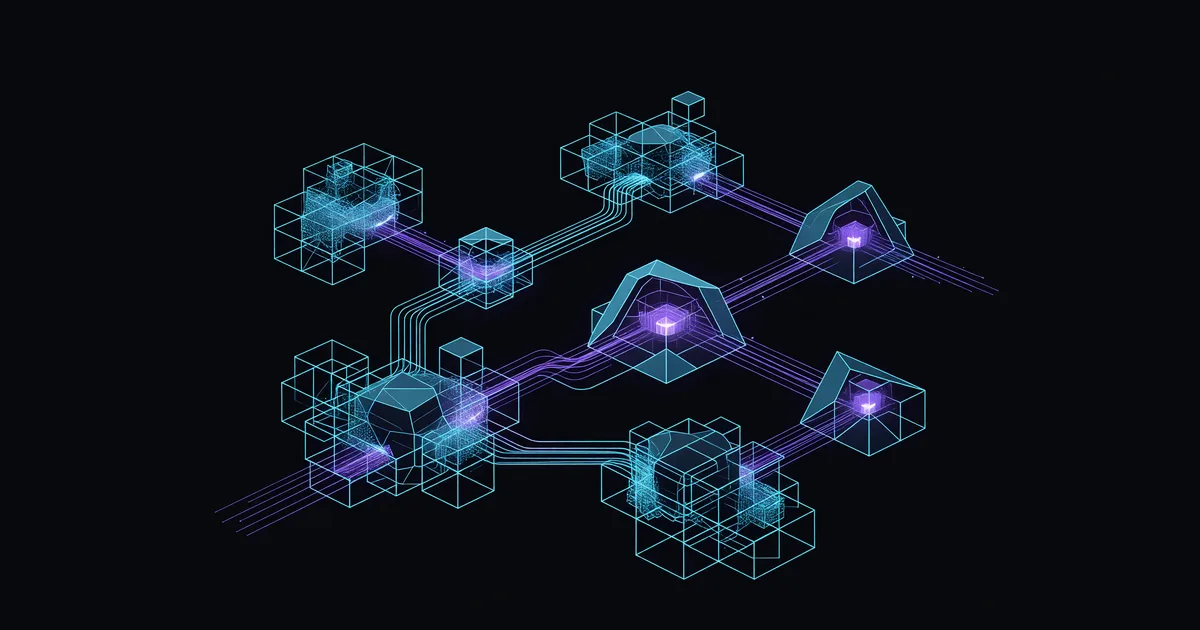
The core of the expanded deal is a reference architecture for deploying AI where the data can't leave the building. The pieces, as described:
- Nemotron open models — Nvidia's family of open-weight LLMs, tuned for agentic and reasoning workloads, that organizations can download, fine-tune, and run on their own hardware. (We covered the lineup in our piece on Nemotron 3 Ultra.)
- Palantir's Ontology — the layer in Foundry/AIP that maps an organization's real-world objects, actions, and permissions so a model operates against governed, structured data rather than a pile of documents.
- Nvidia's compute and inference stack — the GPUs plus the NIM/inference tooling to serve those models on-prem or in a sovereign cloud enclave.
The combination is meant to let an agency stand up customizable, mission-specific AI with — and this is the load-bearing phrase in every sovereign-AI pitch — full data control. No data egress to a vendor's servers, no dependency on a closed API that could change terms, get rate-limited, or fall under an export-control restriction.
What we don't know yet: the announcement is light on the things that decide whether a deal like this matters. There's no published pricing, no named launch customers in the initial materials beyond the general "government agencies and critical infrastructure" framing, and no benchmark comparison showing how a self-hosted Nemotron deployment stacks up against a closed frontier model on the specific tasks these buyers care about. Treat the strategic logic below as analysis, not as a spec sheet — because the spec sheet isn't out.
Why "sovereign AI" is suddenly the whole conversation
Sovereign AI — the idea that a country, agency, or regulated operator should run AI on infrastructure and models it controls — has gone from a niche procurement concern to a headline category in under two years. A few forces are converging:
- Export controls cut both ways. We've written about how Fable 5's export ban works and how AI controls are administered. Once governments treat frontier models as controlled technology, buyers start asking the obvious follow-up: what happens to my mission if my model provider gets restricted, or if I'm the one on the wrong side of a control? Open weights you already hold are insulation against that.
- Data residency is non-negotiable for some buyers. An intelligence agency, a defense program, or a grid operator often literally cannot send operational data to a commercial API. That rules out the default deployment mode for most closed frontier models before the conversation even starts.
- Open models got good enough. Two years ago "host it yourself" meant accepting a meaningful capability gap. With Nemotron, Llama-class models, and strong open reasoning models from labs like DeepSeek and others narrowing that gap on agentic and coding tasks, the tradeoff for a security-conscious buyer is far less painful than it was.
My read: the Palantir-Nvidia move isn't really a product launch. It's a positioning play that says the high-assurance government market is going to be won by open models plus a governance layer — not by whoever has the single smartest closed API.
Open vs. closed, reframed as a security question
For most of the last two years the open-vs-closed debate was about capability and cost. This deal reframes it as a control-surface question, and that's a smarter framing for the buyer Palantir is targeting.
The closed frontier models — Claude, OpenAI's ChatGPT and GPT API, Google's Gemini — generally lead the public benchmarks and ship capabilities first. If your job is to get the single most capable model on a task today, that's where you look. But every one of them is, by default, a service you call: the weights stay with the vendor, the data goes to the vendor, and the terms are the vendor's. Anthropic and OpenAI both offer government and on-prem-adjacent deployment paths, but the fundamental posture is "trust the provider."
Open models invert that. With Llama, Nemotron, or an open release like Grok's open-weight efforts, the buyer holds the weights. The security argument writes itself: you can air-gap it, audit it, fine-tune it on classified data without that data ever touching an external network, and keep running it regardless of what happens to the vendor relationship. The cost is that you own the ops burden and you're usually a step behind the absolute frontier on raw capability.
Here's a quick way to see the tradeoff the way a sovereign buyer does:
| Dimension | Closed frontier API | Open model + Palantir/Nvidia stack |
|---|---|---|
| Peak capability | Generally leads benchmarks | Close, often a step behind on the frontier |
| Data control | Data leaves your environment by default | Stays in your environment; air-gappable |
| Customization | Fine-tune via vendor; weights stay closed | Full fine-tune on your own weights/data |
| Vendor/export risk | Exposed to terms changes, restrictions | You hold the weights — insulated |
| Ops burden | Low — it's a managed API | High — you run the infra |
For a consumer or a startup, the right-hand column rarely wins — the ops burden isn't worth it. For a defense agency or a critical-infrastructure operator, the left-hand column is frequently a non-starter on the data-control row alone. That's the wedge Palantir and Nvidia are driving into.
Why Palantir specifically, and why Nvidia specifically
The interesting part is that neither company is bringing the model. Nvidia brings Nemotron and the silicon; Palantir brings the Ontology and the deployment relationships. Open weights alone don't solve a government's problem — a raw model has no idea what your assets, permissions, or operational objects are. Palantir's bet for years has been that the governance and data-modeling layer is the moat, not the model. An open model makes that bet stronger, not weaker: if the model is a commodity you can swap, the value accrues to whoever owns the layer that makes it useful and auditable.
For Nvidia, pushing Nemotron into this stack is consistent with its broader strategy of making sure that whatever wins — open or closed — runs on Nvidia hardware. We've seen the same logic in deals like the Nvidia-Hyundai physical AI partnership and Nvidia's optics and infrastructure plays. Owning the open-model story for sovereign buyers is one more way to keep the compute demand flowing regardless of which lab is on top this quarter.
The honest take
I think this is a genuinely well-aimed move, and also one that's easy to over-read on day one. The well-aimed part: the high-assurance public-sector market is real, it's large, and it has structural reasons to prefer open weights that aren't going away. Palantir and Nvidia are two of the few companies with the credibility and the stack to serve it end to end. Positioning open models as the national-security-grade option — rather than the budget option — is the right narrative for that buyer.
The over-read risk: announcements like this are reference architectures and intent, and the gap between "here's how you could deploy it" and "here's an agency running mission workloads on it in production" is where these things live or die. Sovereign deployments are slow, procurement-heavy, and unforgiving about reliability. Until there are named deployments and some evidence about how the open-model capability gap plays out on the actual government tasks — not public benchmarks — the smart posture is interested, not convinced.
One thing I'd watch: whether this pushes the closed labs to ship more serious self-hosted and air-gapped options. If Anthropic, OpenAI, and Google decide the sovereign market is worth meeting on its own terms — full weight-level control, on-prem — then the open-model advantage narrows to cost and customization, and the fight moves back to capability. The expanded Palantir-Nvidia deal is partly a bet that the closed labs won't, or can't, go that far without undermining their own business model.
What to actually take away
- If you're in government or critical infrastructure: this is a credible path to frontier-ish AI without data egress, but wait for named production deployments and real task-level evidence before treating it as proven.
- If you're tracking the open-vs-closed fight: the frame has shifted from "which is smarter" to "which posture you can defend." On the data-control axis, open is winning the high-assurance market by default.
- If you're an enterprise buyer with no sovereignty requirement: none of this changes your calculus much. The closed frontier APIs are still the simplest way to get the most capable model, and the self-hosting ops burden rarely pays off without a hard data-control mandate.
The deeper signal is about where AI value is settling. If open weights are good enough for the most demanding buyers, then the durable advantage isn't the model — it's the layer that governs it. Palantir has been making that argument for years. This partnership is the clearest version of it yet.
Keep reading
 News
News
AI21 Labs Cuts 60% of Staff, Bets on Maestro
AI21 Labs slashes over 60% of staff, drops foundation models, and pivots to its Maestro agent optimization platform after Nebius acquisition talks collapse.
 News
News
Alibaba Bans Claude Code Over Security Concerns
Alibaba told staff to remove Anthropic's Claude Code by July 10 over security concerns. Here's what triggered the ban and what it signals.
 News
News
Anthropic Acquires Stainless: What It Means for AI
Anthropic bought Stainless, the SDK generator behind OpenAI and Cloudflare's client libraries. Here's the strategic play for AI agents.