GPT-5.6 Sol Public Launch: What Changes Thursday
OpenAI moves GPT-5.6 Sol, Terra, and Luna from limited preview to broad public release Thursday after US approval. What actually changes.
OpenAI is flipping GPT-5.6 from gated preview to broad public availability on Thursday. Per Reuters on July 8, citing Axios, the company received US government clearance for a wide rollout of the GPT-5.6 family, and OpenAI's own GPT-5.6 Sol launch materials describe the same shift. The three models that a narrow slice of government and enterprise partners have been running for a couple of weeks, Sol, Terra and Luna, open up to anyone with a paid account and an API key.
Most of the capability story will be familiar if you read our earlier coverage of the preview program. What changes is availability, the tier structure going generally available, and the compliance framing OpenAI uses to explain why a release needed sign-off at all. So this is not a verdict on GPT-5.6's quality, but an inventory of what concretely differs when you wake up Thursday.
Three models, segmented by cost per capability
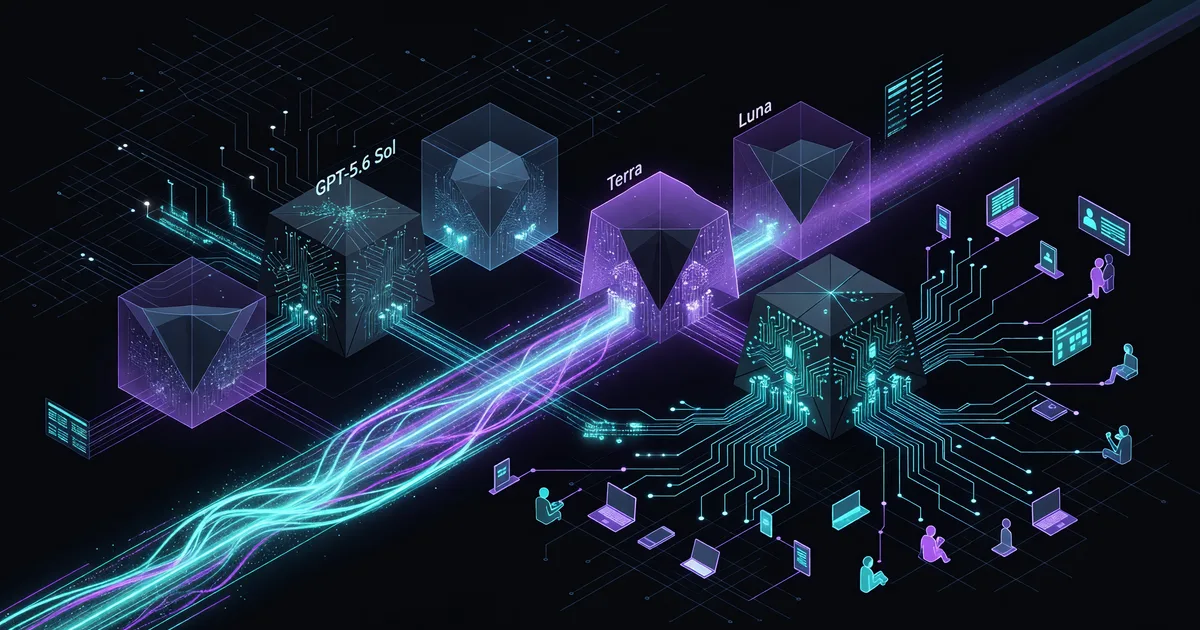
GPT-5.6 ships as a family rather than a single flagship, and the segmentation is the design decision worth noticing.
Sol is the flagship: deepest reasoning, longest effective agentic runs, and the model behind OpenAI's headline benchmark claims. It is what you reach for on hard multi-step work. Terra sits in the middle and is positioned as the default for most production traffic, strong enough for real agent workloads while running cheaper and faster than Sol. Luna is the fast, cheap tier, built for high-volume latency-sensitive calls where frontier reasoning is wasted: classification, routing, extraction, the unglamorous plumbing that most of a real application actually consists of.
Google reached the same structure with Gemini's Pro and Flash split, and Anthropic with Opus, Sonnet and Haiku. The convergence reflects a shared observation that most tokens in production do not need the largest model, and that forcing them through it is the fastest way to burn a budget. Naming all three tiers at general availability, rather than shipping Sol alone and quietly adding cheap variants months later, suggests OpenAI absorbed that lesson before the launch rather than after it.
Four things that change when the gate opens
Access was the entire story during the preview. Government early-access partners and a handful of enterprises could call these models and nobody else could. Thursday removes that wall, and four specific things follow.
API access opens to standard accounts. If you can call GPT-5.5 today, you should be able to call Sol, Terra and Luna by model ID once the rollout reaches you. Expect a staged ramp rather than a single switch, since OpenAI typically gates new flagships behind usage tiers and rolls out over hours to days.
The models appear in the ChatGPT picker. Paid ChatGPT tiers are the obvious first surface, so watch for Sol landing on Plus, Pro, Team and Enterprise with the usual per-tier message caps.
Pricing becomes public, which is the number most people are actually waiting on. Per-token pricing was not broadly published during the preview. Thursday makes the pricing page the source of truth, and it is worth checking directly rather than trusting any figure circulating beforehand.
And the safety stack ships alongside it. The government sign-off was not procedural theater; it attaches to the guardrails OpenAI built specifically for releasing a model of this capability to everyone.
A commercial model release that routed through Washington
Consumer model launches do not normally require clearance. That GPT-5.6's broad rollout did, per the Reuters and Axios reporting, implies the preview was structured partly as a controlled-exposure exercise: let vetted government and enterprise users stress the models, demonstrate that the mitigations hold, then clear the wide release.
Nobody outside the process has the full text of what was reviewed or what conditions attached, and I would treat any confident claim otherwise with suspicion. What the public reporting supports is that the sequence looks deliberate rather than incidental. It also rhymes with the broader 2026 pattern in which the most capable models reach governments and large labs well before the public, an access gap we have flagged before.
My guess is this becomes a template rather than a one-off. If Sol's rollout normalizes a review-then-release cadence for frontier models, Anthropic and Google will face pressure toward the same rhythm, and the interval between a frontier model existing and a working developer being able to use it gets structurally longer.
The benchmark claim to watch: Terminal-Bench 2.1
OpenAI's framing leans on agentic coding, and the specific claim circulating is state of the art on Terminal-Bench 2.1. That benchmark measures whether a model can operate in a real terminal: run commands, read output, recover from errors and finish a multi-step task without a human approving each step. It is a harder and more realistic bar than static code-completion benchmarks like the older SWE-bench snapshots.
Three caveats before treating any leaderboard position as settled. Vendor-run benchmarks are marketing until third parties reproduce them, so wait for independent evaluation from Artificial Analysis, LMSYS-style arenas and practitioners posting real runs before ranking Sol against Claude or Gemini on agentic work. Terminal-Bench also rewards long-horizon reliability, which is precisely where models fail quietly: one wrong rm, one misread stack trace, and a twenty-step run derails. A top score means the failure rate on long chains dropped, which matters far more in daily use than a few points on a one-shot coding test. And state of the art is perishable, with Gemini 3.5 Pro and the Claude line moving on the same axis, so whatever Thursday's number is, read it as a snapshot.
The workloads that gain most from agentic reliability are coding agents and long-running workflows rather than chat, because that is where a small improvement in staying on task compounds into the difference between supervising a run and leaving it alone.
How to decide whether to move
It depends on what you are running today.
If you have GPT-5.5 in production, do not rip and replace on day one. Route a small percentage of traffic to Terra, compare quality and cost against your GPT-5.5 baseline, and expand only if the numbers hold. New flagships arrive with rough edges, early rate limits and occasional regressions on narrow tasks that tend to smooth out over the following weeks.
If you run agents or coding tools, this is the launch most worth your testing time. If the Terminal-Bench gains carry over to your workload, Sol on the hard steps with Terra or Luna handling the cheap ones could beat a single-model setup on both quality and cost at once.
If your volume is high and your calls are simple, Luna is the arrival that matters. Should it come in meaningfully cheaper than 5.5 at comparable quality on easy tasks, the savings across a large call volume will dwarf anything the flagship headline is advertising.
And if you just use ChatGPT, Sol will show up in the picker on a paid tier. Use it, notice whether it answers your actual questions better, and skip the benchmark charts entirely.
What the launch materials need to answer
Exact per-token pricing for all three tiers, plus context-window and output limits. The tier split only pays for itself if Luna and Terra are genuinely cheaper rather than marginally cheaper.
Rate limits and rollout pacing. Public on Thursday rarely means everyone at nine in the morning, so expect tiered access and possibly a queue for the highest Sol throughput.
What the safety review actually constrained. Usage restrictions, region limits or elevated logging tied to the approval would matter a great deal to anyone in a regulated industry, and none of that is public yet.
And a deprecation timeline for 5.5. Nothing published confirms a sunset, but every new family raises the question and the sensible move is to plan as though the answer is coming.
What is worth internalizing about Thursday sits outside the benchmark table. OpenAI now has a three-tier lineup, a public pricing sheet and a government-cleared release process, which together describe a frontier-model business maturing into something closer to regulated infrastructure than a research demo. Whether Sol holds the top of a leaderboard for a week or a month is close to secondary next to that.
Check the pricing page Thursday, route a sliver of traffic before committing anything, and wait for independent benchmarks before crowning a winner. The models will still be there Friday.
Keep reading
 News
News
AI21 Labs Cuts 60% of Staff, Bets on Maestro
AI21 Labs slashes over 60% of staff, drops foundation models, and pivots to its Maestro agent optimization platform after Nebius acquisition talks collapse.
 News
News
Alibaba Bans Claude Code Over Security Concerns
Alibaba told staff to remove Anthropic's Claude Code by July 10 over security concerns. Here's what triggered the ban and what it signals.
 News
News
Anthropic Acquires Stainless: What It Means for AI
Anthropic bought Stainless, the SDK generator behind OpenAI and Cloudflare's client libraries. Here's the strategic play for AI agents.