Grok 4.5 Drops: xAI's Opus-Class Coding Model
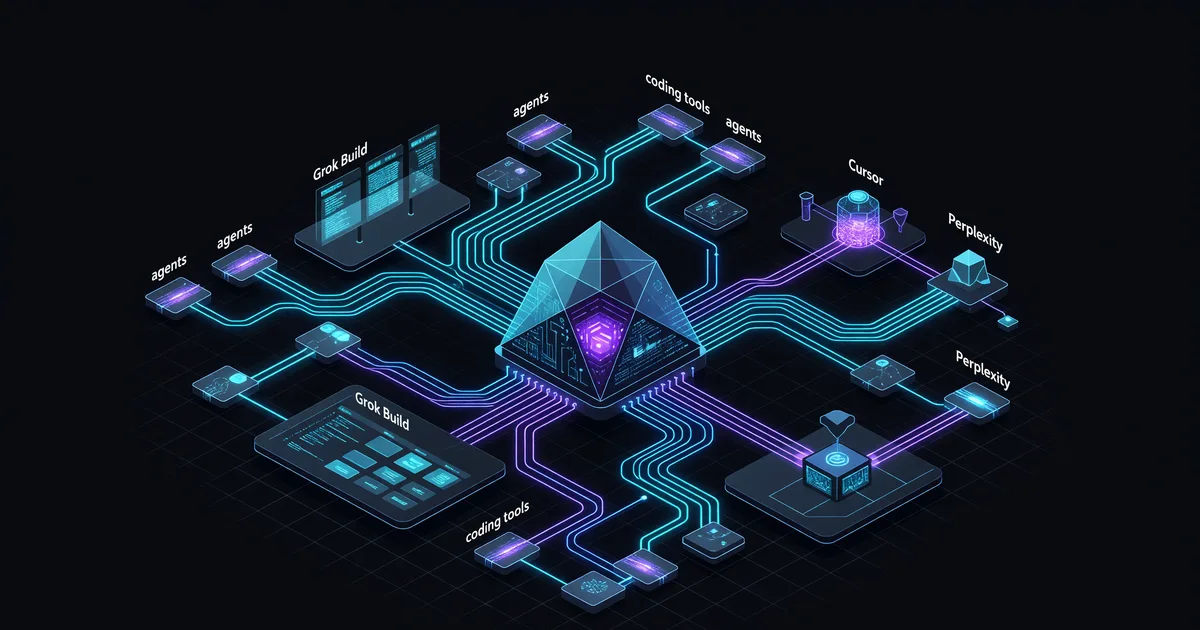
xAI launched Grok 4.5 on July 8 as an "Opus-class" model for coding and agents—now default in Grok Build and live in Cursor and Perplexity.
xAI shipped Grok 4.5 on July 8, 2026, and the framing carries as much information as the model. Elon Musk called it an "Opus-class model" on X, and the company's launch post leans hard into coding and agentic work rather than chatbot bragging rights. TechCrunch, Reuters and Axios all covered it the same day. By the time most people read a headline about it, the model was already the default in Grok Build and selectable inside Cursor and Perplexity.
That last detail separates this from a benchmark announcement. xAI did not publish a model and leave developers to find it. It wired 4.5 into two surfaces where people already work, plus its own CLI agent, on launch day. In a week that already had OpenAI's GPT-5.6 Sol lineup and Gemini 3.5 competing for attention, distribution was the axis xAI chose to lead on.
Opus-class is a competitive anchor, not a specification
The label is a deliberate comparison. Anthropic's Claude Opus tier has spent the better part of a year as the reference point for high-end agentic coding, the model people reach for when a task involves multi-step planning, tool use and editing a real codebase rather than completing a single function. Borrowing the label tells developers this is meant to compete at the top rather than in the middle.
It also tells you nothing about where Grok 4.5 lands on independent evaluations. The phrase names an intended competitive set, Claude Opus and GPT-5.6 Sol and Gemini 3.5 Pro, and stops there. xAI's launch-day numbers are self-reported and selected to flatter, exactly like every other lab's. The genuinely informative part is that xAI is confident enough to invite the Opus comparison out loud, since that is the comparison developers will run on their own repos inside a week.
Worth separating the two claims xAI is making. Every launch says smartest model yet, and that assertion carries no information. The claim with teeth is faster, cheaper and more efficient than rivals, because if it survives third-party testing it changes the cost arithmetic for anyone running agents at volume.
Cost per completed task is the claim that matters
xAI is positioning 4.5 as competitive on quality and better on cost and speed than the frontier models it is chasing. That is the part worth scrutinizing, and the part nobody can yet confirm.
Agentic workflows consume tokens in a way chat never did. A single autonomous coding task might chain dozens of model calls: read the repo, plan, edit, run tests, read the failure, revise. Across a twenty-step loop, a model that costs 30% less per token and finishes in fewer steps compounds into a bill difference you notice. Efficiency is doing more work in this announcement than intelligence, and that reflects something the labs worked out a while ago, which is that the enterprise buying decision for agents turns on cost per completed task rather than leaderboard position.
What is missing is independent pricing-per-quality comparison. How xAI's API pricing for 4.5 stacks against Claude Opus and GPT-5.6 Sol on the same real-world task takes a couple of weeks of third-party testing to shake out. Until then the cheaper claim is a hypothesis xAI is asking you to test rather than a result it has shown you.
Day-one placement in Grok Build, Cursor and Perplexity
Strip away the benchmark theater and three concrete things shipped on July 8. Grok Build, xAI's CLI agent, now runs on 4.5 out of the box, so existing users got the upgrade without touching configuration. Cursor, the most popular AI-native code editor, added 4.5 as a selectable model, putting it directly against Claude and GPT inside the tool where developers spend their day. And Perplexity integrated it, which reaches a mainstream audience rather than a developer one.
This is xAI running the playbook it spent 2025 watching OpenAI and Anthropic execute. A frontier model is worth what its surfaces are worth. Anthropic took coding-agent mindshare substantially because Claude became the default in tool after tool, and xAI evidently decided not to repeat the mistake of launching into a vacuum. Landing in Cursor on day one is worth more than three benchmark points, because Cursor is where the usage and the habit formation both happen.
The Perplexity integration is a different kind of bet, aimed at reach and brand rather than developer adoption. It exposes Grok's reasoning to people who will never call an API, and it deepens a relationship at a moment when every answer engine is shopping for the model that will sit behind its results.
Where this fits in a brutal release week
Grok 4.5 did not launch into calm water. The frontier has been shipping at a punishing cadence.
| Model | Lab | Positioning |
|---|---|---|
| Grok 4.5 | xAI / SpaceXAI | "Opus-class" coding + agents, faster/cheaper |
| Claude Opus (current tier) | Anthropic | Reference standard for agentic coding |
| GPT-5.6 Sol | OpenAI | Frontier reasoning, health + enterprise push |
| Gemini 3.5 Pro | Agentic, long-context, deep Google integration |
There is a corporate backdrop too. xAI now sits inside SpaceX, the merger several outlets shortened to SpaceXAI in their headlines, which hands it a compute and capital story few independent labs can match. Grok 4.5 is the first major model release under that structure, and it reads as a deliberate signal that the merger was meant to accelerate shipping rather than absorb the team into a slower organization. A fast follow-up model is on-brand for a parent company whose entire identity is iteration speed.
How to evaluate it without taking the claims on faith
If you are already in Cursor, the switching cost is close to zero. Select Grok 4.5, run it against the same tasks you would hand Claude, and compare on your own code. A day of real use on a real repo tells you more than any leaderboard, and it is the only benchmark that describes your workflow.
If you run agents at scale, put 4.5 on the evaluation list now and wait for the cost-per-task numbers to firm up before you commit. Should the efficiency claim survive contact with your actual pipeline, the savings accumulate quickly enough to justify the migration work.
If you are happy on Claude Opus or GPT-5.6 Sol, there is no urgency here. The frontier has compressed to the point where model choice turns on ecosystem fit, existing integrations and price more than on a decisive quality gap. Switch when a number or a piece of tooling gives you a concrete reason to.
Go-to-market is the sophisticated part
Grok 4.5 is a serious release, and its go-to-market is more interesting than its architecture. xAI has clearly internalized that frontier quality became table stakes sometime in mid-2026 and that distribution is what remains defensible. Shipping as the default in Grok Build while simultaneously landing in Cursor and Perplexity is a considerably more sophisticated move than xAI's earlier pattern of posting a benchmark and waiting for the timeline to react.
Treating "Opus-class" as verified would be a mistake. It is a well-chosen anchor that tells you what xAI is aiming at, and the company deserves credit for shipping into tools people already use rather than into a demo video. But the claims that would actually change your stack, that 4.5 is genuinely cheaper and more efficient than Claude Opus and GPT-5.6 Sol on real work, are precisely the ones nobody independent has tested yet. Because 4.5 is already sitting in Cursor, you can run that test yourself this week. In a market this crowded, a model you can try in thirty seconds inside the editor you already have open beats one you have to take on faith.
Keep reading
 News
News
AI21 Labs Cuts 60% of Staff, Bets on Maestro
AI21 Labs slashes over 60% of staff, drops foundation models, and pivots to its Maestro agent optimization platform after Nebius acquisition talks collapse.
 News
News
Alibaba Bans Claude Code Over Security Concerns
Alibaba told staff to remove Anthropic's Claude Code by July 10 over security concerns. Here's what triggered the ban and what it signals.
 News
News
Anthropic Acquires Stainless: What It Means for AI
Anthropic bought Stainless, the SDK generator behind OpenAI and Cloudflare's client libraries. Here's the strategic play for AI agents.