Apple Sues OpenAI Over Alleged Trade Secret Theft
Apple's July 10 lawsuit accuses OpenAI of stealing unreleased hardware secrets via interviews and ex-employees. What's actually alleged.
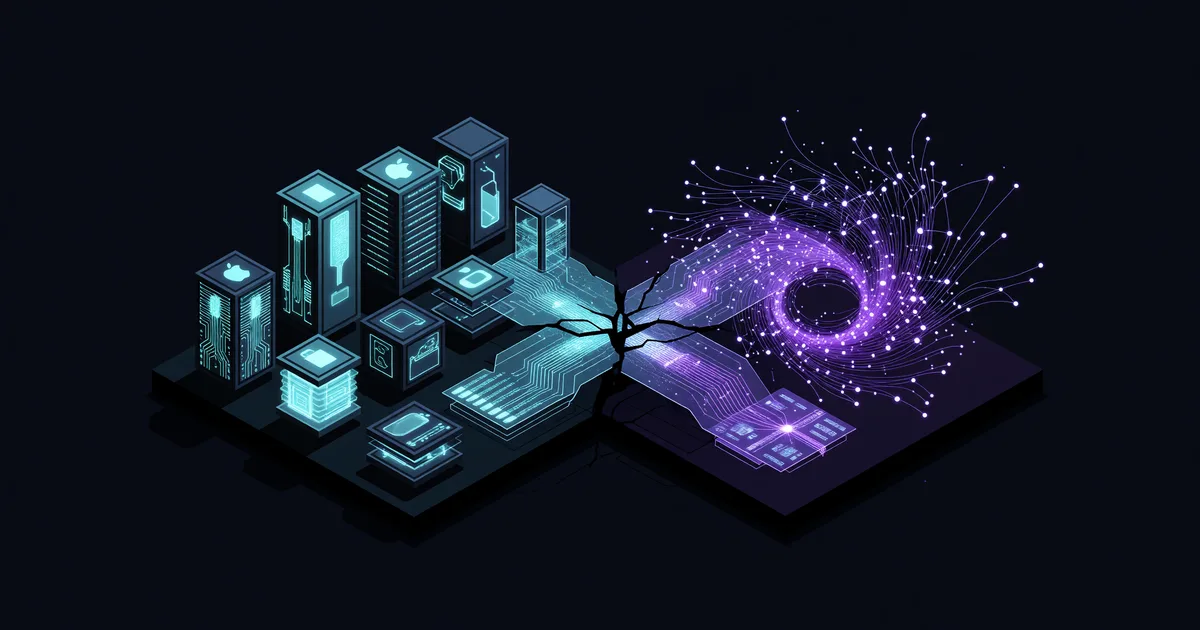
On July 10, 2026, Apple filed a federal lawsuit in the Northern District of California accusing OpenAI of systematically extracting trade secrets about unreleased Apple hardware — routing the theft, Apple claims, through job interviews with Apple staff and a pipeline of departing employees who allegedly carried protected designs out the door. The complaint, first reported by The New York Times and Axios on July 10, reportedly names specifics: iPhone component designs, prototype details, and internal hardware roadmaps.
This is not a patent squabble. Trade-secret litigation between two of the most valuable companies on earth is a different weight class, and the timing tells you why Apple bothered. OpenAI has spent the last year visibly pivoting from a software lab into a full-stack hardware ambition — its own device with the Jony Ive-founded io team, and a custom-silicon effort reportedly built with Broadcom. Apple is watching a company build the exact category it dominates, and it is now alleging OpenAI got a head start using Apple's own designs.
What Apple actually alleges
Based on the July 10 reporting from the Times and Axios, Apple's core claim has two prongs:
- Interview harvesting. Apple alleges OpenAI used job interviews — recruiting Apple employees or interviewing recent departures — as a channel to pull confidential technical detail about unreleased products. The theory is that the "interviews" functioned less as hiring and more as structured intelligence-gathering.
- Departing-employee transfer. Apple claims specific former employees moved to OpenAI carrying protected material about iPhone components and prototype hardware, in breach of confidentiality obligations.
Those are the allegations. Apple has not, as of this writing, made the full evidentiary record public, and OpenAI had not filed a response at the time of the initial reports. My read: the interview-harvesting angle is the more novel and legally interesting one. Employee-poaching-plus-secrets cases are a well-worn genre in Silicon Valley — Apple has been on both sides of them. But framing the interview process itself as an extraction mechanism is an aggressive theory that, if it survives, would put a chill on how aggressively any lab recruits from a hardware incumbent.
Why now: OpenAI's hardware turn
To understand the suit you have to understand what OpenAI is building. Over the past year the company has made no secret of wanting to own the device layer, not just the model layer:
- The io device. OpenAI's acquisition of Jony Ive's io hardware startup was the loudest signal that a consumer device is coming. Ive spent two decades defining Apple's industrial design language — which is precisely why Apple would be sensitive to any hardware detail flowing OpenAI's way.
- Custom silicon. OpenAI's reported chip work with Broadcom (nicknamed in some coverage as the "Jalapeño" program) points at a company trying to control its own compute stack down to the wafer. Chips and devices both touch the kind of component-level secrets Apple guards most tightly.
Put those together and Apple's motive is legible even before you weigh the merits. A lawsuit does two things at once: it seeks damages and injunctive relief, and it plants a flag. Every engineer OpenAI recruits from Cupertino now does so under a litigation cloud. The honest take: even if Apple never wins a dollar, the deterrent value of the filing may be the point.
How strong is the case?
Trade-secret cases under the federal Defend Trade Secrets Act and California's Uniform Trade Secrets Act turn on a few unglamorous questions, and the public reporting doesn't yet answer them:
- Was the information actually a trade secret? Apple has to show the material was genuinely secret, valuable because it was secret, and protected by reasonable measures. Apple's secrecy regime is famously strict, which helps it here.
- Was there misappropriation? Apple needs evidence that OpenAI acquired or used the secrets through improper means — not independent development, and not general skill an employee is entitled to take with them. This is where "an engineer knows how to build things" ends and "an engineer copied a specific protected design" begins. The line is often decided on documents and forensics, not vibes.
- Can Apple tie it to specific OpenAI products? The strongest version of this case shows a named secret appearing in a named OpenAI hardware program. The weakest version is circumstantial — people moved, and Apple is nervous.
We don't yet know which version Apple has. That's the single most important open question, and anyone telling you the case is a slam dunk or a nothingburger on July 11 is guessing.
The distinction that decides most trade-secret cases: general knowledge an employee is legally free to carry to a new job, versus a specific, protected document or design they took without permission. Apple has to land on the second side of that line.
The bigger pattern: Big Tech's AI legal front
This suit doesn't happen in a vacuum. The AI industry has become a dense web of litigation and quiet hostility between former allies:
- Apple and OpenAI were, until recently, partners — OpenAI's models were wired into Apple Intelligence, and at WWDC 2026 Apple leaned further toward outside models, reportedly including a Gemini-powered overhaul of Siri. A vendor relationship and a trade-secret lawsuit can coexist, but it's an awkward marriage.
- The industry has already normalized lab-versus-lab conflict — export-control fights, poaching wars, and acquisition tugs-of-war have defined 2026. A hardware trade-secret suit is the next logical escalation as the labs move down the stack into silicon and devices.
What's underappreciated here: the suit is really about who gets to build the post-smartphone AI device. Apple's entire franchise rests on the iPhone. OpenAI, with Ive and Broadcom, is the first credible challenger with both the design talent and the model that could justify a new form factor. Apple suing over hardware secrets is Apple treating OpenAI as a hardware competitor, not a software vendor — and that reclassification is the actual news.
What it means for OpenAI's device plans
Practically, a lawsuit like this can slow a hardware program even if it never reaches trial. Discovery is invasive: OpenAI could be forced to turn over internal design documents, hiring records, and communications to prove independent development. That's expensive, distracting, and risky for a program OpenAI has kept deliberately secret.
There's also a recruiting chill. If interviewing ex-Apple hardware engineers now carries legal exposure, OpenAI's hiring pipeline for exactly the people it needs — industrial designers, chip engineers, supply-chain experts — gets narrower and more lawyered. For a company trying to ship a first device on an aggressive timeline, friction in the talent pipeline is arguably a bigger threat than any eventual damages award.
The bottom line
Here's what we know: Apple filed on July 10 in the Northern District of California, alleging OpenAI stole unreleased hardware trade secrets through interviews and departing employees, with specifics reportedly touching iPhone components and prototypes. Here's what we don't know: the strength of Apple's evidence, whether any named secret appears in a named OpenAI product, and how OpenAI will respond.
If you want a single thing to watch, watch OpenAI's answer to the complaint. A narrow, technical denial ("independent development, general skill") signals confidence. A motion to dismiss on trade-secret specificity signals Apple's complaint may be thin on the one thing that matters — a concrete secret tied to a concrete product. Until then, treat the confident hot takes on either side with suspicion. This is a fight over the next computing device, dressed up as a trade-secret dispute, and it's just getting started.
Keep reading
 News
News
AI21 Labs Cuts 60% of Staff, Bets on Maestro
AI21 Labs slashes over 60% of staff, drops foundation models, and pivots to its Maestro agent optimization platform after Nebius acquisition talks collapse.
 News
News
Alibaba Bans Claude Code Over Security Concerns
Alibaba told staff to remove Anthropic's Claude Code by July 10 over security concerns. Here's what triggered the ban and what it signals.
 News
News
Anthropic Acquires Stainless: What It Means for AI
Anthropic bought Stainless, the SDK generator behind OpenAI and Cloudflare's client libraries. Here's the strategic play for AI agents.