
GPT-5.5
OpenAI's most capable frontier model, built for complex multi-step reasoning, agentic tool use, and deep coding tasks. Powers ChatGPT and Codex with up to 272K context.
Updated 2026-05-02
No. GPT-5.5 has no free tier on record.
Listed pricing: API: $5/$30 per 1M tokens (in/out). ChatGPT Plus $20/mo, Pro $200/mo.
Overview
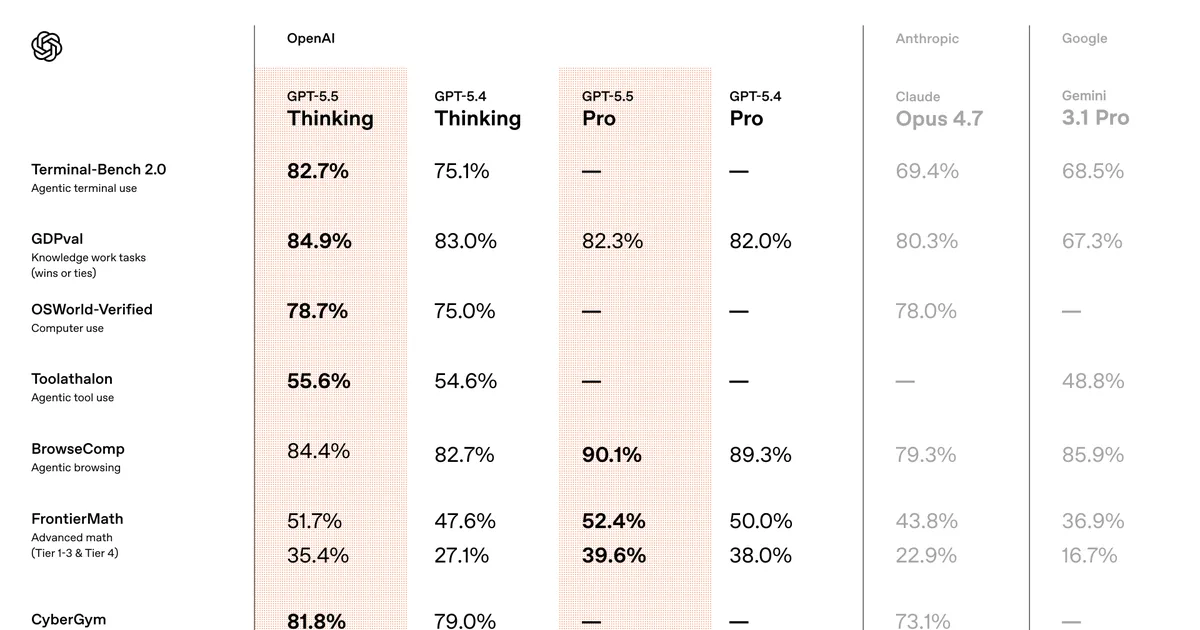
GPT-5.5 is OpenAI's strongest model to date, designed from the ground up for real work rather than demos. It launched in late April 2026 and immediately became the default backbone for ChatGPT Plus, Team, and Enterprise users, while also powering the Codex agent for autonomous software engineering tasks.
What separates GPT-5.5 from GPT-5 and earlier models is its focus on agentic capability. It doesn't just answer questions — it plans multi-step workflows, uses tools (code execution, web browsing, file handling), self-corrects when things go wrong, and completes complex goals with minimal hand-holding. The 272K context window means it can ingest large codebases, lengthy documents, or extended conversation histories without losing track.
For developers specifically, GPT-5.5 sets new benchmarks on SWE-bench and coding evaluations, and the Codex integration lets it autonomously write, test, and iterate on pull requests. The API pricing at $5/$30 per million tokens (input/output) is steep but reflects the model's position as a premium reasoning engine. OpenAI also rolled out GPT-5.5-Cyber, a specialized variant tuned for cybersecurity analysis.
Is GPT-5.5 free?
No. GPT-5.5 has no free tier on record.
What the entry records: No free API tier. Free ChatGPT users get GPT-4o, not GPT-5.5.
Listed pricing: API: $5/$30 per 1M tokens (in/out). ChatGPT Plus $20/mo, Pro $200/mo.
Pricing on this page has not been re-verified. The entry was last edited on , and no separate pricing check has been run since. Treat the figures as a record of what was published then and confirm on the official site.
GPT-5.5 pricing
| Plan | Price | What's included |
|---|---|---|
| ChatGPT Plus | $20/mo | Access to GPT-5.5 as default model, Codex agent, standard rate limits |
| ChatGPT Pro | $200/mo | Highest rate limits, priority access, extended Codex usage |
| API (<=272K) | $5/$30 per 1M tokens | $5 input / $30 output per million tokens, function calling, structured output, vision |
| API (>272K) | Higher rates | Extended context pricing for inputs exceeding 272K tokens |
Access to GPT-5.5 as default model, Codex agent, standard rate limits
Highest rate limits, priority access, extended Codex usage
$5 input / $30 output per million tokens, function calling, structured output, vision
Extended context pricing for inputs exceeding 272K tokens
One plan carries no published number: API (>272K), recorded as “Higher rates”. Nothing is estimated in its place. The vendor's own pricing page is the only source for those figures.
Pricing on this page has not been re-verified. The entry was last edited on , and no separate pricing check has been run since. Treat the figures as a record of what was published then and confirm on the official site.
Is GPT-5.5 worth it?
Worth it for Developers and teams needing a frontier reasoning model for agentic coding workflows and large-codebase context handling.
There is no free tier to test it on, so the plans above are the entry cost. The recorded trade-offs are listed below, and any one of them can settle the question on its own.
The 9.4/10 AI Score is an editorial read of published capability, price and shipping pace. Nobody here has hands-on hours with GPT-5.5. How we verify.
Worth it if
The strengths recorded against this entry.
- Top-of-class coding and reasoning benchmarks — measurably ahead of GPT-5 and competitive alternatives
- True agentic capability with tool use, self-correction, and multi-step task completion
- 272K context handles entire codebases without chunking workarounds
- Codex integration turns it into an autonomous software engineer inside ChatGPT
Not worth it if
Any one of these blocks your use case.
- API pricing is premium — $30/M output tokens adds up fast for heavy usage
- No free tier for the API; ChatGPT Free users are stuck on GPT-4o
- Slower inference than lighter models like GPT-4o-mini for simple tasks
- Closed-source with no self-hosting option — full vendor lock-in to OpenAI
What sets GPT-5.5 apart
- 272K context window ingests entire codebases or long documents without chunking workarounds
- Agentic tool use with self-correction across multi-step workflows, not just single-turn answers
- Powers the Codex agent for autonomous pull-request writing, testing, and iteration inside ChatGPT
- Specialized GPT-5.5-Cyber variant tuned for cybersecurity analysis
Key features
Frontier Model
OpenAI's most capable model with state-of-the-art reasoning, instruction following, and code generation. Tops benchmarks on SWE-bench, GPQA, and multi-step problem solving.
Agentic
Built for autonomous multi-step workflows — plans tasks, calls tools (code interpreter, browser, file I/O), self-corrects, and completes complex goals without constant prompting.
272K Context
272K token context window lets you feed entire repositories, long documents, or extended conversations. Supports structured output, function calling, and vision.
How it compares
| Tool | Best for | Pricing | Score |
|---|---|---|---|
| GPT-5.5 | Developers and teams needing a frontier reasoning model for agentic coding workflows and large-codebase context handling. | API: $5/$30 per 1M tokens (in/out). ChatGPT Plus $20/mo, Pro $200/mo | 9.4/10 |
| Cursor vs Cursor → | Professional developers handling complex, multi-file refactors who want AI built into a familiar VS Code-based editor. | Free Hobby + Individual $20/mo + Teams $40/user/mo + Enterprise Custom | 9.5/10 |
| Claude Code vs Claude Code → | Developers who want an agent that works inside an existing repo and toolchain rather than in a hosted editor, and who already pay for a Claude plan. | Included with Claude Pro $17/mo, Max 5x $100/mo, Max 20x $200/mo, Team and Enterprise plans | 9.3/10 |
| Windsurf vs Windsurf → | Developers who want an AI IDE that autonomously plans, codes, tests, and iterates across a project with minimal input. | Freemium | 9.1/10 |


Learn to use GPT-5.5
Step-by-step, each one stamped with the date it was last checked against the docs.
Compare head-to-head
Related reading

GPT-5.6 Sol vs GPT-5.5: What the Benchmarks Say
OpenAI previewed GPT-5.6 Sol on June 26. Here's how its reported benchmarks stack up against GPT-5.5 — and what to trust.

GPT-5.6 Sol: What Shipped, Pricing & Who It's For
OpenAI's June 26 GPT-5.6 launch splits into three tiers — Sol, Terra, Luna. Here's what shipped, the pricing logic, and who each is for.

OpenAI LifeSciBench: 750 Tasks for Life Sciences AI
OpenAI's new LifeSciBench benchmark tests AI across 750 expert-judged life sciences tasks. GPT-Rosalind outperforms GPT-5.5 on real-world scientific workflows.
Ready to try GPT-5.5?
Head to the official site to start with GPT-5.5 — pricing and plans are listed above.
Visit GPT-5.5