Mistral OCR 4
Mistral's OCR model that turns documents into structured data — bounding boxes, block classification, and confidence scores across 170 languages.
Updated 2026-07-01
No free tier is documented for Mistral OCR 4.
Listed pricing: API $4 / 1,000 pages ($2 batch); Document AI $5 / 1,000 pages.
Overview
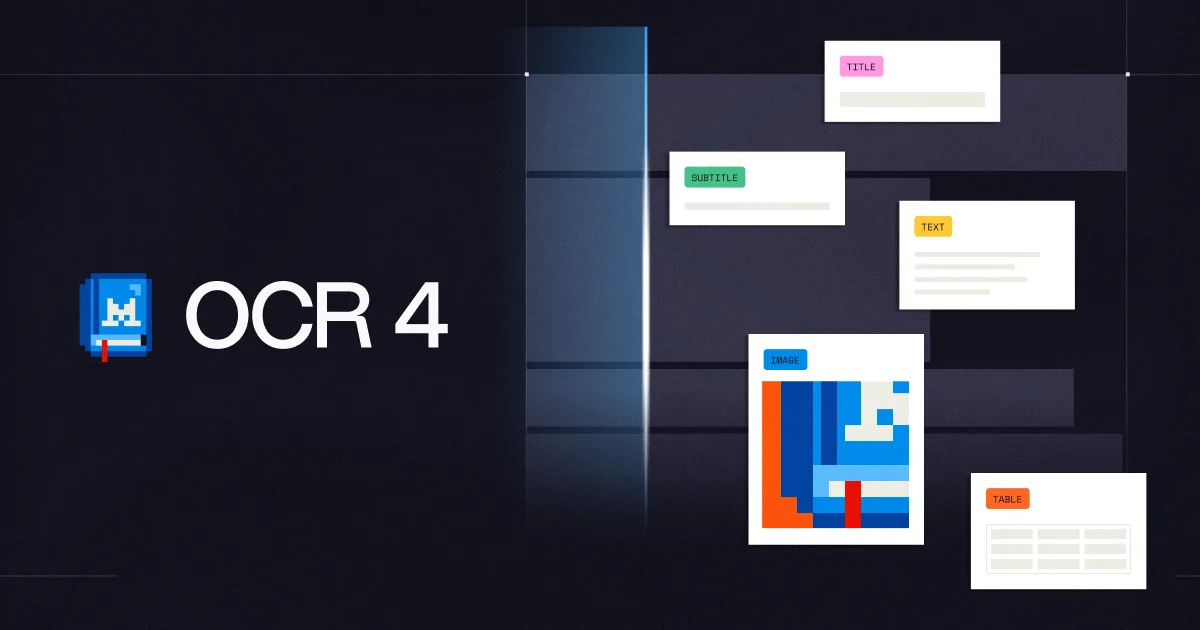
Mistral OCR 4 is a document-understanding model that converts PDFs, scans, and images into structured, machine-readable output — not just a wall of extracted text, but text tied to its position on the page. Each element comes back with a bounding box, a block classification (heading, paragraph, table, figure, and so on), and a per-element confidence score, across 170 languages. That structure is what separates it from plain text OCR: downstream systems can reason about layout, pull specific fields, and flag low-confidence regions for review instead of guessing.
Released June 23, 2026, it sits at the front of what Mistral is positioning as an enterprise document pipeline. You can hit the raw OCR model through the API at $4 per 1,000 pages (dropping to roughly $2 per 1,000 with the batch discount), or use the higher-level Document AI product at $5 per 1,000 pages when you want the extraction-to-fields workflow handled for you. The pricing is aggressive for what is a genuinely structured output, and the batch tier makes large back-catalog digitization projects realistic to budget.
It's built for teams processing documents at volume — invoice and receipt extraction, contract and form parsing, insurance and legal intake, and feeding clean, positioned text into RAG systems where layout context actually matters. It's an API-first, developer-facing product, so it competes less with consumer scan apps and more with Google Document AI, AWS Textract, and Azure Document Intelligence.
Is Mistral OCR 4 free?
No free tier is documented for Mistral OCR 4.
Listed pricing: API $4 / 1,000 pages ($2 batch); Document AI $5 / 1,000 pages.
No figure is estimated here for what is not published. Check Mistral OCR 4's own site for the current terms.
Pricing on this page has not been re-verified. The entry was last edited on , and no separate pricing check has been run since. Treat the figures as a record of what was published then and confirm on the official site.
Mistral OCR 4 pricing
| Plan | Price | What's included |
|---|---|---|
| OCR API | $4 per 1,000 pages | Raw structured OCR — bounding boxes, block classification, confidence scores, 170 languages. Pay-as-you-go via the Mistral API. |
| OCR API (Batch) | ~$2 per 1,000 pages | Batch-processing discount (roughly 50% off) for large, non-latency-sensitive jobs like archive digitization. |
| Document AI | $5 per 1,000 pages | Higher-level document product layering extraction-to-fields workflows on top of the OCR model. |
Raw structured OCR — bounding boxes, block classification, confidence scores, 170 languages. Pay-as-you-go via the Mistral API.
Batch-processing discount (roughly 50% off) for large, non-latency-sensitive jobs like archive digitization.
Higher-level document product layering extraction-to-fields workflows on top of the OCR model.
Pricing on this page has not been re-verified. The entry was last edited on , and no separate pricing check has been run since. Treat the figures as a record of what was published then and confirm on the official site.
Is Mistral OCR 4 worth it?
Worth it for Developer and enterprise teams processing documents at volume, from invoice and contract extraction to feeding positioned text into RAG pipelines.
There is no free tier to test it on, so the plans above are the entry cost. The recorded trade-offs are listed below, and any one of them can settle the question on its own.
The 8.2/10 AI Score is an editorial read of published capability, price and shipping pace. Nobody here has hands-on hours with Mistral OCR 4. How we verify.
Worth it if
The strengths recorded against this entry.
- Structured output — bounding boxes, block types, and confidence scores, not just flat text
- Aggressive per-page pricing with a batch tier that roughly halves cost for bulk jobs
- 170-language coverage handles multilingual and non-Latin document sets
- Confidence scores enable clean auto-accept vs. human-review routing in pipelines
- API-first design fits directly into RAG and enterprise document workflows
Not worth it if
Any one of these blocks your use case.
- No free tier — you pay from the first page, unlike some rivals' monthly free quotas
- Developer/API product with no polished consumer scan-app front end
- Enters a crowded field against entrenched Google Document AI, AWS Textract, and Azure Document Intelligence
- Real-world accuracy on messy handwriting and low-quality scans isn't yet independently benchmarked
What sets Mistral OCR 4 apart
- Returns bounding boxes, block classification, and per-element confidence scores, not just flat text
- Batch tier cuts cost roughly in half for bulk digitization jobs
- 170-language coverage including non-Latin scripts
- Confidence scores enable auto-accept vs. human-review routing
Key features
Positional extraction
Returns bounding boxes for every detected element, so extracted text stays tied to where it sits on the page — essential for tables, forms, and multi-column layouts that flat OCR mangles.
Block classification
Labels each region by type (heading, paragraph, table, figure, etc.), giving downstream code semantic structure to parse against instead of an undifferentiated text blob.
Confidence scoring
Every element carries a confidence score, letting pipelines auto-accept high-certainty regions and route low-confidence ones to human review rather than silently propagating errors.
Broad language coverage
Handles 170 languages, covering multilingual document sets and non-Latin scripts that many OCR engines struggle with.
How it compares
| Tool | Best for | Pricing | Score |
|---|---|---|---|
| Mistral OCR 4 | Developer and enterprise teams processing documents at volume, from invoice and contract extraction to feeding positioned text into RAG pipelines. | API $4 / 1,000 pages ($2 batch); Document AI $5 / 1,000 pages | 8.2/10 |
| Grok Bot vs Grok Bot → | Anyone who wants an always-on teammate that signs into real apps, finishes work end to end, and only pings you for approval. | Included on eligible Cursor ($20+/mo), SuperGrok ($30+/mo), and Cursor Teams ($40+/seat/mo) plans. Product page also lists a Get started for free path. | 9.6/10 |
| Notion AI vs Notion AI → | Notion users who want an assistant that already knows their pages, databases, and documents for summaries and answers. | From $10/mo | 9/10 |
| Zapier | Teams that need to connect many SaaS apps and build automations from a plain-English description instead of manual setup. | Free tier + Professional from $19.99/mo + Team from $69/mo + Enterprise contact | 8.9/10 |

Compare head-to-head
Related reading
GPT-6 Sol and Luna: half the price, mixed scores
OpenAI's GPT-6 Sol and Luna cut token prices roughly in half and stay near GPT-5.6 on Artificial Analysis indexes, with lower hallucination and weaker
GPT-Live's one stream vs Gemini 3.8 Live
OpenAI's GPT-Live listens and speaks on one WebSocket. Google's Gemini 3.8 Live reasons while talking. Specs, prices, and who each model is for.
ChatGPT Finances Experian Soft Credit Check: What Shipped
U.S. Plus/Pro ChatGPT Finances can connect Experian for a soft-pull VantageScore 3.0. What OpenAI's Help Center says about setup, monthly updates, and what not to paste in chat.
Ready to try Mistral OCR 4?
Head to the official site to start with Mistral OCR 4 — pricing and plans are listed above.
Visit Mistral OCR 4