xAI Launches Grok Voice Agent Builder Beta
xAI's no-code Grok Voice Agent Builder ships in beta at $0.05/min with unified STT/LLM/TTS and telephony. What it changes for phone agents.
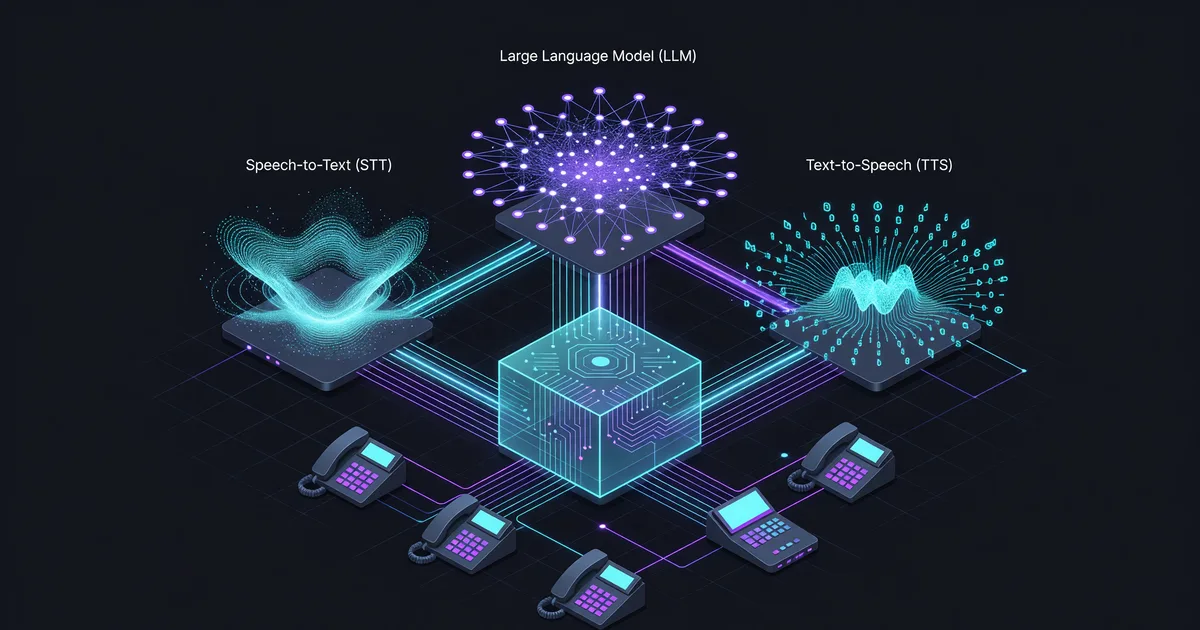
On July 1, 2026, xAI shipped the Grok Voice Agent Builder in beta — a no-code platform that, per the company's announcement, lets you assemble and deploy a production voice agent in under two minutes, billed at $0.05 per minute of conversation. The pitch sounds small for what it actually represents: this is one of the first times a frontier lab has bundled speech-to-text, the language model, text-to-speech, and telephony into a single managed product you configure in a browser instead of wiring together yourself.
If you've ever built a phone agent, you know why that matters. The status quo is a stack of vendors held together with glue code. xAI is betting it can collapse that stack into one bill and one latency budget. Whether it delivers depends on details the launch post only partly answers — so let's separate what's confirmed from what's still an open question.
What xAI actually announced
The headline claims from Grok's launch (x.ai/news, July 1 2026) are straightforward:
- No-code builder. You define the agent's system prompt, pick a voice, connect tools or a knowledge base, and get a deployable agent — no SDK stitching required.
- Unified STT → LLM → TTS pipeline. Speech recognition, Grok's reasoning, and speech synthesis run as one managed service instead of three separate API calls you orchestrate.
- Built-in telephony. Agents can answer and place phone calls — the piece most DIY stacks bolt on last and debug longest.
- $0.05 per minute. Flat conversational pricing, which xAI positions as all-in versus the per-component metering of a stitched stack.
- Two-minute setup. The company's demo framing — treat "under two minutes" as a marketing claim about the happy path, not a guarantee for a call flow with tool calls, transfers, and guardrails.
This builds directly on infrastructure xAI already shipped. The Grok Voice API exposed 80+ voices across 28 languages earlier this year; the Voice Agent Builder is the no-code layer on top of it. If you'd already been calling the Voice API by hand, the Builder is the managed console you didn't have before.
Why "unified stack" is the actual story
The interesting part isn't that xAI built a voice product. It's where the seams are. A typical voice agent today looks like this: a telephony provider (Twilio) hands audio to a speech-to-text engine (Deepgram), which passes text to an LLM (via OpenAI or Anthropic), whose reply goes to a TTS engine (ElevenLabs), and back out through the telephony layer. Four vendors, four failure points, four latency contributions, and four bills.
Every one of those handoffs adds round-trip time, and in a phone conversation latency is the whole game. Humans notice a pause past roughly 300–500 milliseconds; cross that and the agent feels robotic and people start talking over it. The reason orchestration platforms like Vapi, Retell, and Bland exist is precisely to hide that plumbing. xAI's move is to go one level deeper — not orchestrate the vendors, but be all of them.
My read: the unified pipeline is the whole value proposition. If STT, reasoning, and TTS live behind one endpoint, xAI controls the end-to-end latency budget rather than inheriting the sum of four vendors' worst cases. That's the one thing a stitched stack structurally cannot match.
The honest caveat: xAI hasn't published measured end-to-end latency numbers, and neither should you assume them. "Unified" is an architecture that enables low latency; it doesn't prove it. Until there are third-party numbers on time-to-first-audio and turn-taking under real network conditions, the latency advantage is a reasonable hypothesis, not a benchmark.
The pricing angle
At $0.05 per minute, xAI is pricing the whole conversation — STT, LLM, and TTS together — at a number that's competitive with what you'd pay for just the voice-synthesis slice of a DIY stack. Here's how the mental model differs.
| Approach | What you pay for | Billing surface |
|---|---|---|
| Stitched stack | Telephony + STT + LLM tokens + TTS, metered separately | 4 vendors, 4 invoices |
| Orchestration platform (Vapi/Retell/Bland) | Platform per-minute fee plus underlying model/voice costs passed through | 1 invoice, variable pass-through |
| Grok Voice Agent Builder | $0.05/min all-in (per xAI's announcement) | 1 invoice, flat |
A flat, all-in per-minute rate is genuinely easier to reason about than a stack where a chatty agent runs up LLM token costs unpredictably. What the announcement doesn't spell out — and what you should read the fine print for — is whether telephony carrier fees, tool-call compute, or premium voices sit inside that $0.05 or get billed on top. "All-in" claims in voice AI have a habit of developing asterisks once you're in production.
How it stacks up against the alternatives
Two comparisons matter here, because they represent two different threats to different incumbents.
Versus orchestration platforms (Vapi, Retell, Bland)
These companies built real businesses on the premise that gluing voice stacks together is hard enough to pay someone else to do it. xAI's counter is that if you own the whole pipeline, the orchestration layer becomes redundant. The risk for those platforms is obvious. The counter-argument in their favor: they're model-agnostic. A Vapi customer can swap in whichever LLM and voice vendor they prefer, route calls through their existing carrier, and isn't locked to one lab's roadmap. Grok's Builder trades that flexibility for integration. Which you want depends on whether you value control or convenience more.
Versus other frontier labs
OpenAI has pushed hard on real-time voice — the site has covered GPT-Realtime-2, which brings GPT-5-class reasoning to voice agents. But OpenAI's real-time offering is still an API you build against. The difference xAI is drawing is the no-code builder plus telephony layer: OpenAI gives you a fast voice model; xAI is trying to give you a deployed phone agent. That's a product-surface distinction, not a raw-capability one, and it's aimed at a broader audience than model-integrating engineers.
On the voice-quality and breadth axis, ElevenLabs remains the reference point most teams benchmark against for naturalness and voice cloning. xAI's 80+ voices and 28 languages are a serious catalog, but "how good does it actually sound on a noisy phone line" is exactly the kind of thing that needs real-world listening, not spec sheets. Reserve judgment there until independent reviews land.
Who this is for
The clearest fit is anyone building customer-facing phone automation who doesn't want to become a voice-infrastructure expert to ship it:
- Support and reception lines — inbound triage, FAQ handling, appointment booking, after-hours coverage.
- Outbound workflows — reminders, confirmations, qualification calls, where the flat per-minute rate makes unit economics predictable.
- Prototype-to-production teams — the no-code builder lowers the bar to a working demo, and the same platform runs it in production rather than forcing a rewrite.
Who should wait: anyone who needs deep control over turn-taking behavior, custom carrier routing, on-prem or regulated-data handling, or vendor independence. A managed, single-lab pipeline is the opposite of that, and beta is exactly when the sharp edges show up.
The open questions
This is a beta, and the announcement leaves the load-bearing operational details unstated. Before you build a business on it, these are the things to confirm from xAI's docs rather than assume:
- Measured latency. No published end-to-end or time-to-first-audio numbers yet. This is the single most important spec for a phone agent and it's the one we don't have.
- Concurrency and scale limits. Beta products routinely cap simultaneous calls. If you're running a call center, this is a hard constraint to check.
- Interruption handling. How gracefully the agent handles barge-in — a caller talking over it — is what separates "sounds human" from "sounds like a phone tree."
- Data and compliance. Call recording, retention, and whether audio is used for training. For healthcare, finance, or anything touching regulated data, this is non-negotiable.
- What's inside the $0.05. Carrier fees, tool-call compute, premium voices — in or out?
The bigger pattern
Zoom out and the Voice Agent Builder fits a strategy xAI has run repeatedly this year: take a capability that used to require assembling third-party pieces and offer it as one integrated product. It's the same logic behind bundling Grok's coding CLI, image, and video tools under one roof. The company is consistently betting that owning the full stack — and pricing it flat — beats being one interchangeable component in someone else's pipeline.
For the voice-agent ecosystem, the immediate question is whether the orchestration middlemen get squeezed. My take: not overnight. Model-agnosticism and carrier flexibility are real reasons teams pay for Vapi and Retell, and a single-vendor lock-in cuts the other way for a lot of buyers. But xAI just made "roll your own voice stack" a materially worse default for the median developer — and that's the part of the market that was always going to be won on convenience, not control.
The thing to watch over the next few weeks isn't the feature list. It's the first independent latency and voice-quality tests, and whether that flat $0.05 holds its shape once real production bills arrive. Those two numbers will tell you far more than any launch demo.
Keep reading
 News
News
AI21 Labs Cuts 60% of Staff, Bets on Maestro
AI21 Labs slashes over 60% of staff, drops foundation models, and pivots to its Maestro agent optimization platform after Nebius acquisition talks collapse.
 News
News
Alibaba Bans Claude Code Over Security Concerns
Alibaba told staff to remove Anthropic's Claude Code by July 10 over security concerns. Here's what triggered the ban and what it signals.
 News
News
Anthropic Acquires Stainless: What It Means for AI
Anthropic bought Stainless, the SDK generator behind OpenAI and Cloudflare's client libraries. Here's the strategic play for AI agents.