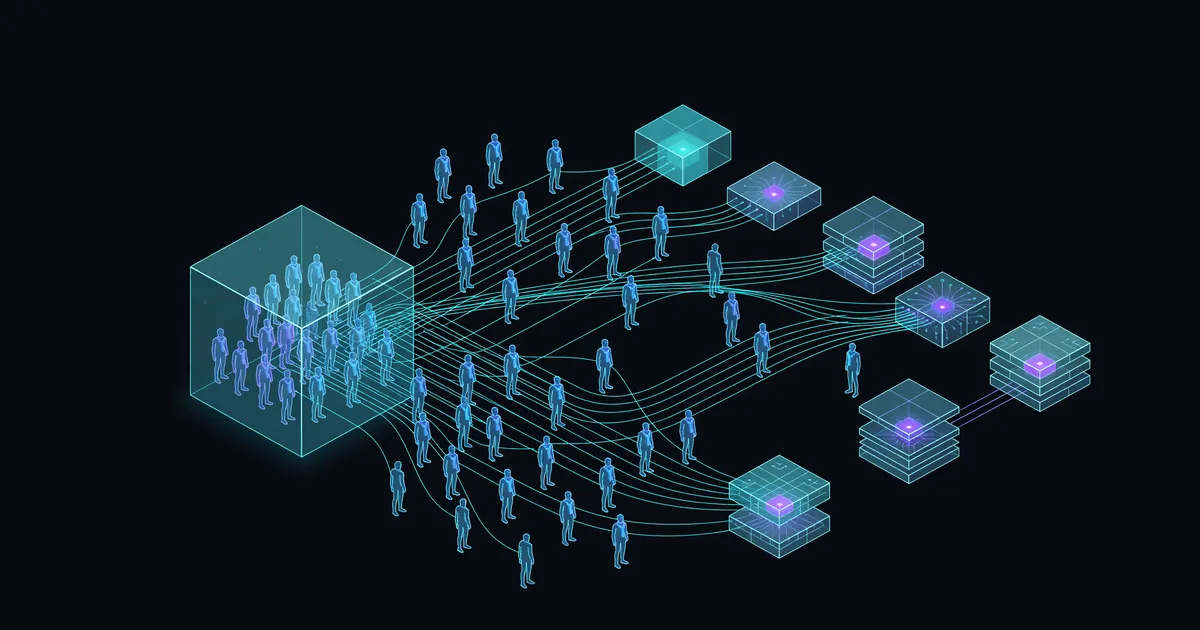
Microsoft Frontier: 6,000 AI Engineers for Hire
Microsoft's new $2.5B Frontier firm embeds 6,000 AI engineers inside customers to close the enterprise deployment gap. Here's the strategy.
On July 2, 2026, Microsoft announced Frontier, a new $2.5 billion company built to do one deeply unglamorous thing: sit inside your organization and make the AI actually work. Per Microsoft's launch post, Frontier will field roughly 6,000 embedded engineers and experts who deploy, integrate, and scale AI systems alongside customer teams, tied to "measurable outcomes" rather than seat licenses. Reuters and GeekWire framed it the same way on the day: Microsoft is moving from selling AI to selling AI implementation.
That distinction is the whole story. For three years the industry has sold access — API calls, Copilot seats, Azure OpenAI capacity. Frontier is a bet that access was never the bottleneck. Delivery was.
What Microsoft actually launched
Frontier is structured as a dedicated firm — a professional-services and engineering organization, not a new model or SKU. The public details, drawn from Microsoft's blog and the Reuters and GeekWire reports on July 2:
- $2.5 billion in committed investment behind the effort.
- ~6,000 experts — AI engineers, architects, and deployment specialists — meant to embed directly inside customer environments.
- A mandate framed around measurable business outcomes: not "we shipped a chatbot," but throughput, cost, and error-rate changes a customer can point to.
- A positioning line — "AI engineering that amplifies and protects your intelligence" — that leans on governance, security, and data protection as much as raw capability.
If that sounds less like a product launch and more like Microsoft standing up its own systems-integrator arm, that's because it more or less is. The difference from a traditional consultancy is the tight coupling to Microsoft's own stack — GitHub Copilot, Copilot Studio, Azure AI Foundry, and the Azure OpenAI models underneath them.
Why now: the deployment gap is real
The timing isn't random. Enterprise AI has a well-documented adoption paradox — spending is up, but attributable ROI is thin. The most-cited data point is MIT's Project NANDA report from mid-2025, which found that roughly 95% of enterprise generative-AI pilots showed no measurable P&L impact. Whether or not you trust that exact figure, the pattern it describes is familiar to anyone who has watched a "Copilot rollout" stall at the proof-of-concept stage.
My read: the gap is rarely the model. It's everything around it — data plumbing, permissions, evaluation, change management, the boring integration work that determines whether a demo becomes a workflow. Microsoft has sold plenty of licenses that customers never operationalized. Frontier is an admission that a Copilot seat on its own doesn't generate outcomes; a human engineer who knows how to wire it into your systems might.
The bottleneck in enterprise AI was never buying the model. It was the last mile between a working demo and a production workflow — and that mile is made of integration, evaluation, and governance, not tokens.
The competitive context: everyone is racing to the last mile
Frontier doesn't exist in a vacuum. The entire frontier-lab tier has concluded, roughly simultaneously, that models are commoditizing and services are where the durable margin lives.
- OpenAI spun up its own deployment-and-consulting operation — the $4B-scale "OpenAI for Companies"-style push and the Tomoro acquisition we covered earlier this year — precisely to own implementation rather than hand it to partners.
- Amazon has been expanding its AWS Generative AI Innovation Center along the same lines, pairing capacity with hands-on engineering help, which Reuters flagged as the most direct competitive parallel to Frontier.
- Anthropic has pushed applied teams and an economic-deployment program aimed at getting Claude into measurable production use rather than experimentation.
- The traditional SIs — Accenture, Deloitte, and the rest — already run enormous AI practices, much of it on Microsoft's own stack.
That last point is the awkward one. Microsoft's partner ecosystem is a massive channel, and a lot of those partners make their living deploying Microsoft AI for customers. A 6,000-person first-party delivery arm competes for exactly that work. Microsoft will insist Frontier complements partners rather than displacing them, and for large, complex accounts that's plausible. But there's real channel tension baked into a $2.5B first-party services bet, and it's worth watching how Microsoft draws the line.
What "embedded" and "outcome-based" really mean
Two words in the announcement carry most of the strategic weight.
Embedded. These engineers work inside the customer's environment, not from a Microsoft office lobbing recommendations over a wall. That's a labor-intensive, high-touch model — the opposite of software's usual zero-marginal-cost economics. It's expensive to scale, which is part of what the $2.5 billion is buying: enough headcount to make the model credible across large accounts.
Outcome-based. Tying engagements to measurable results is the honest response to pilot fatigue. Buyers are tired of paying for capability they can't cash in. But "measurable outcomes" is also the hardest thing to contract around — who defines the baseline, who attributes the gain, and what happens when the number doesn't move? The announcement gestures at outcomes; it doesn't publish the commercial model. That's the detail I'd want before reading too much into the framing.
The "protects your intelligence" angle
The tagline pairs "amplifies" with "protects." That second verb is doing quiet, deliberate work. Enterprise AI adoption keeps snagging on governance: data leakage, prompt injection, model access to sensitive systems, and the compliance overhang of putting a probabilistic system near regulated data. By foregrounding protection, Microsoft is speaking directly to the CISO and the general counsel — the two people most likely to freeze a rollout.
The honest take: this is smart positioning because it targets the actual objection. The failure mode of enterprise AI in 2026 isn't "the model isn't good enough." It's "legal won't sign off" or "we can't prove it's safe on our data." An embedded engineering team that owns governance from day one is a more compelling answer to that than any benchmark score.
What this means if you're a buyer
For enterprises weighing AI investment, Frontier reframes the question. It's less "which model do we license" and more "who owns the last mile." A few practical implications:
- Bundling risk. Frontier's engineers deploy Microsoft's stack. That's efficient if you're already all-in on Azure and Copilot; it's a deeper lock-in if you're trying to stay multi-vendor across Microsoft, OpenAI, Anthropic, and Google.
- Leverage over your SI. Whether or not you use Frontier, its existence gives you a pricing and capability benchmark to hold your existing integrator against.
- Outcome contracts cut both ways. Push for the baseline and attribution method to be written down. "Measurable" is only a benefit to you if you control how it's measured.
The bigger signal
Zoom out and Frontier tells you where the industry thinks the money is going. The frontier labs spent 2024 and 2025 competing on benchmarks. In 2026 they're competing on delivery — because a model that's 3% better on SWE-bench is worth far less than a customer who actually ships it into production. Microsoft, OpenAI, Amazon, and Anthropic have all, within a few months of each other, built or expanded services arms aimed at the same gap.
My read: this is the clearest sign yet that raw model capability is commoditizing at the top. When the leaders start pouring billions into human deployment teams, they're telling you the differentiator has shifted from what the model can do in a demo to what an organization can operationalize. That's a more mature — and frankly more honest — place for the market to be.
Open questions
What Microsoft hasn't said matters as much as what it has. We don't yet know Frontier's commercial model in detail, how outcome-based pricing gets structured and disputed, how the 6,000 hires are sourced (net-new, redeployed, or acquired), or how hard Microsoft will police the boundary with its own SI partners. The $2.5B number and the headcount are real and sourced; the operating details are still thin.
What's not ambiguous is the direction. Microsoft just put $2.5 billion behind the idea that the next phase of enterprise AI is won by whoever closes the gap between a working model and a working outcome. If they're right, the most valuable AI asset in 2027 won't be a model checkpoint — it'll be the people who know how to land it.
Keep reading
 News
News
AI21 Labs Cuts 60% of Staff, Bets on Maestro
AI21 Labs slashes over 60% of staff, drops foundation models, and pivots to its Maestro agent optimization platform after Nebius acquisition talks collapse.
 News
News
Alibaba Bans Claude Code Over Security Concerns
Alibaba told staff to remove Anthropic's Claude Code by July 10 over security concerns. Here's what triggered the ban and what it signals.
 News
News
Anthropic Acquires Stainless: What It Means for AI
Anthropic bought Stainless, the SDK generator behind OpenAI and Cloudflare's client libraries. Here's the strategic play for AI agents.