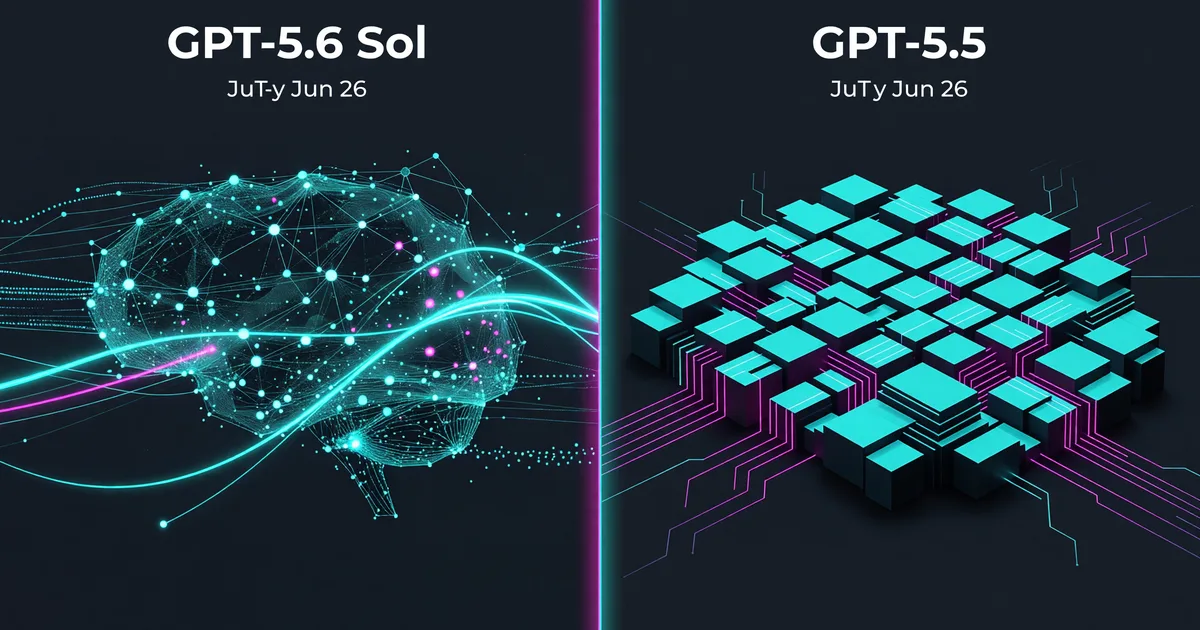
GPT-5.6 Sol vs GPT-5.5: What the Benchmarks Say
OpenAI previewed GPT-5.6 Sol on June 26. Here's how its reported benchmarks stack up against GPT-5.5 — and what to trust.
OpenAI reset the frontier again on June 26, 2026, previewing a three-model GPT-5.6 family — Sol (flagship), Terra (mid-tier), and Luna (fast/cheap) — and claiming a new state of the art on agentic coding via Terminal-Bench 2.1. Coverage landed the same day: TechCrunch, Reuters, and MacRumors all ran launch pieces, and OpenAI's own X posts on Sol's capabilities cleared 500K views apiece within hours.
Here's the catch most of those pieces buried: this is a limited preview, and every headline number comes from OpenAI's own announcement and system card. No independent leaderboard — Artificial Analysis, SWE-bench's hosted harness, LMArena — has scored Sol yet. So this comparison is exactly what the title promises: what the benchmarks say, with a clear line drawn between vendor claims and verified results. That distinction matters more than usual here, because GPT-5.5 is a known, widely-deployed quantity and Sol is a hours-old preview behind a staggered rollout.
The GPT-5.6 family, briefly
Like the 5.5 generation before it, GPT-5.6 ships as a tiered family rather than a single model. The naming switched from numeric suffixes to celestial names, which signals OpenAI wants these read as distinct products, not just size variants:
- Sol — the flagship reasoning and agentic model. This is the one carrying the Terminal-Bench SOTA claim and the cybersecurity story.
- Terra — the balanced mid-tier, positioned where most production traffic is meant to land (the rough analogue to GPT-5.5's default model).
- Luna — the fast, low-cost tier for high-volume and latency-sensitive work, competing with GPT-5.5 mini and Gemini 3.5 Flash.
For a head-to-head against GPT-5.5, Sol is the only fair comparison point — it's the model OpenAI is positioning as a generational step over last cycle's flagship. Terra and Luna are best understood as cost/latency knobs on the same underlying training run.
The benchmark claims (and who's making them)
The centerpiece of the launch is Terminal-Bench 2.1, the agentic-coding benchmark that measures whether a model can drive a real shell to completion across multi-step tasks — install dependencies, run tests, fix what breaks, repeat. OpenAI says Sol takes the top spot on the public 2.1 leaderboard, ahead of GPT-5.5 and the current frontier field. That's a meaningful benchmark to lead, because Terminal-Bench rewards the exact loop that coding agents like Codex, Cursor, and Claude Code run thousands of times a day: it punishes models that hallucinate file paths, forget prior steps, or give up after one failed command.
The second pillar is security. OpenAI's announcement and system card emphasize gains on cyber-offense and cyber-defense evaluations — the kind of capability tracked by benchmarks in the ExploitBench/vulnerability-discovery family. The framing is dual-edged: better at finding and reasoning about vulnerabilities, which is exactly why the rollout is gated (more on that below).
Here's how the reported picture compares. Every Sol figure here is OpenAI-reported as of the June 26 preview; GPT-5.5 numbers are its established published results. Treat the Sol column as a vendor claim until third parties confirm:
| Dimension | GPT-5.6 Sol (OpenAI-reported) | GPT-5.5 (established) |
|---|---|---|
| Terminal-Bench 2.1 (agentic coding) | Claimed #1 on public leaderboard | Strong but below Sol per OpenAI |
| Cybersecurity / exploit reasoning | Headlined as a major gain | Baseline for the family |
| Availability | Limited preview, staggered rollout | Generally available |
| Independent verification | None yet (day-one preview) | Extensive (months in market) |
| Positioning | Flagship reasoning/agent model | Prior-generation flagship |
My read: a single-benchmark SOTA claim on launch day is the weakest kind of evidence, not because vendors lie outright but because benchmark selection, harness configuration, and prompt scaffolding all favor the lab that built the model. Terminal-Bench is a good benchmark, and leading it is real signal — but "OpenAI says Sol is #1 on the leaderboard it chose to highlight" is a very different statement from "Sol is #1 after Artificial Analysis re-ran it under a neutral harness." Both can be true. Only one is confirmed today.
Why the security angle is the actual story
If you read only the coding headline, you'll miss what's different about this launch. OpenAI didn't just ship a better agent — it shipped a model whose rollout schedule was shaped by government input. The preview is staggered, and the framing around cybersecurity gains is the reason.
This connects to a pattern we've tracked all spring: AI systems crossing the threshold where vulnerability discovery becomes a national-security variable, not just a product feature. When a frontier model gets materially better at reasoning about exploits, the same capability that helps a defender triage a codebase helps an attacker find the soft spot first. A staggered, oversight-influenced rollout is OpenAI getting ahead of that — and a tacit admission that Sol's security capabilities are strong enough to warrant it.
The honest take: the most important "benchmark" in this launch isn't Terminal-Bench. It's that OpenAI felt the cyber capabilities were significant enough to pace the release around them. That's a louder signal about Sol's real-world strength than any leaderboard screenshot.
For developers, this has a practical edge. If Sol is genuinely better at security reasoning, the near-term winners are defensive tooling — automated code review, dependency auditing, SAST/DAST augmentation. The same capability in an ungated model would be a liability; gated and API-metered, it's a feature you'll see wired into security products within weeks of general availability.
Pricing and tiers: the part that decides adoption
OpenAI's family strategy is, at this point, well-understood: a flagship priced for hard reasoning, a mid-tier priced for the bulk of production traffic, and a cheap tier for high-volume calls. Sol/Terra/Luna map cleanly onto that ladder, mirroring how GPT-5.5 split flagship/mini/nano economics.
Exact preview pricing wasn't fully detailed across all tiers in the launch materials at the time of writing, and that's worth flagging rather than guessing — invented per-token numbers would be worse than honest uncertainty. What we can say with confidence: the value question is never "is the flagship the best?" It's "is the flagship better per dollar than running Terra or GPT-5.5 for the same job?" For most teams, the mid-tier wins on economics, and the flagship earns its premium only on the hardest agentic and reasoning tasks. That was true for GPT-5.5, and there's no reason Sol changes the math — a top-of-leaderboard coding model is overkill for summarization, classification, or routine chat.
Should you switch from GPT-5.5?
Not yet — and that's not a knock on Sol. Here's the decision framework:
- If you're shipping coding agents: watch Terminal-Bench's independent runs and the SWE-bench community numbers over the next two weeks. If Sol holds its lead under neutral harnesses, it becomes the default to evaluate. Until then, GPT-5.5 (or Claude's latest, or Grok 4.3) remains the safe production choice.
- If you're in security tooling: get on the preview waitlist now. The cyber gains are the differentiated capability, and early access is the advantage. Just expect the gating to mean slower, more conditional availability.
- If you're running general production traffic: there's no urgency. Terra and Luna aren't broadly available, GPT-5.5 is stable and cheap, and switching a working stack to a day-one preview is risk for no proven reward.
The thing I'd resist is the reflex that a new flagship obsoletes the last one. GPT-5.5 didn't get worse on June 26. It's still a strong, fully-available, independently-benchmarked model with known costs and known failure modes. Sol is a promising preview with one vendor-reported SOTA claim and a rollout deliberately slowed by oversight concerns. Those are not interchangeable risk profiles.
What we still don't know
Plenty, and it's worth being explicit:
- Independent benchmark confirmation. The single biggest open question. Vendor SOTA claims have a habit of compressing once neutral harnesses get involved.
- Full pricing across all three tiers. Without it, the per-dollar comparison that actually drives adoption can't be made.
- General availability timing. "Staggered rollout" with government input is open-ended by design — it could be days or months before Sol is broadly callable.
- Real-world coding behavior. Terminal-Bench is a proxy. How Sol behaves on messy private repos, long agent runs, and unfamiliar frameworks won't be clear until the community puts hours on it.
Bottom line
GPT-5.6 Sol looks like a real step forward — a credible Terminal-Bench SOTA claim and security gains serious enough to pace its own release. That's a strong launch. But "looks like" is doing load-bearing work, because everything we have is from OpenAI and dated June 26. The benchmark that matters most over the next fortnight isn't the one in the announcement; it's whether independent leaderboards reproduce the lead. If they do, Sol is the new model to beat for agentic coding. If they don't, GPT-5.5 keeps its crown by default — and you'll have lost nothing by waiting for the data instead of the press release.
Keep reading
 Comparisons
GitHub Copilot vs Cursor vs Windsurf: Which Wins?
Compare GitHub Copilot, Cursor, and Windsurf. Which AI coding assistant is best for your development workflow? Features, pricing, and performance analysis.
 Comparisons
DeepSeek V4-Flash vs GPT-5.6 Sol: $0.14 Against $5
DeepSeek's V4-Flash beta lists $0.14 and $0.28 per million tokens against GPT-5.6 Sol's $5 and $30. The cache line and the agent wire format decide the bill.
 Comparisons
GPT-5.6-Cyber vs GPT-5.6 Sol: The Daybreak Split
OpenAI's GPT-5.6-Cyber is gated on authorized cybersecurity work. The Daybreak Blue and Red tiers, the 95% claim, and who each model is meant for.