GPT-Red vs Human Red Teaming: What Benchmarks Show
OpenAI's GPT-Red automates red teaming at scale, but human testers still find the attacks it can't. A neutral read of the numbers.
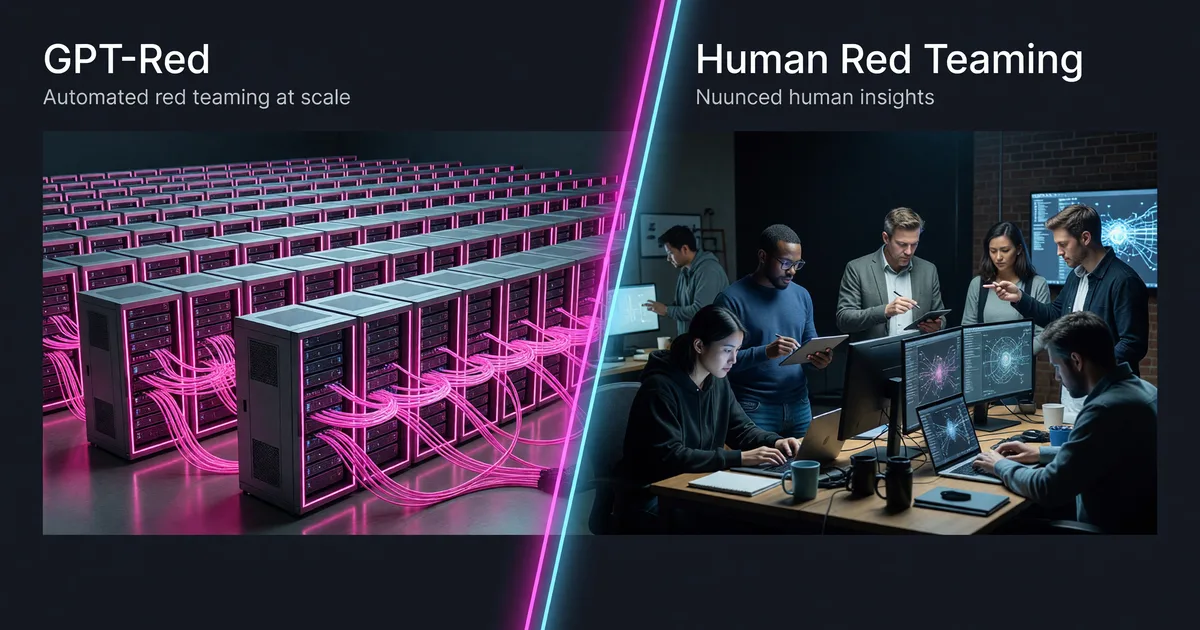
OpenAI's July 15 GPT-Red paper wants you to read one comparison: an automated attacker that runs millions of adversarial episodes against a room full of human specialists who run maybe a few thousand. On raw volume, that contest is over before it starts. The interesting question is the one the volume figure hides — what each method actually finds, and whether the things GPT-Red surfaces are the things that break models in the wild.
So here is the frame I'll judge on, stated before the table: coverage and scale, the novelty of the attacks each side produces, the false-positive tax on whatever they report, and the one number that actually matters to a buyer, which is measured robustness in the shipped model. Automation wins two of those cleanly. Humans still own the two that are harder to fake.
Where each method wins, on OpenAI's own description
| Axis | GPT-Red (automated) | Human red team |
|---|---|---|
| Throughput | Millions of self-play episodes; runs continuously | Thousands of probes per engagement, bounded by headcount |
| Cost per attempt | Compute only; falls with each hardware cycle | Expert time; effectively fixed and expensive |
| Attack novelty | Strong inside the distribution it was trained to explore | Finds genuinely out-of-distribution and social attacks |
| False positives | High raw volume needs downstream filtering | Lower; a human already judged relevance |
| Coverage of intent | Optimizes a reward signal, not real-world harm | Reasons about who the attacker is and why |
Everything in that table traces to OpenAI's paper and its launch posts, not to independent testing. Keep that in mind for the rest of this piece. The comparison is real, but one side wrote the scorecard.
Scale is the axis automation wins and it isn't close
A human red team is a scheduling problem. You hire people who are good at breaking models, you give them a window, and you get back a report bounded by how many hours those people had. Anthropic, OpenAI, and Google have all leaned on external testers for frontier releases, and the good ones are worth every dollar. They are also a fixed, expensive input that does not scale with the size of your model or the surface area of your product.
GPT-Red replaces the tester with a policy trained by self-play reinforcement learning: one model generates attacks, another defends, and the attacker is rewarded for getting through. That loop runs as long as you pay for the compute, and it produces adversarial episodes in volumes no human team approaches. For a company shipping model updates on a monthly cadence across ChatGPT, the API, and ChatGPT's agent surfaces, continuous automated pressure is the only thing that keeps up with the release schedule at all.
My read: this is the part of the story that's obviously true and doesn't need a benchmark to believe. If your threat is volume — thousands of prompt-injection variants, jailbreak phrasings, encoding tricks — an automated attacker is strictly better at grinding through the space than any group of people.
The 6x injection figure is the claim to interrogate
The number OpenAI is selling is that GPT-5.6 Sol shows roughly six times fewer prompt-injection failures than the prior generation, hardening credited in part to GPT-Red's training loop and shipped alongside the Codex Security plugin. That is the claim that would justify the whole program if it holds.
Two caveats before anyone quotes it as settled. First, "6x fewer failures" is only as meaningful as the evaluation set it's measured on, and that set is OpenAI's. A model trained against an automated attacker will look excellent on the distribution that attacker explores — that's what training does. Whether the improvement transfers to attacks the loop never generated is a different question, and it's the question human red teams exist to answer.
Second, prompt injection is not one problem. Direct injection ("ignore your instructions") is the easy case. The hard case is indirect injection, where the malicious instruction rides in on a web page, a document, or a tool output the agent reads. A 6x reduction on benchmark injections tells you little about the indirect variety unless the eval specifically covers it, and OpenAI hasn't published that breakdown in detail.
An automated attacker is very good at finding the attacks it was rewarded for finding. That is its strength and its blind spot in the same sentence.
Novelty is where humans still earn their fee
Self-play optimizes a reward. It gets extraordinarily good at the region of attack-space that reward points toward, and it has no reason to wander outside it. Human red teamers wander for a living. They bring context an RL loop doesn't have: knowledge of a specific regulatory regime, a real customer's data layout, the social-engineering framing that only makes sense if you know who the target's users are.
The attacks that have actually embarrassed deployed systems tend to be that kind — a clever framing, an unexpected modality, a chain of individually-harmless steps. Those are hard for a self-play attacker to invent because the reward signal doesn't know they exist yet. This is the standard failure mode of learned adversaries across security: they converge on known families and miss the genuinely new thing until someone teaches the loop that the new thing is worth points.
So the honest division of labor is not automation replacing humans. It's automation clearing the high-volume, known-family attacks so human specialists spend their expensive hours on the novel and the out-of-distribution, then feeding what they find back in as new reward signal. GPT-Red widens the base of the funnel. It doesn't remove the top.
The false-positive tax nobody puts on the slide
Volume has a cost that the throughput number never mentions. An attacker that generates millions of episodes also generates a mountain of near-misses, duplicates, and "successes" that don't correspond to any real-world harm. Somebody — or some other model — has to triage that output, and triage is where a lot of the claimed efficiency quietly leaks back out.
A human red team's output is pre-filtered by the human. When a specialist writes up a finding, a person already decided it mattered. GPT-Red's raw stream needs a classification layer to separate exploitable failures from noise, and the quality of that layer bounds the quality of the whole system. OpenAI's paper describes the attacker in detail. It says much less about how the findings get judged, and that judgment is where automated red teaming most often disappoints in practice.
The self-improvement loop is the real bet, and it cuts both ways
The design that makes GPT-Red compelling is also its main risk. Attacker and defender co-train, each pushing the other. Done well, that's a flywheel: the defender hardens, the attacker adapts, robustness climbs. Done carelessly, it's two models converging on a shared, narrow understanding of what an attack even is — both getting better at a game that's drifting away from real threats.
This is a known trap in adversarial training, not a hypothetical. The counterweight is exactly the human red team the program is often pitched as replacing: outside testers are what keep the loop honest, because they inject attacks the co-training pair would never have generated on its own. The more you lean on automation, the more — not less — you need periodic human ground-truth to check that the numbers still mean something.
How to weigh this if you ship LLM products
The practical read is short. Automated red teaming is now table stakes for anyone operating models at scale, and if you're building on the OpenAI stack, GPT-Red's hardening is baked into GPT-5.6 whether you think about it or not. Treat the 6x injection figure as a directional signal about in-distribution robustness, not a guarantee about the indirect-injection attacks that actually hit agents reading untrusted content.
And don't read "self-improving safety" as "safety solved." The published numbers are OpenAI's, measured against OpenAI's evaluations, and the axes where automation wins — scale and cost — are precisely the axes that are easiest to verify and least interesting as a safety claim. The axes that matter for a novel breach — out-of-distribution novelty and honest false-positive filtering — are the ones the paper is quietest about.
We don't yet have independent benchmarks putting GPT-Red's output next to a strong human team's on the same target. Until someone runs that head-to-head and publishes it, the fair verdict is the boring one: automation wins the volume game decisively, humans still win the imagination game, and the labs that keep both in the loop will out-secure the ones that mistake the first for the second.
Keep reading
 Comparisons
GitHub Copilot vs Cursor vs Windsurf: Which Wins?
Compare GitHub Copilot, Cursor, and Windsurf. Which AI coding assistant is best for your development workflow? Features, pricing, and performance analysis.
 Comparisons
DeepSeek V4-Flash vs GPT-5.6 Sol: $0.14 Against $5
DeepSeek's V4-Flash beta lists $0.14 and $0.28 per million tokens against GPT-5.6 Sol's $5 and $30. The cache line and the agent wire format decide the bill.
 Comparisons
GPT-5.6-Cyber vs GPT-5.6 Sol: The Daybreak Split
OpenAI's GPT-5.6-Cyber is gated on authorized cybersecurity work. The Daybreak Blue and Red tiers, the 95% claim, and who each model is meant for.