Anthropic's J-Space: Claude's Hidden Workspace
Anthropic's July 2026 paper describes J-space, a small internal workspace inside Claude — what it is and why it matters for AI safety.
On July 6, 2026, Anthropic published interpretability research describing what it calls J-space: a small, low-dimensional internal workspace inside Claude models that appears to broker information between the model's silent internal computation and the tokens it actually reports back to you. The announcement went out from @AnthropicAI on X, with the full write-up on transformer-circuits.pub and follow-on coverage from VentureBeat, Firstpost and others within a day.
If you only read the headlines, you'd think Anthropic found a seat of consciousness in Claude. It didn't — and the company was careful to say so. But the actual finding is more interesting than the hype, and it has real consequences for how we monitor these systems.
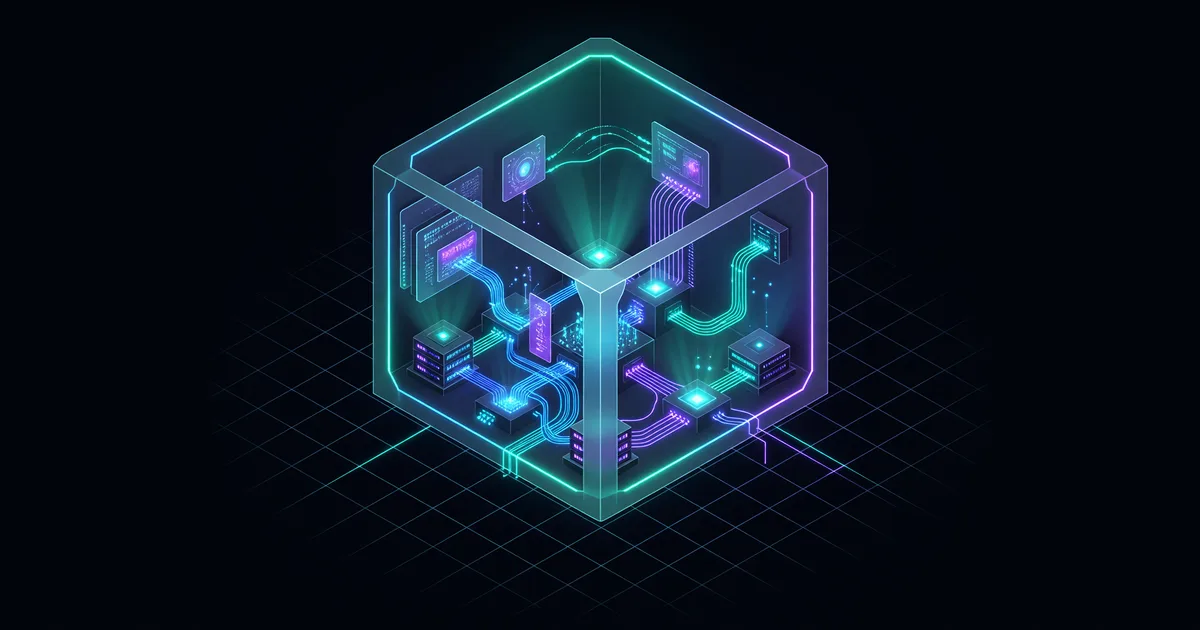
The short version: Anthropic describes a compact region of Claude's internal representation that behaves like a coordination hub. Some information passes through it and becomes reportable — it surfaces in what the model says. Other computation happens off to the side and never reaches the page. That distinction between what a model computes and what it can report is the whole ballgame for safety, which is why this paper is drawing attention beyond the usual interpretability crowd.
What J-space actually is
Frontier language models compute in enormously high-dimensional spaces — a single residual stream carries thousands of dimensions per token, layer after layer. Anthropic's core claim is that a surprisingly large share of the behavior that governs a model's outputs can be captured inside a much smaller subspace. That subspace is J-space.
The "J" comes from the Jacobian — the matrix of partial derivatives that describes how a small change in one part of the model's internal state propagates to changes in another. If you want to know which internal directions actually influence what the model will say next, the Jacobian is the mathematically honest way to ask. Anthropic's "Jacobian lens" uses this to identify the directions along which internal state most strongly drives the reportable output, then projects the model's activity into that reduced space.
My read: the framing matters here. Anthropic isn't claiming it found a literal room inside Claude with thoughts written on a whiteboard. J-space is a measured subspace — the set of internal directions that demonstrably move the output — not a hand-picked feature. That's a more defensible claim than "we found the model's inner monologue," and it's why the paper leans on the calculus rather than on vibes.
The global-workspace parallel — and its limits
The reason this landed on tech front pages instead of staying in an interpretability Slack is the analogy Anthropic draws to global workspace theory, one of the leading scientific accounts of human consciousness. In that theory, most brain processing is local and unconscious; a limited "global workspace" broadcasts a small selection of information widely, and that broadcast content is roughly what we experience and can report.
J-space rhymes with that structure. A lot of Claude's computation stays local and never surfaces. A narrow workspace carries the subset that becomes reportable. The parallel is genuinely striking, and Anthropic uses it deliberately.
The honest take: an architectural analogy is not evidence of consciousness, and Anthropic does not claim it is. That two systems share a hub-and-broadcast shape tells you something about information flow, not about subjective experience. Treat anyone who jumps from "J-space resembles a global workspace" to "Claude is conscious" as skipping several very large steps that no one has demonstrated.
What the parallel does buy you is a vocabulary. If there's a measurable channel that separates "computed silently" from "reported aloud," you can start asking engineering questions about it — which is where safety comes in.
Why this matters for AI safety
The most important safety problem in large models is that their explanations of themselves aren't guaranteed to be true. A model can produce a chain-of-thought that looks like faithful reasoning while the real computation driving its answer happened elsewhere. Anthropic's own earlier work on unfaithful reasoning documented exactly this gap. If you're monitoring a model by reading what it says, and what it says isn't causally connected to what it did, your monitoring is theater.
J-space speaks directly to that problem. If Anthropic can identify the subspace that actually gates reportable output, then:
- You can check whether a stated reason is load-bearing. Does the reasoning the model reports actually pass through the workspace that drives its answer, or is it a post-hoc narrative running on a side channel?
- You can look for computation that never gets reported. The scarier failure mode isn't a model that lies in its chain-of-thought — it's a model doing consequential computation that never surfaces at all. A measured workspace gives you a place to watch for that gap.
- You get an intervention point. A low-dimensional subspace is something you can probe, steer, and monitor at scale far more cheaply than the full activation tensor.
That last point is the underappreciated one. Interpretability has long had a tractability problem: the models are too big to inspect exhaustively, so researchers chase individual features and circuits. A compact workspace that captures a disproportionate share of output-relevant behavior is exactly the kind of handle that could make monitoring economically feasible instead of a science project.
How the Jacobian lens differs from earlier tools
Anthropic's interpretability program has produced a string of techniques over the past two years — sparse autoencoders and dictionary learning to pull interpretable features out of activations, attribution graphs to trace how features connect, and steering experiments that push models along discovered directions. The Jacobian lens is a different cut at the problem.
| Approach | What it surfaces | Core question |
|---|---|---|
| Sparse autoencoders / dictionary learning | Interpretable features hidden in activations | "What concepts is the model representing?" |
| Attribution / circuit tracing | How features connect into computations | "How does the model get from input to output?" |
| Jacobian lens (J-space) | The subspace that drives reportable output | "Which internal directions actually change what it says?" |
The shift is from cataloguing what is represented to measuring what has causal influence on the output. Features can exist in a model without mattering for a given response; the Jacobian filters for the ones that move the needle. That's a cleaner definition of "reportable" than prior work offered, because it's grounded in derivatives rather than in a researcher deciding a feature looks important.
What we don't know yet
A few honest caveats, because the coverage has run ahead of the evidence:
- Which models, and how general. The public write-up is a research paper, not a product-wide claim. How consistently J-space appears across model sizes and Claude versions — and whether the same structure holds in non-Anthropic models — isn't something you should assume from the announcement alone.
- How complete the capture is. "A large fraction of output-relevant behavior lives in a small subspace" is a strong claim whose usefulness depends entirely on the numbers. The exact fraction, and what leaks outside the workspace, is where the real safety value lives. Read the paper's measurements before trusting any round-number summary you see quoted secondhand.
- Whether it survives adversarial pressure. A monitoring channel is only useful if a capable model can't route around it. Nothing in an initial paper tells you whether a model optimized against workspace-based monitoring would simply learn to do its consequential computation elsewhere. That's the question that decides whether J-space is a durable safety tool or a temporary one.
- Consciousness. To be blunt: this paper is not about that, cannot settle that, and Anthropic did not claim it. Any headline that says otherwise is selling clicks.
Why Anthropic published this now
The strategic context matters here. Anthropic has spent 2026 leaning hard into interpretability and safety as its differentiator — the Mythos cyber-defense work, the Glasswing vulnerability findings, the public research cadence out of its interpretability team. J-space fits that pattern: a legible, mechanistic story about seeing inside the model, released openly, at a moment when regulators and enterprise buyers are asking pointed questions about whether anyone actually understands what these systems are doing.
I think that framing tells you more about why this is a big announcement than the neuroscience does. "We found a measurable workspace that lets us monitor what the model reports versus what it hides" is a sentence Anthropic wants government and enterprise customers to hear. It's a safety-as-product-moat play, and it's a smart one — provided the follow-up research holds up.
The bottom line
Strip away the consciousness headlines and J-space is a concrete interpretability result: Anthropic used a Jacobian-based lens to identify a compact internal subspace in Claude that gates what the model reports, and it noticed that the structure resembles global workspace theory. The neuroscience parallel is the hook; the safety implication is the substance.
If it generalizes — and that "if" is doing a lot of work until independent replication and more measurements land — it's a genuinely useful handle for the hardest problem in model monitoring: telling the difference between a model that's explaining itself and a model that's performing an explanation. That's worth watching. Just don't let anyone tell you Anthropic found Claude's soul. It found a subspace, and a subspace is plenty interesting on its own.
Want the technical version? We've published a full paper review — methodology, quantitative findings, limitations, and the open questions: The Jacobian Lens: Inside Anthropic's J-Space Paper.
Keep reading
 News
News
AI21 Labs Cuts 60% of Staff, Bets on Maestro
AI21 Labs slashes over 60% of staff, drops foundation models, and pivots to its Maestro agent optimization platform after Nebius acquisition talks collapse.
 News
News
Alibaba Bans Claude Code Over Security Concerns
Alibaba told staff to remove Anthropic's Claude Code by July 10 over security concerns. Here's what triggered the ban and what it signals.
 News
News
Anthropic Acquires Stainless: What It Means for AI
Anthropic bought Stainless, the SDK generator behind OpenAI and Cloudflare's client libraries. Here's the strategic play for AI agents.