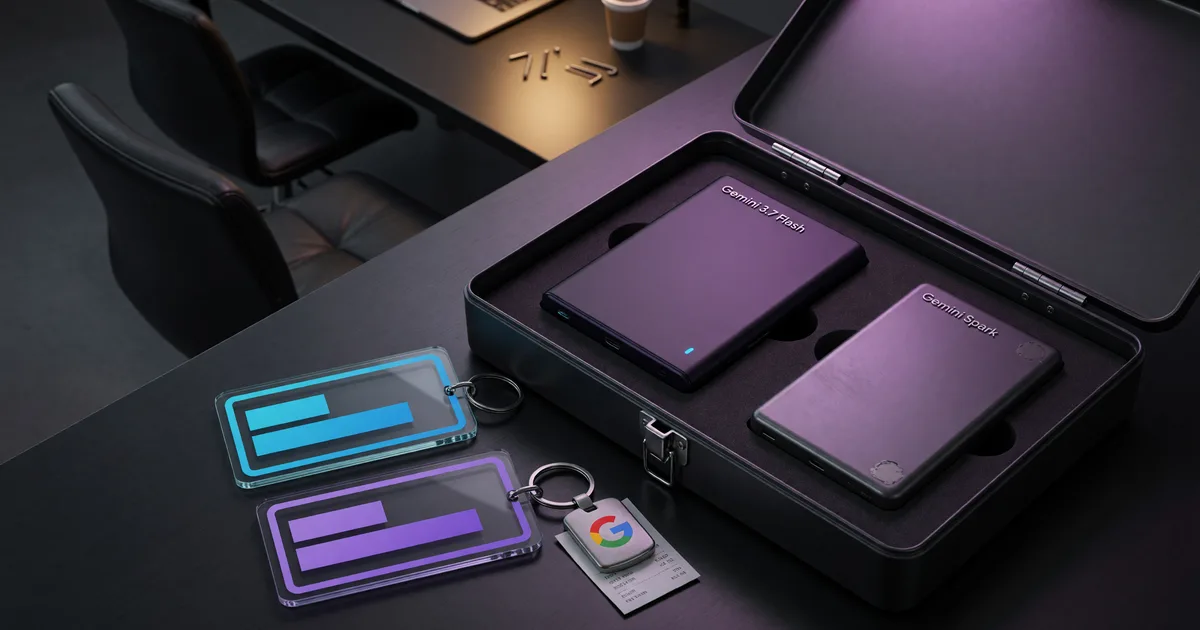
Gemini 3.7 Flash: What Shipped and What It Costs
Google launched Gemini 3.7 Flash on August 13. Intro API price is $0.75/$3.75 per 1M tokens through December 31, 2026, then $1.50/$7.50.
Introductory API pricing is the first fact worth writing down: $0.75 per million input tokens and $3.75 per million output tokens for Gemini 3.7 Flash.
Tulsee Doshi, Senior Director of Product Management, writing on behalf of the Gemini team in Google's August 13 Keyword post, calls the model "our most intelligent workhorse model yet for coding and agents." The same post places the drop three weeks after Gemini 3.6 Flash and sets the intro rate at half the original 3.6 Flash cost per million tokens.
GitHub's August 13 changelog uses the line "Gemini 3.7 Flash is now available in GitHub Copilot." That confirmation sits outside Google's own blog, and it is how a lot of working developers will meet the model without opening AI Studio.
Treat the ship as three separate claims: a model ID behind surfaces you already use, a pair of dated token prices, and a vendor-cited eval table against 3.6 Flash. Mix those together and the launch reads like a new product. Keep them apart and you can decide what to turn on this week.
3.7 Flash is a model ID behind five existing surfaces
Nothing here is a new consumer app. Doshi's post lists the places you can already reach the model: the Gemini API through Google AI Studio, Android Studio, Google Antigravity, Gemini Enterprise, and Gemini Spark for Google AI Pro and Ultra subscribers.
You pick 3.7 Flash the way you pick any other Gemini model. The agent loop, the IDE, or the Workspace session you already have stays in place. The new piece is the weights behind that picker.
Doshi writes that 3.7 Flash "better adapts to roadblocks, clarifies intent when needed, and follows instructions with greater fidelity." The same paragraph says the model "thinks more diligently, putting in more effort into multi-step planning and tool calls." Google is describing execution style: more planning, more tool calls, fewer retries, less manual oversight across engineering workflows. Those sentences are the vendor's claim about how the model spends its tokens, not a third-party latency or retry study.
Spark is the consumer agent surface. Google launched it at I/O as a personal agent that runs 24/7 and takes action under your direction. Starting August 13, Spark uses 3.7 Flash. The launch post says the swap makes Spark more efficient for knowledge work, with improved tool use for Google Workspace apps. Doshi names consolidating files, drafting emails, and updating status documents as the jobs Spark can now finish more efficiently.
Spark is available to Google AI Pro and Ultra subscribers in more than 160 countries. The help article Google links from the post excludes the European Economic Area, Nigeria, Switzerland, and the United Kingdom. If you live in one of those four, Spark is not the on-ramp. The API, Android Studio, Antigravity, and Gemini Enterprise still are, per the same "Try it today" list.
A model card shipped on day one. The launch post also says 3.7 Flash ships with updated Frontier Safety safeguards against misuse in chemical, biological, radiological, and nuclear work and in cyber offense, while still allowing beneficial use, in line with DeepMind's bioresilience and cyber programs. Read that as a safety claim from the vendor, published with the model, not as an outside audit.
Google's own demos on the launch page stay inside that same story: a text prompt turned into a playable 3D game with Nano Banana generating characters and textures, landing pages orchestrated with Gemini Omni, a robotics training loop, and a static PDF turned into a page with live charts. They are Google's illustrations of coding, agents, and document work. They are not a substitute for the eval table or the price footnote.
Google's cited scores beat 3.6 Flash on FrontierCode and DeepSWE
Every number below comes from the August 13 Keyword post. Google published the 3.7 versus 3.6 Flash pairing. Nobody at this site re-ran the harnesses.
| Eval | What Google says it measures | 3.7 Flash | 3.6 Flash |
|---|---|---|---|
| FrontierCode 1.1 Main | Production-ready code | 43.6% | 34.4% |
| DeepSWE v1.1 | Long-horizon software engineering | 65.3% | 49.0% |
| WebDev Arena Elo | Web development, via Arena.ai | 1588 | 1538 |
| GDP.pdf | Complex document comprehension | 34.0% | 22.0% |
| AutomationBench | Real-world business workflows | 30.4% | 17.0% |
On coding, Doshi's post says 3.7 Flash shows strong gains over 3.6 Flash in debugging and issue resolution, plus higher first-pass code accuracy. FrontierCode 1.1 Main is the production-code number Google highlights: 43.6% against 34.4% on 3.6 Flash. DeepSWE v1.1 is the long-horizon software-engineering number: 65.3% against 49.0%. Both jumps are the size of a routing change if they survive contact with your own repos.
On web work, the post says 3.7 Flash generates more functional layouts and feature-complete apps in fewer prompts, and that it follows a screenshot, an image, or a full design system. The public score attached to that claim is Arena.ai's WebDev Arena Elo: 1588 versus 1538.
On documents and office automation, GDP.pdf is listed at 34.0% versus 22.0%, described as an eval of a model's ability to process complex documents in fields such as finance, law, and biosciences. AutomationBench, which Zapier published as a workflow eval, is listed at 30.4% versus 17.0%.
The deltas are large enough to change a default if they hold on an internal mix. They remain vendor-cited pairings from a launch post. A team that already compares ChatGPT and Grok on a private eval should drop 3.7 Flash into that same harness and keep the Keyword table as context, not as a purchase order.
Intro token price is $0.75 in and $3.75 out through 2026
Put the dated price in a spreadsheet before you argue about Elo.
Through the end of 2026, the introductory Gemini API rate is $0.75 per 1 million input tokens and $3.75 per 1 million output tokens. A footnote on the same post is explicit: introductory pricing expires on December 31, 2026. Starting January 1, 2027, $1.50 per 1 million input tokens and $7.50 per 1 million output tokens apply.
Doshi's post describes the intro rate as half the original 3.6 Flash cost per million tokens. The January 2027 rate is exactly double the intro rate on both input and output. Output is five times input during both windows ($3.75 against $0.75 now, $7.50 against $1.50 later), so a coding or agent job that writes a lot of tokens feels the output line first.
The launch post does not publish a free-token allotment for 3.7 Flash specifically. Anyone building a cost model should use the two dated API rows, $0.75 / $3.75 now and $1.50 / $7.50 after December 31, and treat January 1, 2027 as the day the bill doubles.
Spark is not a separate Flash SKU. Google lists it as included with Google AI Pro and Ultra in supported countries. Copilot availability is the GitHub changelog line, not an API price. Use the $0.75 / $3.75 rows only for Gemini API traffic. Use the subscription you already pay for Spark or Copilot.
Turn 3.7 Flash on in the API, Spark, or Copilot
Three on-ramps cover almost everyone who will use this model this month.
Gemini API: Open Google AI Studio, select gemini-3.7-flash, and call it the way you already call Flash. Android Studio and Google Antigravity are the other developer surfaces on Doshi's list. Enterprises get the same model through the Gemini Enterprise Agent Platform and the Gemini Enterprise app.
Spark: If you already pay for Google AI Pro or Ultra and you are outside the EEA, Nigeria, Switzerland, and the United Kingdom, Spark is using 3.7 Flash as of August 13. No extra model purchase. Open the Gemini app, use Spark, and 3.7 Flash is already running under that agent.
GitHub Copilot: GitHub's August 13 changelog lists 3.7 Flash as available in Copilot. If Copilot is already in your workflow, that is the same-day on-ramp that does not go through AI Studio.
Pick the surface you already pay for, set the model to 3.7 Flash, and start a job there today.
Keep reading
 News
News
Gemini 3.5 Flash Cyber: What Shipped, Pricing & Who It's For
Google says Gemini 3.5 Flash Cyber patched 61 open-source vulnerabilities in a pilot. What that number counts, what it leaves out, and who can use it.
 News
News
Gemini 3.5 Flash: Google's Agentic Model Explained
Google built Gemini 3.5 Flash specifically for autonomous agent workflows. Here's what the model does differently and why developers should care.
 Guides
Google Gemini 2.5: Everything You Need to Know
Complete guide to Google Gemini 2.5. Learn what's new, key features, how it compares to previous versions, pricing, and who it's best for.