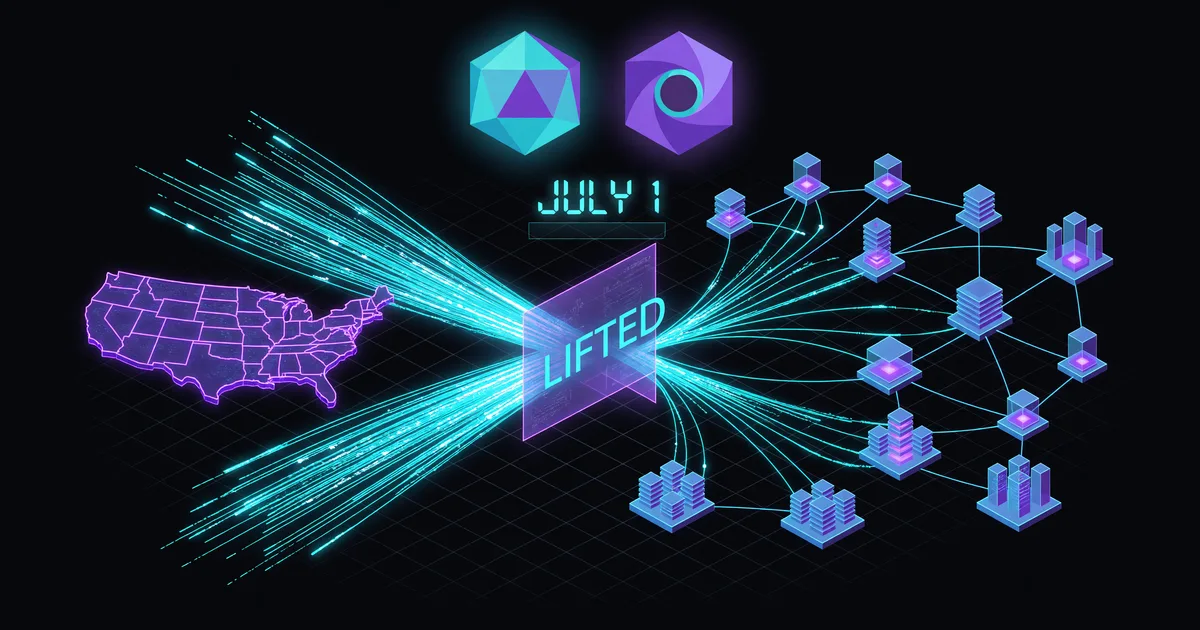
Claude Fable 5 Returns as Export Controls Lift
Anthropic restores global access to Claude Fable 5 and Mythos 5 on July 1 after the US lifted an 18-day export block. Here's what changed.
Anthropic turned Claude Fable 5 back on for the rest of the world today. As of July 1, 2026, both Fable 5 — Anthropic's flagship frontier model — and Mythos 5, its specialized cyber-capable sibling, are available again outside the US after the Department of Commerce lifted the export restrictions it imposed in mid-June. The suspension lasted 18 days. Anthropic confirmed the redeployment in a post titled "Redeploying Fable 5," and the news was picked up quickly by The Guardian and Al Jazeera.
If you've been reading this site, you already know the backstory. We covered the ban itself when it landed, and the separate Mythos 5 cyber-model block that ran on the same track. This post is about the other side of that arc: what it actually took to switch the models back on, what Anthropic says it changed, and what the whole episode tells you about how frontier AI now ships under a government's thumb.
The timeline, briefly
Here's the compressed version for anyone catching up:
- Mid-June 2026: The Commerce Department imposes export restrictions covering Fable 5 and Mythos 5, effectively pulling them from general international availability. Anthropic complies and suspends non-US access.
- The 18-day gap: International users lose direct access to the two newest models. Existing lower-tier Claude models remain available; the block is scoped to the frontier tier.
- July 1, 2026: Commerce lifts the restrictions. Anthropic publishes "Redeploying Fable 5" and restores global access, paired with a set of safety changes it says were built for the redeployment.
That's an unusually short regulatory round-trip. Export actions on hardware — the GPU rules that have dominated the last few years — tend to grind on for months. An 18-day suspension-and-restore on a model is a different kind of event, and the speed is part of the story.
What Anthropic says it changed for the redeployment
Anthropic didn't just flip the same binary back on. Its redeployment note frames the return around additional safety measures implemented before the models went back out globally. As of writing, the company has described these at a high level rather than publishing a full technical breakdown, so I'll be precise about the line between what's stated and what's inferred.
What's stated: Anthropic positions Fable 5 and Mythos 5 as returning under a strengthened safety posture — the redeployment is explicitly a "safer version goes back out," not "the pause simply ended." Mythos 5 is the more sensitive of the two because of its cyber capabilities, which is exactly why it drew a dedicated block in the first place.
What we don't yet know: Anthropic hasn't published a delta — no side-by-side of the pre-suspension and post-suspension model cards, no benchmark table showing capability held constant while guardrails tightened. Until that lands, "we made it safer" is a claim I'd treat as directional, not measured. If you're deploying Mythos 5 for security work, the honest answer is that you should wait for the updated documentation before assuming behavior is identical to the June release.
My read: the fact that the restrictions came off in 18 days, rather than being litigated for a quarter, suggests this was resolved through a negotiated safety commitment more than a legal reversal. The model came back because Anthropic gave Commerce something to point to.
Why a model — not a chip — got export-controlled
This is the part worth sitting with. Export controls were built for physical goods and, more recently, for the advanced chips that train frontier systems. Applying them to the weights and access of a specific model is a newer move, and Fable 5 / Mythos 5 is one of the cleaner test cases of it to date.
The logic runs like this: if a model can materially accelerate offensive cyber operations — which is the whole premise of a "Mythos"-class system — then unrestricted global API access is itself a proliferation vector. You don't need to smuggle a GPU across a border if you can hit an endpoint. That reframes a hosted model as something closer to a dual-use technology, and dual-use technologies are what export control regimes exist to govern.
The catch is that a hosted model isn't a chip. It can be updated, gated, geofenced, and rate-limited server-side in ways a shipped H-series card cannot. That flexibility is probably why the block could be both imposed and lifted so fast: the "export" here is a permission setting, not a container on a ship.
Industry framework proposals: the real subtext
The more interesting thread underneath the headline is governance. An episode like this — sudden block, negotiated fix, fast restore — is the kind of thing that pushes labs and regulators toward a standing framework instead of one-off interventions. Nobody at a frontier lab wants their flagship yanked from half the planet on 18 days' notice with no playbook; nobody at Commerce wants to improvise capability thresholds under deadline pressure.
What a durable framework would need to specify:
- Capability thresholds that trigger review — ideally measurable (specific eval scores on offensive-cyber or bio tasks) rather than vibes.
- Geographic scoping — who's actually restricted, and whether allied nations are carved out by default.
- A redeployment path — the concrete safety bar a model has to clear to come back, so a suspension has a defined off-ramp instead of being open-ended.
- Notice and continuity — how much warning users get, and what happens to workloads mid-flight.
The Fable 5 case gives all four of those a data point. I'd expect it to be cited heavily the next time this comes up — and given the pace of frontier releases, "next time" is measured in weeks, not years.
What users can expect now vs. during the suspension
Practically, here's the before-and-after for anyone building on these models:
| Aspect | During the block (mid-June → June 30) | After redeployment (July 1 on) |
|---|---|---|
| Fable 5 access outside US | Suspended | Restored |
| Mythos 5 access outside US | Suspended | Restored, under strengthened safety measures |
| Older Claude tiers | Available | Available |
| Documentation | Prior model cards | Expect updated safety docs to follow |
If you shifted production workloads to an older Claude tier — or to a competitor like Gemini or Grok — during the gap, the migration back isn't automatic. A few things to check before you flip traffic:
- Behavioral drift. If Anthropic tightened guardrails, some prompts that passed in early June may now be refused or handled differently. Re-run your eval suite before assuming parity.
- Regional availability. "Global" restore doesn't always mean literally every jurisdiction on day one. Confirm your specific region is live rather than assuming.
- Contractual language. If your terms reference a specific model version, the redeployed build may carry a new identifier or updated usage policy. Read the fine print.
The honest take
The reassuring reading of this is that the system worked: a capability concern surfaced, access paused, safety got a second look, and the model came back in 18 days. The uncomfortable reading is that a single government's decision took a frontier model offline for most of the world's users on short notice — and could do it again tomorrow. Both are true.
What this really underscores is a shift we've been tracking across the site: frontier AI is no longer a pure product story. It's a product story wrapped in an export-control story wrapped in a geopolitics story. When your model can be classified as dual-use, your release schedule stops being entirely yours. Anthropic — a company that has leaned harder into safety framing than any of its rivals — is arguably better positioned to navigate that than most. The redeployment note reads like a company that would rather be the one writing the framework than the one getting frameworks imposed on it.
The open question, and I don't think anyone can answer it cleanly yet, is whether the next suspension resolves in 18 days or 18 weeks — and whether the model on the other side is still the one you built against. Until Anthropic publishes the redeployment safety delta, treat Fable 5 and Mythos 5 as "back, and probably a little different." Verify before you trust it in production.
Bottom line
Claude Fable 5 and Mythos 5 are available globally again as of July 1, 2026, after an 18-day US export block was lifted and Anthropic redeployed with added safety measures. The models are back; the precedent is the part that sticks. Re-validate your integrations, watch for the updated documentation, and assume that "a frontier model can be switched off by policy" is now a permanent line item in your risk register — not a one-time anomaly.
Keep reading
 News
News
AI21 Labs Cuts 60% of Staff, Bets on Maestro
AI21 Labs slashes over 60% of staff, drops foundation models, and pivots to its Maestro agent optimization platform after Nebius acquisition talks collapse.
 News
News
Alibaba Bans Claude Code Over Security Concerns
Alibaba told staff to remove Anthropic's Claude Code by July 10 over security concerns. Here's what triggered the ban and what it signals.
 News
News
Anthropic Acquires Stainless: What It Means for AI
Anthropic bought Stainless, the SDK generator behind OpenAI and Cloudflare's client libraries. Here's the strategic play for AI agents.