Paperguide
An all-in-one AI research assistant that searches 200M+ academic papers to run literature reviews, manage citations, write drafts, and chat with PDFs.
Updated 2026-06-27
Yes, within limits. Paperguide runs a free tier with paid plans above it.
Listed pricing: Free tier + Plus ~$12/mo, Pro ~$24/mo (billed annually).
Overview
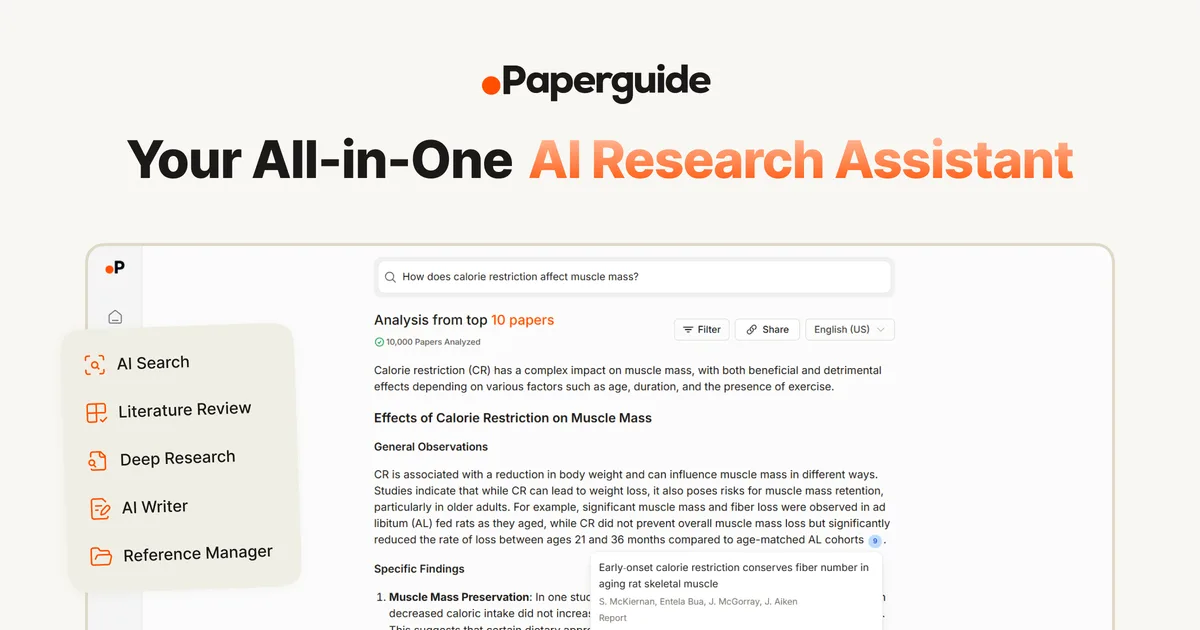
Paperguide is an AI research assistant that bundles four jobs most academics currently spread across separate tools: searching the literature, reviewing it, managing references, and writing it up. Its search runs over a corpus the company puts at 200M+ academic papers, and on top of that it layers automated literature reviews, longer "deep research" reports, a citation-grounded reference manager, an AI academic writer, and a chat-with-PDF reader.
It's aimed at researchers, grad students, and anyone writing a thesis or systematic review who is tired of stitching together Elicit for discovery, Zotero for references, and a separate model for drafting. Paperguide's pitch is that those steps live in one workspace — you find papers, extract findings into a review matrix, save them to a library, and pull citations straight into a draft without leaving the app. The company claims adoption across 1,000+ researchers and universities.
What distinguishes it from the single-purpose research tools already in this space is breadth rather than depth. Elicit and Consensus are sharper at structured evidence synthesis, and Scite is the authority on citation context; Paperguide instead tries to be the whole pipeline. That's a real convenience if you want one subscription, but it also means each feature competes against a specialist. The reference manager and AI writer in particular are the parts you should evaluate hardest before switching off an established workflow.
Is Paperguide free?
Yes, within limits. Paperguide runs a free tier with paid plans above it.
What the free tier covers: Free plan with limited monthly AI credits and around 20 searches — enough to test discovery and chat-with-PDF before paying.
Listed pricing: Free tier + Plus ~$12/mo, Pro ~$24/mo (billed annually).
Pricing on this page has not been re-verified. The entry was last edited on , and no separate pricing check has been run since. Treat the figures as a record of what was published then and confirm on the official site.
What the free tier leaves out
Read straight off the plan list below. Vendors move features between tiers, so check the current split before you pay.
- Plus ~$12/mo (billed annually) Higher AI credit allowance, literature review tools, and reference management for regular individual use.
- Pro ~$24/mo (billed annually) Largest credit allowance plus deep-research reports and the full writing toolkit for heavy users.
- Enterprise Custom Team and institutional plans; contact sales. A 40% student discount is offered on paid tiers.
Paperguide pricing
| Plan | Price | What's included |
|---|---|---|
| Free | $0 | Limited monthly AI credits and roughly 20 searches; enough to evaluate the core search and chat features. |
| Plus | ~$12/mo (billed annually) | Higher AI credit allowance, literature review tools, and reference management for regular individual use. |
| Pro | ~$24/mo (billed annually) | Largest credit allowance plus deep-research reports and the full writing toolkit for heavy users. |
| Enterprise | Custom | Team and institutional plans; contact sales. A 40% student discount is offered on paid tiers. |
Limited monthly AI credits and roughly 20 searches; enough to evaluate the core search and chat features.
Higher AI credit allowance, literature review tools, and reference management for regular individual use.
Largest credit allowance plus deep-research reports and the full writing toolkit for heavy users.
Team and institutional plans; contact sales. A 40% student discount is offered on paid tiers.
One plan carries no published number: Enterprise, recorded as “Custom”. Nothing is estimated in its place. The vendor's own pricing page is the only source for those figures.
Pricing on this page has not been re-verified. The entry was last edited on , and no separate pricing check has been run since. Treat the figures as a record of what was published then and confirm on the official site.
Is Paperguide worth it?
Worth it for Researchers, grad students, and thesis writers who want search, literature review, reference management, and AI drafting in one workspace.
You can test that on the free tier before paying anything. The recorded trade-offs are listed below, and any one of them can settle the question on its own.
The 8/10 AI Score is an editorial read of published capability, price and shipping pace. Nobody here has hands-on hours with Paperguide. How we verify.
Worth it if
The strengths recorded against this entry.
- Combines search, literature review, reference manager, and AI writing in one workspace instead of three separate subscriptions
- Search corpus claimed at 200M+ papers, broad enough to cover most fields
- Citations stay grounded to source papers, reducing the fabricated-reference problem common with general LLMs
- Generous-feeling free tier and a 40% student discount lower the barrier for academics
- Chat-with-PDF and deep-research reports speed up reading dense literature
Not worth it if
Any one of these blocks your use case.
- Jack-of-all-trades breadth means each feature competes with a sharper specialist — Elicit for extraction, Scite for citation context, Consensus for evidence
- Free tier's ~20 searches and limited credits run out fast for any serious review
- Best pricing requires annual billing; monthly rates are higher
- AI-written academic text still needs careful human verification — treat drafts and citations as a starting point, not final copy
What sets Paperguide apart
- Bundles search, literature review, reference manager, and writer in one app
- Searches a claimed 200M+ academic paper corpus
- Citations stay grounded to source papers, reducing fabrication
- Chat-with-PDF and deep-research reports speed reading dense literature
Key features
AI Paper Search
Searches a corpus the company puts at 200M+ academic papers using natural-language queries, surfacing relevant work without exact keyword matching. It's the discovery layer the rest of the tool builds on.
Automated Literature Review
Extracts findings, methods, and outcomes across multiple papers into a structured matrix, and can generate longer deep-research reports. This is the feature that most directly competes with Elicit's data-extraction tables.
Citation-Grounded Reference Manager
Stores papers in a library and inserts formatted citations into drafts, keeping references tied to source material. It aims to replace a separate Zotero or Mendeley step in the workflow.
AI Academic Writer & Chat-with-PDF
Drafts and rewrites academic text with citations pulled from your library, and lets you ask questions of any uploaded paper. Useful for summarizing dense PDFs and turning notes into prose.
How it compares
| Tool | Best for | Pricing | Score |
|---|---|---|---|
| Paperguide | Researchers, grad students, and thesis writers who want search, literature review, reference management, and AI drafting in one workspace. | Free tier + Plus ~$12/mo, Pro ~$24/mo (billed annually) | 8/10 |
| Perplexity AI vs Perplexity AI → | Knowledge workers and researchers who want cited, synthesized answers instead of a list of links to click through. | Freemium | 9.4/10 |
| NotebookLM vs NotebookLM → | Students, researchers, and professionals who need answers grounded strictly in the specific documents they upload. | Free | 9.1/10 |
| Inkling-Small vs Inkling-Small → | — | Free — open weights download; Tinker Playground access | 8.8/10 |


Compare head-to-head
Comparison explorer Put Paperguide up against any three tools Opens with Paperguide already loaded. Add up to three more from the full index and read pricing, features, pros and cons in one table. →Related reading
GPT-Live's one stream vs Gemini 3.8 Live
OpenAI's GPT-Live listens and speaks on one WebSocket. Google's Gemini 3.8 Live reasons while talking. Specs, prices, and who each model is for.
ChatGPT Finances Experian Soft Credit Check: What Shipped
U.S. Plus/Pro ChatGPT Finances can connect Experian for a soft-pull VantageScore 3.0. What OpenAI's Help Center says about setup, monthly updates, and what not to paste in chat.

Anthropic Traced More Than 23 Million Exchanges
Anthropic attributed more than 23 million exchanges to Moonshot between May and July in its September 2026 threat intelligence report.
Ready to try Paperguide?
Head to the official site to start with Paperguide — pricing and plans are listed above.
Visit Paperguide