Research · Head-to-head
Inkling-Small vs Paperguide
Inkling-Small vs Paperguide: pricing, features, and which to pick in 2026.
The verdict
Pick Inkling-Small if…
- →budget is the constraint
- →overall capability matters more than price (AI Score 8.8 vs 8)
- →you want our editor's pick for this category
Pick Paperguide if…
- →your primary use case is researchers, grad students, and thesis writers who want search, literature review, reference management, and ai drafting in one workspace.
- →you need: research, education, content-creation
Side-by-side specs
| Spec | Inkling-Small | Paperguide |
|---|---|---|
| Category | Research | Research |
| Pricing model | free | freemium |
| Headline pricing | Free — open weights download; Tinker Playground access | Free tier + Plus ~$12/mo, Pro ~$24/mo (billed annually) |
| Free tier | Yes — the weights themselves are free to download and run. Compute is the real cost. | Free plan with limited monthly AI credits and around 20 searches — enough to test discovery and chat-with-PDF before paying. |
| AI Score | 8.8/10 | 8/10 |
| Best for | — | Researchers, grad students, and thesis writers who want search, literature review, reference management, and AI drafting in one workspace. |
| Editor's pick | ✓ Yes | — |
| Use cases | — | research education content-creation |
| Date added | 2026-07-31 | 2026-06-27 |
Pros and cons

Inkling-Small
Research · free
Pros
- ✓Open weights on Hugging Face, so it can run fully offline for sensitive audio, documents, or code
- ✓12B active parameters keeps per-token inference cost near a mid-size dense model despite the 276B total
- ✓Audio and vision are native to the model rather than a separate encoder stage
- ✓1M-token context handles whole codebases or long document sets in one pass
- ✓Hosted Tinker Playground path for teams that want to evaluate before committing hardware
Cons
- ×"Free weights" is misleading on cost — serving 276B parameters requires enough VRAM to put local deployment out of reach for individuals and small teams
- ×The claim that it outperforms the larger Inkling comes from the lab's own launch benchmarks; independent third-party evaluations aren't in yet
- ×Released July 30, 2026, so tooling, quantizations, and community fine-tunes are still thin compared to established open-weights families
- ×It's a raw model, not a product — no chat app, no agent harness, no support contract unless you build or buy one
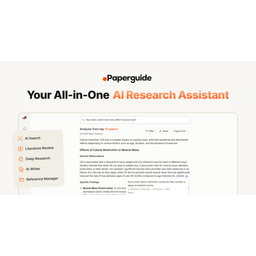
Paperguide
Research · freemium
Pros
- ✓Combines search, literature review, reference manager, and AI writing in one workspace instead of three separate subscriptions
- ✓Search corpus claimed at 200M+ papers, broad enough to cover most fields
- ✓Citations stay grounded to source papers, reducing the fabricated-reference problem common with general LLMs
- ✓Generous-feeling free tier and a 40% student discount lower the barrier for academics
- ✓Chat-with-PDF and deep-research reports speed up reading dense literature
Cons
- ×Jack-of-all-trades breadth means each feature competes with a sharper specialist — Elicit for extraction, Scite for citation context, Consensus for evidence
- ×Free tier's ~20 searches and limited credits run out fast for any serious review
- ×Best pricing requires annual billing; monthly rates are higher
- ×AI-written academic text still needs careful human verification — treat drafts and citations as a starting point, not final copy
Related comparisons
Updated 2026-07-31. Spec data sourced from official product pages and tracked in our public directory at /tools.