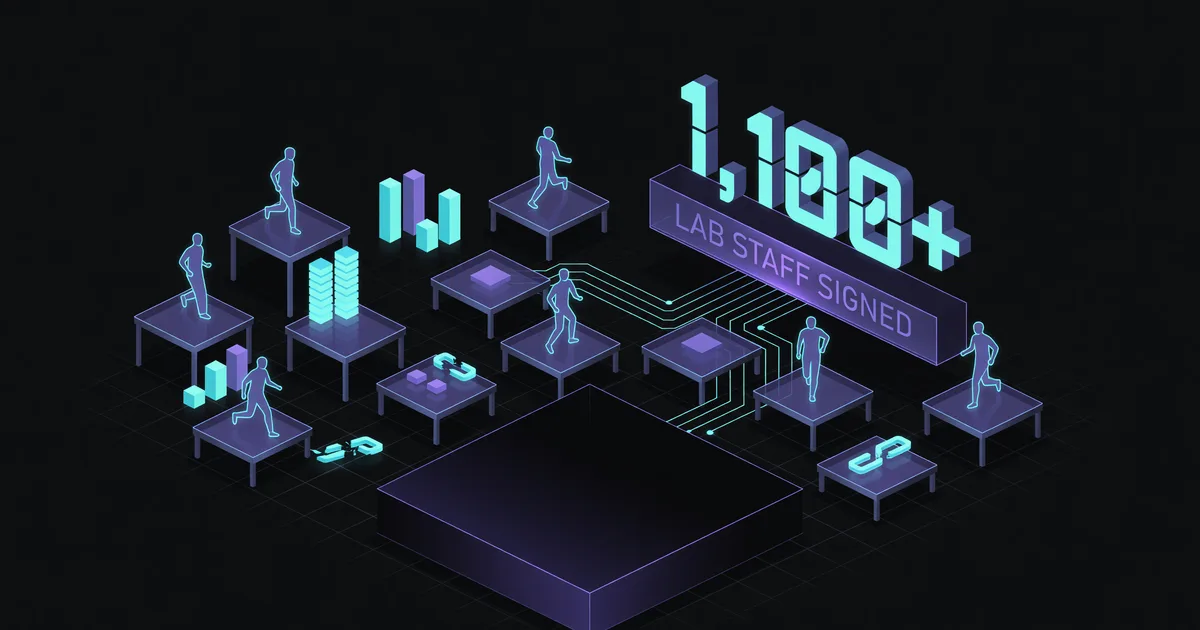
Pacing the Frontier's 1,100: What It Counts
The pacingthefrontier.com counter says 1,100+ lab staff signed. What that figure measures, what it leaves out, and the denominator nobody publishes.
"More than 1,100" is the figure the counter on pacingthefrontier.com was showing when Politico published its story on July 28, 2026, and it is the same figure the Washington Post carried the following day in a piece framing OpenAI and Anthropic as endorsing the call. Every write-up used it because there is exactly one place to get it.
The petition asks for mechanisms that would let frontier AI development be deliberately paced when capability outruns safeguards, with government help rather than voluntary restraint. That ask is worth arguing about on its merits. The count attached to it is a separate object, and it has been doing most of the persuasive work this week.
A self-attested employer field, tallied by the site making the ask
The number is produced by the petition itself. A signature is a form submission: a name, an employer string the signer types or selects, and a timestamp. The site publishes the running total. The July 28 and 29 reporting does not describe an independent audit of that total, a roll of verified names, or a stated verification procedure.
None of that is unusual. Open letters have worked this way for two decades, and organizers who do verify work addresses often decline to publish the method because publishing it is a roadmap for spoofing it. The problem is what happens downstream: a self-reported figure gets quoted by a wire outlet, then by everyone citing the wire outlet, and by day three it reads like a measured quantity.
One detail here is genuinely odd. The loudest amplifiers of the count on July 29 were OpenAI's and Anthropic's own accounts on X, which means two of the four employers being counted spent the news cycle boosting a number about their own staff. Employee letters usually get their force from employer discomfort. This one is being co-signed by the org chart it points at, which changes what a large count is evidence of.
What one signature certifies: a name, an employer string, a date
Read literally, 1,100 means roughly 1,100 individual acts of typing a name into a web form once, each asserting an affiliation with a frontier lab, in support of a short policy statement. That is the whole of it.
The count does not certify current employment. "AI staff" in a headline covers a researcher who trains frontier models and a recruiter who staffs the team that does, and both are real employees with a legitimate view. It does not carry seniority, tenure, or team. It does not indicate whether a signer has ever been in a room where a release date was set.
It also flattens disagreement about the mechanism. A signature endorses the sentence on the page. "Tools to deliberately pace development" is compatible with statutory capability thresholds, with mandatory third-party pre-deployment evaluation, with compute reporting requirements, and with a licensing regime, and those options have very different constituencies inside a research org. Eleven hundred people agreeing on a paragraph is not 1,100 people agreeing on a bill.
No denominator, no current-versus-former split, no way to unsign
The absent number is the denominator. Signature counts become interpretable the moment you know what they are a fraction of, and the two employee letters in this industry that changed an outcome both had one.
| Letter | Signatures | Denominator | What followed |
|---|---|---|---|
| Google, Project Maven (April 2018) | ~3,100 employees | ~85,000 Alphabet staff at the time | Google said in June 2018 it would not renew the contract |
| OpenAI board crisis (November 2023) | ~700 employees | ~770 employees | Board reversed within days; Altman returned |
| Pacing the Frontier (July 2026) | 1,100+ | Not published | Amplification from two of the four named labs; no dated commitments reported |
The Maven letter was around 4% of Alphabet and it worked because of who signed and what they threatened to withhold. The November 2023 OpenAI letter was roughly 90% of the company, which is the rare case where the count alone is the argument. Pacing the Frontier publishes a numerator across four or more employers and no split between them.
That split matters more than the total. A thousand signatures concentrated at one lab is a board-level governance event at that lab. The same thousand spread across OpenAI, Anthropic, Google DeepMind and Meta is a low single-digit share at each, and low single digits is a number those companies can absorb without changing a roadmap. Both readings are consistent with "more than 1,100," and the site does not let you tell which one you are looking at.
You cannot reconstruct it from outside, either. None of the four publishes a current, auditable headcount for the teams in question, and press estimates are approximate and stale by the time they print. Any percentage anyone quotes this week is an estimate resting on an estimate.
Two smaller gaps are worth naming. The count is cumulative and monotonic, so it measures everyone who has ever signed rather than everyone who still would, and a withdrawal has no visible effect on the display. And nobody is counting the other side of the ledger: staff who read the text and declined to sign leave no trace, so the figure has no ratio behind it, only a tally.
This cuts both ways. If the organizers are verifying against work email, as several past lab letters did, the underlying roster could be stronger than the public presentation suggests. They have published the total and not the method, so the strongest version of their own evidence is currently invisible.
What 1,100 changes on a roadmap shipping this quarter
If you are building on frontier APIs, the honest translation of this number into your planning is zero. A petition asking legislators for pacing mechanisms does not alter model availability, context limits, rate limits or per-token pricing on any timeline a product team cares about. Statutes and rulemaking move in years. The counter moves in hours.
The figures that do bind a roadmap are elsewhere and they are all dated. The EU AI Act's general-purpose obligations have been applying since August 2, 2025, with a Code of Practice as the compliance path. Each of the four labs publishes a capability framework with thresholds that can, at least in principle, delay a launch. Export-control decisions have already pulled a frontier model out of specific markets and put it back, which is a live demonstration that release timing is politically contingent in a way no petition has yet made it.
If you want a signal from this story rather than a headline, three disclosures would carry more information than another 500 signatures: a per-employer breakdown, a current-versus-former split, and any one of the four labs converting a supportive post on X into a written commitment with a date on it. Claude, ChatGPT and Gemini ship on schedules set by product organizations, and none of those three disclosures has been made.
The count turns out to be wrong in one direction if the organizers publish their verification method and it accepts unconfirmed employer strings, and in the other if any of the four labs confirms an internal tally that dwarfs the share the site implies. Both are a single disclosure away, and as of July 29 neither has arrived.
Keep reading

AI21 Labs Cuts 60% of Staff, Bets on Maestro
AI21 Labs slashes over 60% of staff, drops foundation models, and pivots to its Maestro agent optimization platform after Nebius acquisition talks collapse.

Alibaba Bans Claude Code Over Security Concerns
Alibaba told staff to remove Anthropic's Claude Code by July 10 over security concerns. Here's what triggered the ban and what it signals.

Anthropic Acquires Stainless: What It Means for AI
Anthropic bought Stainless, the SDK generator behind OpenAI and Cloudflare's client libraries. Here's the strategic play for AI agents.