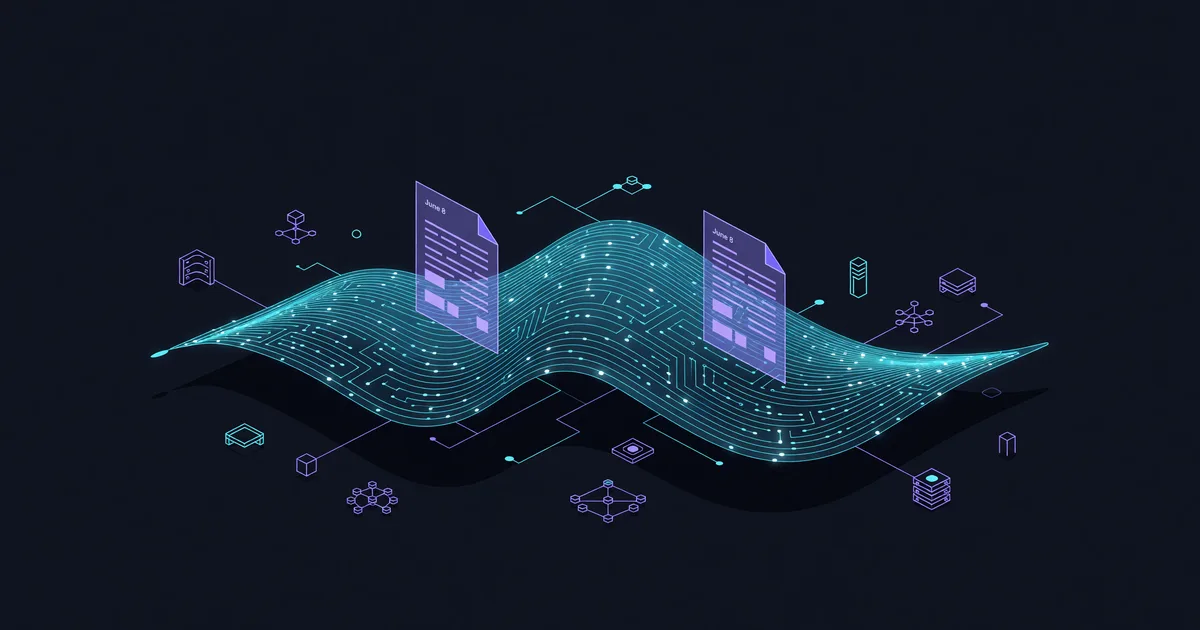
OpenAI Files for IPO, Days After Anthropic
OpenAI submitted a confidential S-1 to the SEC on June 8, days after Anthropic did the same. What the AI IPO wave means for the industry.
OpenAI submitted a confidential S-1 registration statement to the SEC on June 8, 2026, days after Anthropic filed its own confidential IPO paperwork. Two of the three most valuable AI companies on Earth are now formally on the path to public markets, and the timing is almost certainly not a coincidence.
A confidential S-1 filing, technically a "Draft Registration Statement" under the JOBS Act, lets a company begin the SEC review process without immediately making its financials public. The numbers stay private until at least 15 days before a roadshow begins. Stripe, Instacart and Reddit all took the same route, so the mechanism is standard for high-profile tech listings.
The pacing is the unusual part. Anthropic and OpenAI filing within the same week suggests both companies, and their respective banks, see the same window opening, and neither wants the other to define the narrative first.
The four forces that made mid-2026 the window
Revenue acceleration is the first. OpenAI reportedly crossed $10 billion in annualized revenue earlier this year, per multiple press reports from Reuters and The Information. Anthropic has not disclosed comparable figures, but its enterprise traction, including the $1.8 billion Akamai deal, the $200 million Gates Foundation partnership and the SpaceX Colossus 1 compute lease, signals a business scaling fast enough to withstand public-market scrutiny.
Valuation momentum is the second. OpenAI's last private round reportedly valued it north of $300 billion, per TechCrunch's June 8 reporting on the filing. At some point the secondary market becomes less efficient than public equity for both liquidity and future capital raises, and both companies appear to have crossed that threshold.
The SpaceX signal is the third. SpaceX has been preparing its own IPO path, and market appetite for generational tech listings is clearly strong. A company that famously resisted going public deciding to move resets the calculus for every other mega-cap private company.
Compute capital requirements close the list. Training frontier models requires billions in GPU infrastructure. Both OpenAI and Anthropic have raised massive private rounds, but public equity markets offer a deeper and more permanent capital base, and Anthropic's recent infrastructure deals with Akamai and SpaceX alone represent multi-billion-dollar commitments that need long-term financing.
What a confidential filing does and does not commit you to
Precision matters about what has and has not happened. A confidential S-1 is the starting gun rather than the finish line, and the typical sequence runs like this.
| Stage | What Happens | Typical Duration |
|---|---|---|
| Confidential filing | S-1 submitted to SEC; financials stay private | We are here |
| SEC review | Multiple rounds of comments and revisions | 2-4 months |
| Public S-1 | Full financials disclosed (15+ days before roadshow) | 1-2 weeks before roadshow |
| Roadshow | Management pitches institutional investors | 1-2 weeks |
| Pricing and trading | Stock begins trading | Day after pricing |
Actual trading therefore lands somewhere around Q4 2026 or Q1 2027, assuming no delays, market disruptions or strategic pauses. Either company could also withdraw its filing at any point, because filing does not obligate you to go public.
Whoever prices first sets the benchmark
The near-simultaneous filings create a specific dynamic. Whichever company prices first gets to set the valuation benchmark for "frontier AI company." An OpenAI listing at a $300B+ market cap anchors how investors value Anthropic, and the same works in reverse. Both have strong incentives to go first if they believe their story is stronger, and to go second if they think the other's IPO will validate the category and lift both.
Talent is the second axis. Public equity means liquid stock compensation. The AI talent market is brutal and both companies are competing for the same researchers and engineers, so whoever lists first can offer something private-company stock cannot: liquidity without waiting for a secondary sale or an acquisition.
Filing order is the noisy signal here. Pricing order is the one that will actually define what a frontier AI business is worth on public markets.
The five disclosures that will move valuations
Confidential filings are opaque by design, which leaves five open questions carrying most of the weight.
OpenAI's corporate structure is the first. The company has been converting from its unusual capped-profit structure to a more conventional for-profit corporation, per OpenAI's own announcements in 2025, and the S-1 will need to explain that clearly to public investors. How the transition is presented, and whether any legacy nonprofit obligations remain, could materially affect valuation.
Anthropic's unit economics are the second. The company has signed enormous compute deals, with the SpaceX Colossus 1 lease alone involving 220K+ GPUs per Anthropic's announcement, and investors will want the cost structure: what it costs Anthropic to serve Claude at scale, and what the margins look like.
Revenue mix is the third. How much of each company's revenue comes from API access versus consumer subscriptions versus enterprise contracts determines which public comps investors reach for, and therefore the multiple.
Profitability timeline is the fourth. Neither company is believed to be profitable, and the S-1 disclosures will reveal burn rates, gross margins and whether either has a credible path to profitability or is running a grow-now-profit-later story.
Microsoft's role is the fifth. Microsoft owns a significant stake in OpenAI and has committed billions in infrastructure, so the S-1 will need to detail that relationship, including any revenue-sharing arrangements and how the cloud partnership affects OpenAI's independence as a public company.
A $300B listing against the biggest tech IPOs
If OpenAI goes public anywhere near the $300 billion valuation range reported by TechCrunch, it would rank among the largest tech IPOs in history. Meta went public in 2012 at roughly $104 billion. Alibaba listed in 2014 at about $168 billion. Arm Holdings returned to public markets in 2023 at approximately $54 billion.
A $300B listing dwarfs all three at the time of their IPOs. Whether public-market investors accept frontier-AI valuations priced on potential rather than current earnings is the open question. The enterprise AI market is growing fast, and growing fast is a different claim from worth $300 billion today.
Anthropic's valuation gets less public discussion, but its most recent private round reportedly valued it at roughly $61 billion, per early 2025 reporting. That number has almost certainly moved significantly upward given the infrastructure deals and revenue growth since.
What public reporting does to the industry
Public listings force a level of transparency private companies avoid. Once these S-1s go public, we will see audited financials for the two most important AI companies outside Google DeepMind, which is buried inside Alphabet's reporting, for the first time.
That transparency cuts both ways. Strong numbers would validate the AI investment thesis and attract even more capital to the sector. Revenue that fails to match the hype could trigger a correction, in the way WeWork's 2019 S-1 disclosure exposed a business that could not justify its private valuation.
Both companies look fundamentally stronger than WeWork ever was. They have real enterprise customers paying real money for products that are clearly useful. The question is not whether the businesses are real, but whether they are worth the specific multiples the private market has assigned.
For developers and users
Public companies face quarterly earnings pressure, which changes how products evolve: more focus on revenue-generating features, potentially less tolerance for expensive research without a clear commercial path. It also means more data about pricing, usage and strategy becomes public, which helps anyone deciding which AI platform to build on.
For competitors
If both IPOs succeed and both companies raise significant public capital, the competitive moat around frontier AI deepens. The cost of training and serving state-of-the-art models is already prohibitive for most companies, and public-market access to billions in fresh capital widens the gap.
That is particularly relevant for open-source players like Meta with Llama and Mistral, as well as newer entrants like Recursive AI and xAI. Whether open-source can compete on model quality is a settled enough question; whether it can compete on the infrastructure spending required to stay at the frontier is not.
Where the two filings leave things
Two confidential S-1 filings in one week is the clearest signal yet that AI's startup phase is ending and its public-company phase is beginning. The actual IPOs remain months away, and plenty can change between now and then, whether market conditions, regulatory developments or a strategic decision by one company to let the other go first.
The direction is set regardless. OpenAI and Anthropic are both headed for public markets, and when the full S-1 documents become public they will contain the most detailed look anyone has had at the economics of frontier AI. That data will reshape how investors, developers, competitors and regulators all think about the industry, and it will show up first in the SEC's EDGAR database.
Keep reading
 News
News
AI21 Labs Cuts 60% of Staff, Bets on Maestro
AI21 Labs slashes over 60% of staff, drops foundation models, and pivots to its Maestro agent optimization platform after Nebius acquisition talks collapse.
 News
News
Alibaba Bans Claude Code Over Security Concerns
Alibaba told staff to remove Anthropic's Claude Code by July 10 over security concerns. Here's what triggered the ban and what it signals.
 News
News
Anthropic Acquires Stainless: What It Means for AI
Anthropic bought Stainless, the SDK generator behind OpenAI and Cloudflare's client libraries. Here's the strategic play for AI agents.