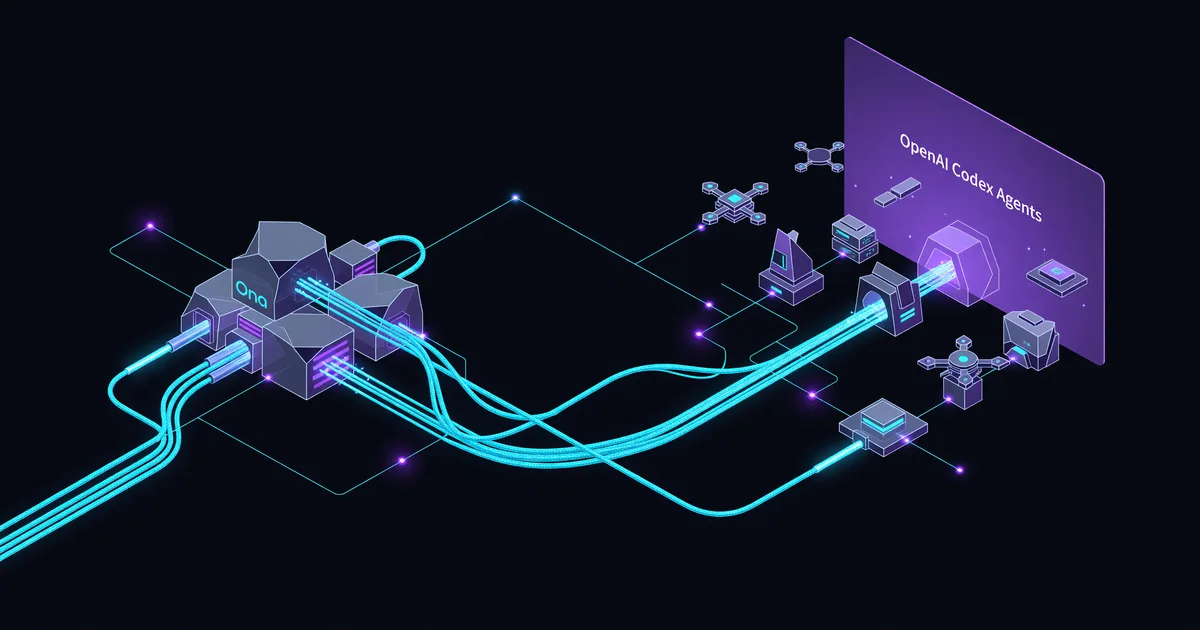
OpenAI Acquires Ona to Power Codex Agents
OpenAI is buying cloud platform Ona to give Codex agents persistent, secure environments. Here's what the deal means for the agent race.
OpenAI Just Bought Itself an Agent Runtime
OpenAI announced on June 11, 2026 that it's acquiring Ona, a cloud platform that builds pre-configured, secure environments for running software (per OpenAI's official announcement). The deal is straightforward on the surface — Ona's tech lets AI agents spin up persistent cloud environments where they can install packages, access tools, and run long-duration tasks without hitting the sandbox walls that currently constrain Codex.
But the subtext is bigger than the headline. This acquisition is OpenAI's clearest signal yet that the future of Codex isn't a chatbot that writes code snippets — it's an autonomous agent that operates inside real infrastructure, for hours or days at a time, doing actual software engineering work.
What Ona Brings to the Table
Ona built cloud environments designed for developer tooling — pre-configured machines with the dependencies, credentials, and access patterns that software projects actually need. Think of it as the difference between giving an AI a blank terminal and giving it a fully set-up dev workstation.
For Codex specifically, this solves several concrete problems:
- Persistence. Current Codex agents run in ephemeral sandboxes. When a task takes longer than a single session — large refactors, multi-step deployments, CI pipeline debugging — the agent loses its state. Ona's environments persist.
- Tool access. Production software work requires databases, APIs, package managers, build systems, and cloud CLIs. Ona's pre-configured environments come with these ready to go, rather than requiring the agent to install and configure everything from scratch each run.
- Security boundaries. Letting an AI agent loose in real infrastructure is a trust problem. Ona's environments provide isolation — the agent can do meaningful work without having unrestricted access to production systems. This is the kind of controlled-access design that makes enterprise adoption possible.
According to Bloomberg's reporting on the deal, Ona's team will integrate directly into OpenAI's Codex organization. That's a signal this isn't a talent acquisition or a patent grab — it's about shipping Ona's infrastructure as a core part of the Codex product.
Why Codex Needed This
Codex has evolved rapidly since its launch. OpenAI shipped Goal mode in May 2026, which lets Codex work toward open-ended objectives rather than just executing one-shot instructions. It added Appshots for richer project context. It brought Codex to mobile through the ChatGPT app. Each update pushed Codex further from "code autocomplete" toward "autonomous software agent."
But there was an infrastructure gap. Goal mode is meaningless if the agent can't maintain a working environment long enough to achieve multi-step goals. Appshots give context, but the agent still needs somewhere to act on that context — a real environment with real tools, not a stripped-down sandbox.
Ona fills that gap. My read: this acquisition is less about adding a new feature and more about removing the ceiling on what Codex agents can do. The model capabilities were already there. The runtime wasn't.
The Production Agent Problem
Every AI lab building coding agents is hitting the same wall: sandboxes are safe but limited, and real environments are powerful but dangerous. The entire challenge of production-grade AI agents comes down to threading that needle — giving agents enough access to be useful without enough access to be catastrophic.
This isn't a theoretical concern. We've seen well-documented cases of AI agents causing real damage when given unconstrained access to production systems. The challenge is engineering environments where agents can install dependencies, run tests, access APIs, and modify code — all within security boundaries that prevent lateral movement into systems they shouldn't touch.
Ona's approach — pre-configured environments with explicit access controls — is one answer. It's not the only possible architecture, but it's a pragmatic one: rather than trying to make agents safe in arbitrary environments, you build environments that are safe for agents.
The race to build production coding agents isn't primarily a model quality race anymore. It's an infrastructure race. The model that can operate in the most realistic environment, for the longest duration, with the right security boundaries, wins.
How This Compares to the Competition
OpenAI isn't the only company trying to solve agent runtime. Here's how the major players are approaching it:
| Company | Coding Agent | Runtime Approach |
|---|---|---|
| OpenAI | Codex | Ona acquisition — persistent, pre-configured cloud environments |
| Anthropic | Claude Code | Local execution + Claude Agent SDK for orchestration |
| Gemini Code Assist / Jules | Cloud Workstations integration via Google Cloud | |
| Cursor | Cursor Agent | Local IDE sandbox with background agents |
Anthropic's approach with Claude Code is notably different — it runs locally on the developer's machine, inheriting whatever environment and tools already exist there. That's zero-friction but limits the agent to what the local machine can do and doesn't scale to long-running background tasks.
Google has the natural advantage of owning Cloud Workstations, which could serve a similar function to Ona. But Google hasn't yet deeply integrated its cloud runtime with its coding agents in the way OpenAI is signaling here.
What's underappreciated: Cursor's local-first model and OpenAI's cloud-first model aren't competing for the same use cases. Local agents are great for interactive development — the developer is present, guiding, reviewing. Cloud agents are for the tasks you want to hand off entirely: "refactor this module, run the tests, open a PR when it's green, I'll review tomorrow." The Ona acquisition positions Codex squarely in the second category.
The Enterprise Angle
This matters most for OpenAI's enterprise push. Individual developers might be fine with a local coding agent. Enterprise teams need agents that can:
- Run inside corporate cloud environments with specific compliance requirements
- Access internal package registries, private APIs, and proprietary build systems
- Operate on schedules — nightly refactors, automated code reviews, dependency updates
- Maintain audit trails showing exactly what the agent did and why
None of this works in an ephemeral sandbox. All of it works in Ona-style persistent, configurable environments. OpenAI's $4 billion deployment company (announced earlier this year) is the sales channel. Codex with Ona's runtime is the product those enterprise deployments will actually ship.
What We Don't Know
Several important details are still missing from the public record:
- Deal price. Neither OpenAI's announcement nor the CNBC and Bloomberg coverage disclosed the acquisition price. Given Ona's relatively narrow focus, this is likely a mid-range acqui-hire/tech deal rather than a blockbuster figure — but that's speculation.
- Timeline to integration. How quickly will Ona's environments show up in the Codex product? The announcement frames this as a near-term integration, but "near-term" in AI company announcements can mean anything from weeks to quarters.
- Pricing model. Persistent cloud environments cost real money to run. Will Codex users pay per-environment-hour? Will it be bundled into existing ChatGPT Pro/Team/Enterprise tiers? The pricing structure will determine whether this is a feature for power users or a default for everyone.
- Self-hosting. Enterprise customers with strict data residency requirements will want to know if Ona-style environments can run in their own cloud accounts. No word on this yet.
The Pattern: Labs Are Becoming Infrastructure Companies
Zoom out and this acquisition fits a clear pattern across the industry. AI labs are no longer just building models — they're vertically integrating into the infrastructure that makes models useful in production:
- Anthropic acquired Stainless (SDK generation) and leased massive GPU clusters from SpaceX and Akamai
- OpenAI built a $4B deployment company, acquired Ona (agent runtime), and launched MRC for networking GPU clusters
- Google signed a $920M/month SpaceX compute deal and is tying Gemini deeper into Cloud Workstations
The common thread: the model is no longer the product. The model plus the infrastructure to deploy it in production is the product. Every major lab has realized that selling API access to a smart model isn't enough. You have to sell the environment the model operates in.
I think this is the right read on the Ona deal. OpenAI isn't buying a cloud platform because it wants to be in the cloud business. It's buying a cloud platform because Codex agents need somewhere to live — and whoever controls that runtime controls the agent experience.
The Honest Take
This is a logical, well-timed acquisition. Codex's capabilities have outgrown its sandbox. Ona's persistent environments are exactly the infrastructure Codex needs to go from "impressive demo" to "thing enterprises actually deploy for production work." The execution risk is in the integration — making Ona's environments feel native to Codex rather than bolted on — but the strategic logic is sound.
For developers already using Codex: watch for environment configuration options in upcoming releases. The ability to hand off multi-hour tasks to a Codex agent running in a fully equipped cloud environment would be a genuine workflow change, not an incremental improvement.
For the broader market: this is another data point confirming that the coding agent war is now an infrastructure war. The best model doesn't automatically win. The best model running in the most capable, secure, persistent environment wins. OpenAI just made its biggest move on that front.
Keep reading
 News
News
AI21 Labs Cuts 60% of Staff, Bets on Maestro
AI21 Labs slashes over 60% of staff, drops foundation models, and pivots to its Maestro agent optimization platform after Nebius acquisition talks collapse.
 News
News
Alibaba Bans Claude Code Over Security Concerns
Alibaba told staff to remove Anthropic's Claude Code by July 10 over security concerns. Here's what triggered the ban and what it signals.
 News
News
Anthropic Acquires Stainless: What It Means for AI
Anthropic bought Stainless, the SDK generator behind OpenAI and Cloudflare's client libraries. Here's the strategic play for AI agents.