DeepMind's Singapore Deal: National AI Done Right
Google DeepMind partners with Singapore on AI co-clinicians, researcher training, and Gemma-powered accessibility tools.
The Partnership at a Glance
Google DeepMind and the Singapore government announced an expanded national AI partnership in late May 2026, covering healthcare, scientific discovery, education, and inclusive innovation. The announcement, published on both the DeepMind blog and the Google Asia blog around May 20-23, represents one of the most concrete examples of a frontier AI lab embedding itself into a nation's public infrastructure — not just selling API access, but co-building programs across government agencies.
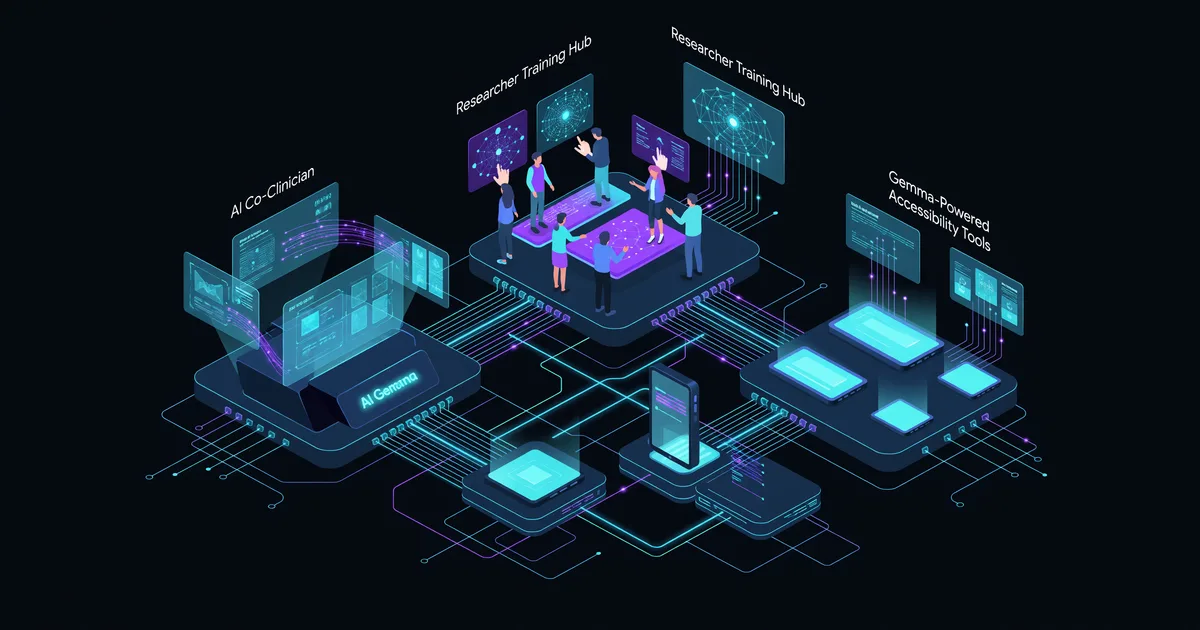
This isn't a vague MOU or a press-release partnership. The scope includes AI co-clinicians for healthcare, agentic AI training programs for researchers, and Gemma-powered tools for accessibility. That's three distinct deployment surfaces, each with different safety and governance requirements. Singapore is essentially becoming a testbed for what responsible national AI adoption looks like when a top lab is directly involved.
Why Singapore, Why Now
Singapore has been positioning itself as Southeast Asia's AI hub for years. The city-state has a unique combination of advantages: a highly educated population of under 6 million, a government that moves fast on tech policy, world-class research institutions, and a regulatory environment that's pragmatic rather than reactionary. It's small enough to be a controlled environment, influential enough to set regional precedent.
For DeepMind, the strategic logic is straightforward. The AI lab race isn't just about benchmarks anymore — it's about who gets deployed in real institutions first. OpenAI has its enterprise push. Anthropic has its government contracts and the massive Akamai compute deal. DeepMind choosing to go deep with a national government rather than just chasing enterprise seats is a different bet: prove that your models work safely at the infrastructure level, and other governments will follow.
My read: Singapore is to DeepMind what the U.S. government market is to Anthropic and Palantir — a credibility anchor that makes every subsequent deal easier.
AI Co-Clinicians: The Healthcare Play
The most consequential piece of this partnership is the healthcare component. According to the DeepMind announcement, the program includes development of AI co-clinicians — AI systems designed to work alongside doctors rather than replace them.
This is a loaded term. "Co-clinician" implies a level of integration that goes beyond the typical "AI assists with diagnosis" framing. It suggests systems that participate in clinical workflows: reviewing patient data, flagging potential issues, suggesting treatment options, and possibly handling administrative burden that eats into actual patient care time.
Singapore's public healthcare system is well-suited for this. The country operates a centralized system with strong digital health records infrastructure, which means less of the messy data integration work that stalls AI healthcare deployments in fragmented systems like the U.S. If you're going to test AI co-clinicians anywhere, a small country with unified health records and a government willing to move quickly is about as good as it gets.
The honest take: healthcare AI has been "two years away" for a decade. What makes this different is the institutional backing — this isn't a startup pitching a hospital system, it's a frontier lab working with a national government that controls the entire healthcare pipeline from policy to deployment.
The open question is how much clinical autonomy these systems will have. There's a massive difference between "AI flags an anomaly for a doctor to review" and "AI recommends a treatment plan that the doctor rubber-stamps." The announcement doesn't specify where on that spectrum Singapore is aiming, and that detail matters enormously.
Agentic AI Training for Researchers
The second major pillar is an agentic AI training program aimed at Singapore's research community. This targets scientific discovery — training researchers to use AI agents as tools for their work rather than just using chatbots for literature review.
This is where the timing gets interesting. Agentic AI has gone from buzzword to real product category in 2026. Google's own Gemini 3.5 Flash launched with explicit agentic capabilities. Anthropic's Claude has tool use and computer control. OpenAI's Codex has goal mode. The infrastructure for researchers to actually use AI agents — not just chat interfaces — now exists.
Training programs like this matter because the gap between "AI agents exist" and "researchers know how to use them effectively" is enormous. Most scientists aren't prompt engineers. They need structured onboarding into agentic workflows: how to set up multi-step research tasks, how to validate agent outputs, how to integrate AI into experimental design without introducing systematic bias.
What's underappreciated here: if Singapore's researchers become early, skilled users of agentic AI for scientific work, that's a genuine competitive advantage. The country punches well above its weight in research output per capita. Adding effective AI agents to that workforce could widen the gap.
Gemma-Powered Accessibility Tools
The third component uses Gemma, Google's open-weight model family, to build accessibility tools. This is a smart architectural choice and says something about DeepMind's deployment philosophy.
Gemma models are small enough to run on-device or on modest infrastructure. For accessibility applications — think real-time captioning, text-to-speech, language translation for Singapore's multilingual population, or assistive tools for people with disabilities — you want low latency and the ability to run locally. You don't want to route every accessibility request through a cloud API.
Singapore is one of the most linguistically diverse countries in Asia, with four official languages (English, Mandarin, Malay, Tamil) and dozens of dialects. Building inclusive AI tools here means handling that linguistic complexity natively, which is a harder problem than building for an English-only market.
Using Gemma rather than the full Gemini stack also signals that DeepMind is thinking about sustainability. Open-weight models that can be fine-tuned and deployed locally by Singapore's own engineers create less dependency on Google's infrastructure over time. That's an important trust signal for a sovereign government.
What This Tells Us About the Lab Race
The big AI labs are differentiating their go-to-market strategies in ways that are now clearly visible:
| Lab | Primary Strategy | Key Recent Moves |
|---|---|---|
| OpenAI | Enterprise + consumer scale | $4B deployment company, Codex mobile, ChatGPT finance tools |
| Anthropic | Government + compute infrastructure | $1.8B Akamai deal, SpaceX GPU lease, Gates Foundation |
| Google DeepMind | National partnerships + open models | Singapore partnership, Gemma ecosystem, Gemini agentic push |
| xAI | Integrated platform (SpaceXAI) | Grok 4.3, Grok Build CLI, voice API |
DeepMind's approach is arguably the most patient. National partnerships take years to show results. You don't get a press release about "10x revenue growth" from training researchers and building accessibility tools. But if Singapore becomes the global reference case for "here's how a country adopted AI responsibly and got measurable outcomes," that's worth more than any enterprise contract.
I think this matters because the regulatory environment globally is shifting toward requiring exactly what Singapore is building: demonstrated safe deployment in real public systems, not just benchmark scores and safety cards. The EU AI Act, evolving U.S. executive orders, and ASEAN's own AI governance frameworks all point toward a world where "show me where this worked safely at national scale" becomes the key question.
The Risks and Open Questions
No partnership this ambitious comes without risks worth naming:
- Vendor lock-in: Singapore is tying significant national infrastructure to one lab's technology. If DeepMind's models fall behind or Google's priorities shift, unwinding that dependency won't be simple. The Gemma choice mitigates this somewhat for accessibility tools, but the healthcare and research programs likely depend on Gemini-class models.
- Safety at scale: AI co-clinicians sound great in a controlled pilot. Deploying them across a national healthcare system introduces failure modes that don't show up in small tests. One high-profile AI error in a clinical setting could set back the entire program.
- Measuring success: Neither the DeepMind nor Google blog posts (based on what's been published) specify concrete success metrics or timelines. "Expanded partnership" and "new programs" are commitments to activity, not outcomes. What does success look like in 2 years? 5 years? We don't know yet.
- Regional dynamics: Singapore's neighbors — Indonesia, Vietnam, Thailand, Malaysia — have much larger populations and different infrastructure realities. A model that works for a wealthy city-state of 6 million may not transfer to a developing nation of 270 million. The "reference case" argument has limits.
What to Watch Next
The details that will determine whether this partnership actually matters:
- Clinical trial specifics for the AI co-clinician program — which hospitals, which specialties, what level of autonomy
- Open-source contributions — whether Singapore's Gemma fine-tuning work gets released back to the community, particularly for Southeast Asian languages
- Government procurement signals — if other ASEAN nations start announcing similar partnerships with DeepMind or rival labs, that confirms the template is working
- Researcher adoption metrics — how many scientists actually complete the agentic AI training and integrate it into their workflows, versus how many attend a workshop and go back to their old methods
Singapore has a track record of executing on ambitious tech policy. The country's digital identity system, smart port infrastructure, and COVID contact tracing were all government-led, tech-enabled, and actually deployed — not just announced. That execution track record is probably the strongest argument that this DeepMind partnership will produce real results rather than joining the graveyard of AI partnership announcements that never ship anything.
For now, this is a bet on patient, institutional AI deployment over the move-fast-and-ship approach. Whether that bet pays off depends entirely on what gets built in the next 12-18 months.
Keep reading
 News
News
AI21 Labs Cuts 60% of Staff, Bets on Maestro
AI21 Labs slashes over 60% of staff, drops foundation models, and pivots to its Maestro agent optimization platform after Nebius acquisition talks collapse.
 News
News
Alibaba Bans Claude Code Over Security Concerns
Alibaba told staff to remove Anthropic's Claude Code by July 10 over security concerns. Here's what triggered the ban and what it signals.
 News
News
Anthropic Acquires Stainless: What It Means for AI
Anthropic bought Stainless, the SDK generator behind OpenAI and Cloudflare's client libraries. Here's the strategic play for AI agents.