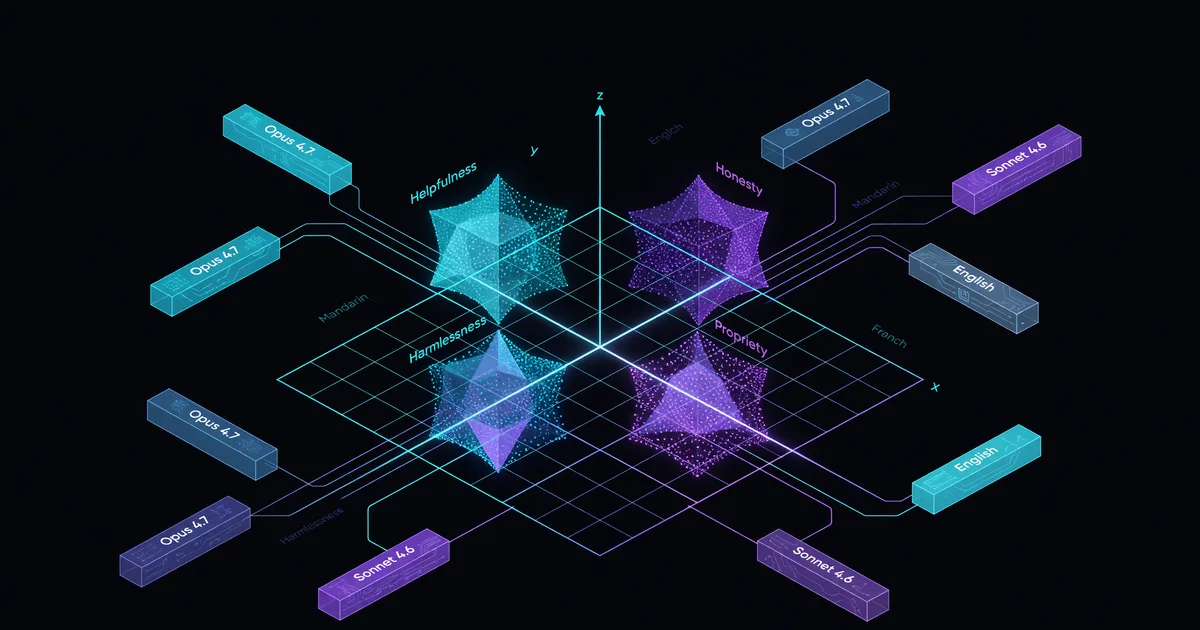
Anthropic Maps Claude's Values by Model and Language
Anthropic's July 2026 study clusters 3,000+ Claude values into four axes and shows how they shift across Opus 4.7, Sonnet 4.6, and language.
Anthropic published research on July 13, 2026 that takes more than 3,000 distinct values Claude expresses in real conversations and sorts them onto four measurable axes. The same study shows those values are not fixed: they move depending on which Claude model is answering and what language the conversation is in.
The thread went up on Claude-maker Anthropic's X account and cleared 90,000 views within a day. That reach matters less than the method. This is one of the few times a frontier lab has published a structured, quantitative map of how its own model's expressed character drifts across versions and languages, using production traffic rather than a curated eval set.
3,000 observed values collapsed into four axes
The starting point is Anthropic's earlier "Values in the Wild" line of work, which pulled the values Claude actually voices during conversations, things like intellectual honesty, harm avoidance, user autonomy, and grouped them into a taxonomy of thousands of entries. A taxonomy that large is good for cataloguing and bad for reasoning about. You cannot look at 3,000 values and say anything crisp about how two models differ.
So the new work compresses that catalogue down to four axes. Each axis is a spectrum with a value-laden pole at either end, and any given model-and-language combination lands somewhere along it. Instead of "Claude holds these 3,000 values," you get "this configuration of Claude leans this far toward one pole on each of four dimensions." That is a shape you can compare, chart, and argue about.
Anthropic highlighted two of the axes by name. One is Deference versus Caution: how far the model bends toward doing what the user asked versus flagging risk, adding caveats, or declining. The other is Warmth versus Rigor: whether a response leans into empathy and rapport or toward precision and correctness. The remaining axes are laid out in the full writeup; I'm not going to invent labels for them here, and you should be suspicious of any summary that states all four with confidence unless it's quoting Anthropic directly.
The useful move is the compression. Four axes is a vocabulary a developer can hold in their head while choosing a model. Three thousand values is a spreadsheet nobody reads twice.
Opus 4.7 and Sonnet 4.6 don't land in the same spot
The headline finding for anyone shipping on Claude: the models differ measurably on these axes. Opus 4.7 and Sonnet 4.6 are not just separated by cost and latency. They express a different balance of values on identical prompts.
Anthropic frames this as a real, observable divergence rather than folklore. Developers have long traded anecdotes that "Opus is more cautious" or "Sonnet is more agreeable," and mostly those claims died in the comments because nobody could measure them. Putting the models on a shared coordinate system turns a vibe into a number you can point at.
I'd stop short of repeating specific figures, because the exact per-model coordinates live in Anthropic's charts and I don't want to hand you a made-up percentage. What the research establishes is the direction: pick a different Claude and you're picking a different point on Deference-versus-Caution and Warmth-versus-Rigor, not just a different price per token. For a support agent, that gap between deference and caution is the difference between a bot that reassures a frustrated customer and one that keeps hedging. For a coding agent, rigor over warmth is usually what you want.
Why version drift is the part to watch
The quieter implication is that these coordinates move between releases. If Sonnet 4.6 and Opus 4.7 sit in different places, then Sonnet 4.7 or Opus 4.8 will sit somewhere else again. Teams that tuned prompts and guardrails against one model's disposition can have that disposition shift under them on the next upgrade, without a single line in the changelog naming it. A values map gives Anthropic, and in principle its customers, a way to notice that drift instead of discovering it through a spike in weird support transcripts.
The conversation language shifts the values too
The second axis of variation is language. The same Claude model expresses a different blend of values depending on whether the conversation is in English, Japanese, German, or another language. Anthropic reports this as a systematic effect across the four axes, not scattered noise.
This is the finding with the least public attention and, I'd argue, the most operational bite. A lot of the alignment and red-teaming that shapes a model's behavior is done and measured in English. If the value profile visibly moves when you switch to another language, then an app that's been carefully steered in English is running on partly unmeasured behavior the moment a user types in Turkish or Korean.
Some of this is unavoidable. Values like directness, formality, and deference to authority carry different weight across cultures, and training data reflects that. A model that mirrors those norms isn't malfunctioning. But "the model is culturally adaptive" and "the model's safety posture is weaker in language X" can look identical on a dashboard, and only one of them is fine. Measuring the axes per language is how you tell them apart.
How to actually use this when picking a Claude
For developers, the research reframes model selection. The usual comparison is a grid of benchmark scores, context window, price, and speed. None of that captures disposition. Two models can post near-identical SWE-bench numbers and still handle an ambiguous, emotionally loaded prompt very differently, and this study is Anthropic putting a ruler on exactly that difference.
- Match the axis to the job. A therapy-adjacent or customer-facing bot probably wants the warmer, more deferential end. A financial or medical reasoning tool wants rigor and caution even when it costs some rapport.
- Re-test on version bumps. If value coordinates move between Sonnet 4.6 and Opus 4.7, treat a model upgrade as a behavior change, not just a capability change. Re-run your character-sensitive evals, not only your accuracy ones.
- Evaluate in your users' languages. If your product serves non-English users, English-only behavior testing is measuring the wrong model. The language effect says the profile you validated may not be the one shipping.
- Steer, don't assume. System prompts and constitutions can push a model along these axes. Knowing where the base model sits tells you how hard you have to push.
What Anthropic hasn't answered yet
A few honest gaps. First, the four axes are Anthropic's chosen compression, and any compression throws information away. A model could hold a value that doesn't map cleanly onto Deference-Caution or Warmth-Rigor, and it would get flattened. The axes are a lens, not the territory.
Second, this is a lab describing its own model with its own taxonomy. That's not a knock, it's genuinely useful primary data, but it isn't independent. There's no third-party replication yet putting Claude and, say, Gemini or GPT-5.6 on the same four axes, which is the comparison developers would actually kill for. Until someone runs a competing model through the same instrument, we can measure Claude against Claude and not much else.
Third, the causal story is thin. The research shows that values differ by model and language. It's more careful about why. How much of the language effect is genuine cultural adaptation versus uneven safety coverage across languages is exactly the question that matters for anyone deploying globally, and it's the one the summary leaves open.
What's already clear is that "which Claude" is now a question with a values answer, not only a benchmark one. If you build agents that talk to real people, that's a variable worth putting on your own dashboard before Anthropic's next release quietly moves it.
Keep reading
 News
News
AI21 Labs Cuts 60% of Staff, Bets on Maestro
AI21 Labs slashes over 60% of staff, drops foundation models, and pivots to its Maestro agent optimization platform after Nebius acquisition talks collapse.
 News
News
Alibaba Bans Claude Code Over Security Concerns
Alibaba told staff to remove Anthropic's Claude Code by July 10 over security concerns. Here's what triggered the ban and what it signals.
 News
News
Anthropic Acquires Stainless: What It Means for AI
Anthropic bought Stainless, the SDK generator behind OpenAI and Cloudflare's client libraries. Here's the strategic play for AI agents.