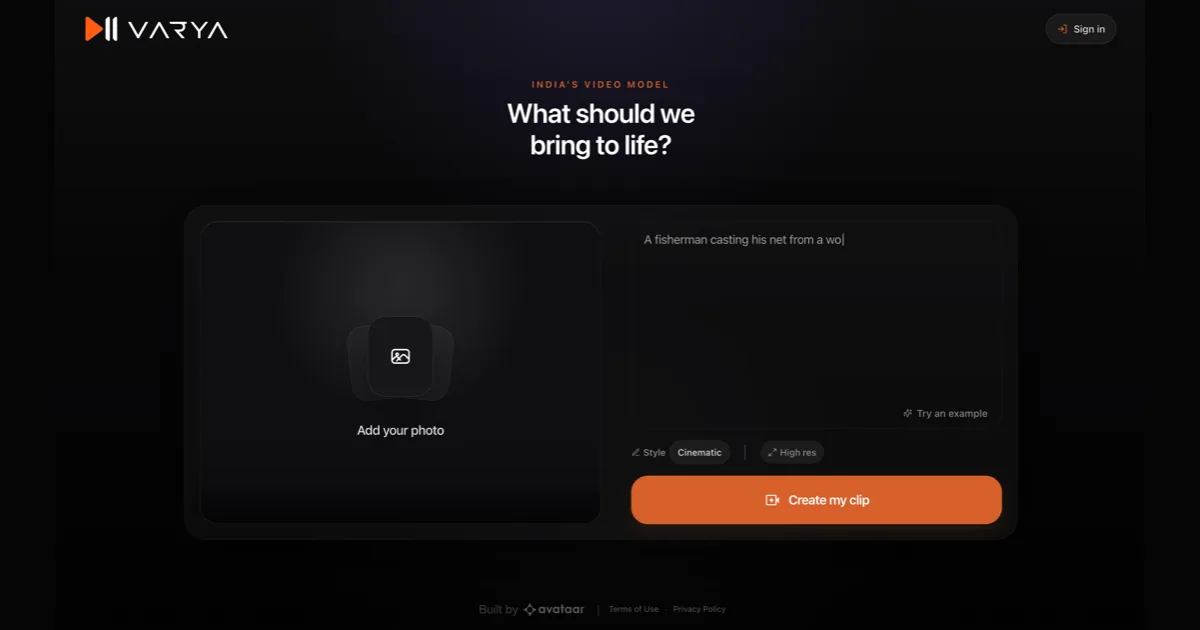

Varya
India's first distilled AI video model, trained on local cultural contexts with claimed 10-27x faster generation at a fraction of global competitors' cost.
Updated 2026-06-14
Not settled here. This entry does not record a confirmed free tier for Varya.
Listed pricing: From ₹0.48/sec (~$0.006/sec).
Overview
Varya is a text-to-video AI model built by Avataar.ai under India's IndiaAI Mission, launched on June 12, 2026. It's positioned as the country's first homegrown video generation model, and its headline claim is dramatic: 10-27x faster inference than models like Sora and Runway, at costs that start at ₹0.48 per second of video (roughly half a US cent). The model uses a distilled architecture, meaning it's derived from a larger foundation model but compressed for speed and efficiency — a legitimate engineering approach that trades some raw capability for dramatically lower latency and cost.
What makes Varya genuinely different from the global video AI crowd is its training data focus. The model was specifically trained on Indian cultural contexts — festivals like Diwali and Holi, regional clothing and textiles, local food, architecture, and social settings. If you've tried generating a Bollywood-style scene or an Indian wedding video in Runway or Pika, you know the results tend to default to Western aesthetics. Varya is built to handle these contexts natively, which gives it a clear niche advantage for Indian content creators, brands, and agencies.
The model is accessible via API with pay-per-second pricing, making it viable for startups and small teams who can't justify the monthly subscriptions of Western platforms. However, it's still very new — launched days ago — and independent benchmarks or third-party reviews are essentially nonexistent. The speed and cost claims are from the team itself, and the model's output quality across diverse prompts remains to be validated by the broader community. For Indian-market content, it's worth watching closely; for global production work, the established players still have deeper feature sets and proven track records.
Is Varya free?
Not settled here. This entry does not record a confirmed free tier for Varya.
What the entry records: Check website for current free tier availability.
Listed pricing: From ₹0.48/sec (~$0.006/sec).
No figure is estimated here for what is not published. Check Varya's own site for the current terms.
Pricing on this page has not been re-verified. The entry was last edited on , and no separate pricing check has been run since. Treat the figures as a record of what was published then and confirm on the official site.
Varya pricing
| Plan | Price | What's included |
|---|---|---|
| API Access | ₹0.48/sec (~$0.006/sec) | Pay-per-second video generation via API; no monthly commitment; optimized for high-volume and cost-sensitive workflows |
Pay-per-second video generation via API; no monthly commitment; optimized for high-volume and cost-sensitive workflows
Pricing on this page has not been re-verified. The entry was last edited on , and no separate pricing check has been run since. Treat the figures as a record of what was published then and confirm on the official site.
Is Varya worth it?
Worth it for Indian content creators, brands, and agencies who need text-to-video generation with authentic local cultural context at low cost.
There is no free tier to test it on, so the plans above are the entry cost. The recorded trade-offs are listed below, and any one of them can settle the question on its own.
The 7.4/10 AI Score is an editorial read of published capability, price and shipping pace. Nobody here has hands-on hours with Varya. How we verify.
Worth it if
The strengths recorded against this entry.
- Extremely low cost — roughly $0.006 per second of video, undercutting every major competitor
- Trained on Indian cultural contexts that global models handle poorly (festivals, clothing, food, architecture)
- Distilled architecture delivers claimed 10-27x speed advantage over full-scale models
- Backed by IndiaAI Mission, signaling government support and long-term investment
Not worth it if
Any one of these blocks your use case.
- Brand new (launched June 12, 2026) with no independent benchmarks or third-party reviews yet
- Output quality relative to Runway, Kling, or Veo 3 is unproven outside the team's own demos
- Feature set appears basic compared to competitors offering camera controls, image-to-video, and style transfer
- Cultural niche focus means it may underperform on non-Indian visual contexts
What sets Varya apart
- Trained on Indian cultural contexts — festivals, clothing, food, architecture — that global models default away from
- Distilled architecture claims a 10-27x speed advantage over models like Sora and Runway
- Pay-per-second API pricing (~$0.006/sec) with no monthly commitment
- Backed by India's IndiaAI Mission
Key features
Text-to-Video Generation
Generate video clips from text prompts with the model handling scene composition, motion, and visual coherence. Optimized for fast inference through a distilled model architecture.
Indian Cultural Context Training
Trained specifically on Indian cultural data — festivals, traditional clothing, regional food, architecture, and social contexts that global models typically misrepresent or default to Western aesthetics.
Distilled Model Architecture
Uses knowledge distillation to compress a larger foundation model into a faster, lighter version. This enables the claimed 10-27x speed advantage over full-scale models like Sora, at significantly lower compute cost.
Pay-per-Second API
API access priced at ₹0.48 per second of generated video (~$0.006 USD), making it one of the cheapest video generation APIs available. No monthly subscription required.
How it compares
| Tool | Best for | Pricing | Score |
|---|---|---|---|
| Varya | Indian content creators, brands, and agencies who need text-to-video generation with authentic local cultural context at low cost. | From ₹0.48/sec (~$0.006/sec) | 7.4/10 |
| Runway vs Runway → | Filmmakers, advertisers, and content creators who need cinematic AI video with realistic motion and fine-grained creative control. | Free tier + Standard $12/mo + Pro $28/mo + Max $76/mo + Enterprise contact sales | 9.3/10 |
| Veo 3 vs Veo 3 → | Filmmakers, content creators, and marketing teams who need production-quality cinematic video with synced audio, without a production budget. | Free via Gemini + Vertex AI pay-per-use | 9.1/10 |
| Seedance 2.0 | Video creators and developers who need short AI-generated clips with synchronized audio, lip-sync, and cinematic camera control. | Free daily credits (Dreamina) + paid ~$15-$70/mo; API from ~$0.08/s | 9/10 |



Compare head-to-head
Comparison explorer Put Varya up against any three tools Opens with Varya already loaded. Add up to three more from the full index and read pricing, features, pros and cons in one table. →Related reading

Kimi K3.1 Pro vs Opus 5.5 on Scores and Access
Moonshot’s Kimi K3.1 Pro hits 65.7% on Terminal-Bench 4.0 against Claude Opus 5.5 at 66.4%, with live API access and open weights dated November 4.

Meta's $35B Class C Raise Buys Compute, Not Votes
Meta's October 2026 Class C equity raise funds AI data centers while preserving founder control and lifting the compute bar for smaller labs.

Brotli Unauthenticated RCE Claim, Audited
Security digests keep repeating Brotli RCE with “no account needed.” Here is what that claim measures, skips, and when it fails for your stack.
Ready to try Varya?
Head to the official site to start with Varya — pricing and plans are listed above.
Visit Varya