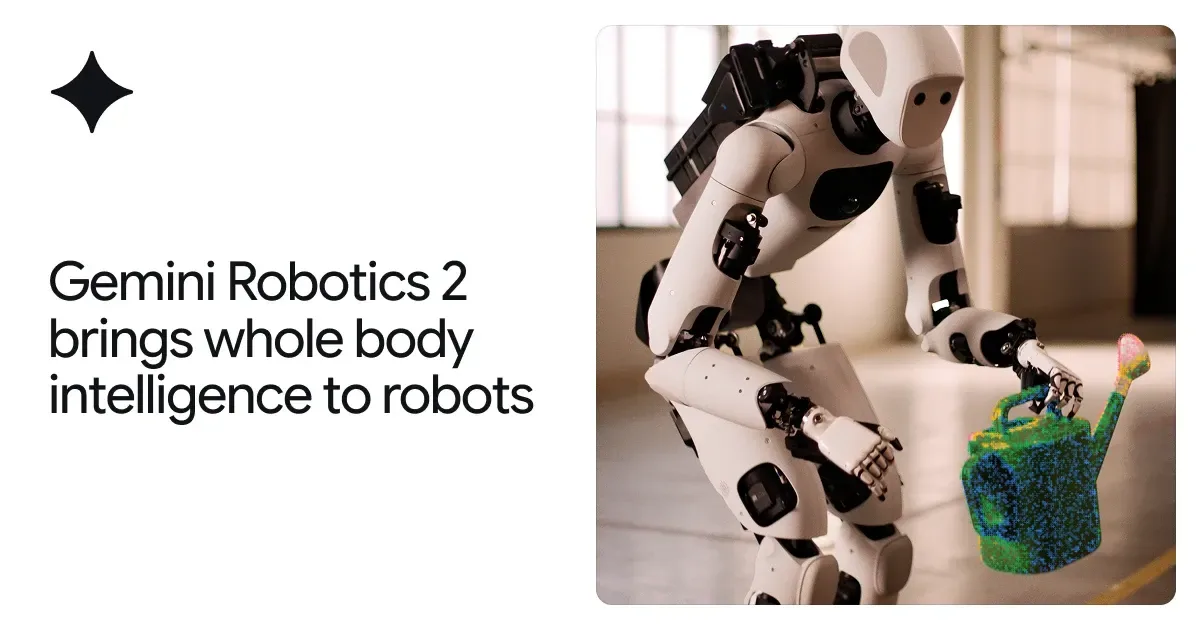

Gemini Robotics 2
Google DeepMind's robotics model layer for whole-body control, dexterous manipulation, and robots that coordinate with each other on physical tasks.
Updated 2026-08-02
No free tier is documented for Gemini Robotics 2.
Listed pricing: Waitlist for early access; enterprise and research partnerships (pricing not published).
Overview
Gemini Robotics 2 is Google DeepMind's robotics model layer, announced July 30, 2026. It takes a robot's camera and sensor input plus a plain-language instruction and produces the motor behaviour to carry it out — with the headline addition being whole-body intelligence: coordinating a base, torso, arms and hands as one system instead of treating manipulation as an isolated arm-planning problem. The launch demos leaned on messy household chores, tidying a garage and kitchen work, which is a deliberate choice: those tasks punish models that can only handle a clean tabletop and a single fixed viewpoint.
The other new claim is robot-to-robot collaboration — multiple machines working the same task rather than one robot executing a script in isolation. That is the harder problem, and it is where the demo footage did most of the persuading in the DeepMind X thread that carried the announcement past 100k views. This sits on top of the lineage DeepMind has been building since the original Gemini Robotics and the ER (embodied reasoning) variants: a vision-language model doing the thinking, a vision-language-action model doing the moving, and the ability to carry learned behaviour across different robot bodies.
This is not a product you sign up for and use. It is a model available through a waitlist and partner programme, aimed at robotics labs, hardware makers and research groups with a physical platform to put it on. If you don't have a robot, there is nothing here to try. Notably, DeepMind has not published pricing, a supported-platform list, or head-to-head benchmark figures alongside the launch post — so the honest read is that the demos are impressive and the reproducibility story is still missing. Treat the capability claims as unverified until third parties get hardware access.
Is Gemini Robotics 2 free?
No free tier is documented for Gemini Robotics 2.
Listed pricing: Waitlist for early access; enterprise and research partnerships (pricing not published).
No figure is estimated here for what is not published. Check Gemini Robotics 2's own site for the current terms.
Pricing on this page has not been re-verified. The entry was last edited on , and no separate pricing check has been run since. Treat the figures as a record of what was published then and confirm on the official site.
Gemini Robotics 2 pricing
| Plan | Price | What's included |
|---|---|---|
| Early access waitlist | Not published | Sign up via the DeepMind announcement page. Access is gated and selective — no self-serve API key. |
| Enterprise / research partnership | Not published | Direct partnership route for robotics companies and research labs with hardware platforms. Terms negotiated, nothing listed publicly. |
Sign up via the DeepMind announcement page. Access is gated and selective — no self-serve API key.
Direct partnership route for robotics companies and research labs with hardware platforms. Terms negotiated, nothing listed publicly.
2 plans carry no published number: Early access waitlist, recorded as “Not published”; Enterprise / research partnership, recorded as “Not published”. Nothing is estimated in its place. The vendor's own pricing page is the only source for those figures.
Pricing on this page has not been re-verified. The entry was last edited on , and no separate pricing check has been run since. Treat the figures as a record of what was published then and confirm on the official site.
Is Gemini Robotics 2 worth it?
There is no free tier to test it on, and no plan on this entry carries a published price, so the cost question goes to the vendor first. The recorded trade-offs are listed below, and any one of them can settle the question on its own.
The 8.2/10 AI Score is an editorial read of published capability, price and shipping pace. Nobody here has hands-on hours with Gemini Robotics 2. How we verify.
Worth it if
The strengths recorded against this entry.
- Whole-body control targets the actual failure mode of most robot demos — tasks that need the machine to move its body, not just its arm
- Robot-to-robot collaboration is a real step past the single-policy-per-robot pattern of earlier releases
- Demos were shot on genuinely messy real-world scenes (garages, kitchens) rather than sanitised tabletops
- Builds on DeepMind's existing embodied-reasoning stack, so it inherits Gemini's language understanding for instruction-following
- Backed by Google DeepMind's hardware partnerships, which matters for a model that is useless without a robot to run on
Not worth it if
Any one of these blocks your use case.
- No public pricing, no self-serve access — waitlist and partnerships only, so most people reading about it cannot try it
- DeepMind published demo footage but no head-to-head benchmark numbers or supported-platform list alongside the launch, making the claims hard to verify
- Requires a physical robot platform, which puts it out of reach of anyone without hardware and an integration budget
- Curated demo videos are weak evidence for reliability — success rates on unscripted tasks are unknown until outside labs get access
Key features
Whole-body control
Coordinates base, torso, arms and hands as a single system rather than planning arm motion in isolation, which is what lets a robot reach into a cluttered space or shift its stance to complete a task instead of failing when the object is out of arm range.
Dexterous manipulation
Targets fine two-handed work — the grasping, reorienting and in-hand adjustment that household and workshop tasks demand. This has historically been the bottleneck between a robot that can point at an object and one that can actually pick it up and use it.
Multi-robot collaboration
Robots can work the same task together rather than each running an isolated policy. This is the genuinely new piece versus earlier Gemini Robotics releases and the hardest to fake in a demo video.
Language-instructed tasks
Takes plain-language instructions and turns them into physical behaviour, building on the embodied-reasoning approach in DeepMind's earlier robotics models where a VLM handles planning and a separate action model handles execution.
How it compares
| Tool | Best for | Pricing | Score |
|---|---|---|---|
| Gemini Robotics 2 | — | Waitlist for early access; enterprise and research partnerships (pricing not published) | 8.2/10 |
| Perplexity AI vs Perplexity AI → | Knowledge workers and researchers who want cited, synthesized answers instead of a list of links to click through. | Freemium | 9.4/10 |
| NotebookLM | Students, researchers, and professionals who need answers grounded strictly in the specific documents they upload. | Free | 9.1/10 |
| Inkling-Small vs Inkling-Small → | — | Free — open weights download; Tinker Playground access | 8.8/10 |


Compare head-to-head
Related reading

Gemini Robotics 2 and Whole-Body Intelligence
Google DeepMind's Gemini Robotics 2 claims whole-body control of a humanoid. What that means, and how NVIDIA, Physical Intelligence and Mistral compare.

Anthropic Traced More Than 23 Million Exchanges
Anthropic attributed more than 23 million exchanges to Moonshot between May and July in its September 2026 threat intelligence report.

ChatGPT for Financial Services: What Shipped, Pricing & Who It's For
OpenAI launched a tailored ChatGPT Work experience for investment bankers and equity researchers with GPT-6 Astra, built-in PitchBook/Daloopa/LSEG data, citations, and sales-quoted pricing.
Ready to try Gemini Robotics 2?
Head to the official site to start with Gemini Robotics 2 — pricing and plans are listed above.
Visit Gemini Robotics 2