Meta Llama
Meta's open-weight LLM family. Llama 4 brings mixture-of-experts, native multimodal input, and up to 10M token context — all free to download and deploy.
Updated 2026-05-02
Yes. Meta Llama is free to use.
Listed pricing: Free (self-hosted) · Cloud API pricing varies by provider.
Overview
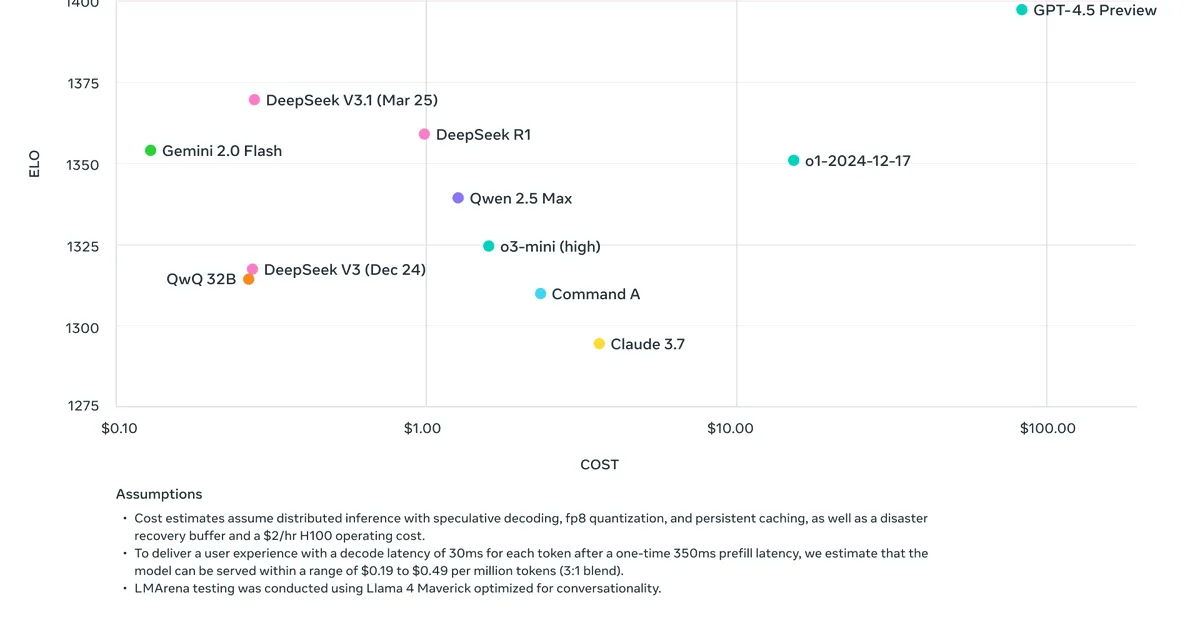
Meta's Llama 4 family represents the strongest open-weight models available, built on a mixture-of-experts (MoE) architecture that keeps inference efficient despite massive total parameter counts. Llama 4 Scout (17B active / 109B total parameters, 16 experts) handles up to 10 million tokens of context — the longest of any production model — while Llama 4 Maverick (17B active / 400B total, 128 experts) targets quality-critical tasks with benchmark scores competitive with GPT-4o and Gemini 2.5 Pro. Both models natively process text and images without bolted-on adapters.
The ecosystem around Llama is what truly sets it apart. Thousands of fine-tuned variants exist on Hugging Face for every niche imaginable — medical, legal, code, multilingual. You can run quantized Llama 4 Scout on a single high-end GPU, or deploy Maverick across a small cluster. Every major cloud provider (AWS Bedrock, Azure AI, Google Cloud, Together, Groq, Fireworks) offers Llama 4 as a managed API, typically at a fraction of closed-model pricing. Meta AI at meta.ai also provides a free consumer chatbot powered by Llama 4 with web search, image generation, and integration across WhatsApp, Instagram, and Messenger.
The trade-off is clear: Llama gives you control and cost savings, but you're responsible for the infrastructure, guardrails, and tooling that closed-source providers bundle in. For teams with ML engineering capability, it's often the best dollar-for-quality option. For individuals wanting a polished chat experience, the Meta AI chatbot works but doesn't match ChatGPT or Claude in UX refinement.
Is Meta Llama free?
Yes. Meta Llama is free to use.
What the free tier covers: Completely free when self-hosted. Meta AI chatbot is free for consumer use.
Listed pricing: Free (self-hosted) · Cloud API pricing varies by provider.
Pricing verified . That is the date the plans were last re-checked against the vendor's own pages, not today's date. Confirm on the official site before you pay.
What the free tier leaves out
Read straight off the plan list below. Vendors move features between tiers, so check the current split before you pay.
- Cloud APIs ~$0.10–0.90/M tokens Available on AWS Bedrock, Azure, Google Cloud, Together, Groq, Fireworks, and others. Pricing varies by provider and model size.
Meta Llama pricing
| Plan | Price | What's included |
|---|---|---|
| Self-hosted | Free | Download and run on your own hardware. Quantized Scout runs on a single 24GB GPU; Maverick needs multi-GPU setup. |
| Meta AI Chatbot | Free | Consumer chatbot at meta.ai with web search, image gen, and social platform integration. No API access. |
| Cloud APIs | ~$0.10–0.90/M tokens | Available on AWS Bedrock, Azure, Google Cloud, Together, Groq, Fireworks, and others. Pricing varies by provider and model size. |
Download and run on your own hardware. Quantized Scout runs on a single 24GB GPU; Maverick needs multi-GPU setup.
Consumer chatbot at meta.ai with web search, image gen, and social platform integration. No API access.
Available on AWS Bedrock, Azure, Google Cloud, Together, Groq, Fireworks, and others. Pricing varies by provider and model size.
Pricing verified . That is the date the plans were last re-checked against the vendor's own pages, not today's date. Confirm on the official site before you pay.
Is Meta Llama worth it?
Worth it for Teams with ML engineering capability who want open-weight models to self-host, fine-tune, or deploy through cloud APIs instead of paying per query for a closed model.
You can test that on the free tier before paying anything. The recorded trade-offs are listed below, and any one of them can settle the question on its own.
The 8.7/10 AI Score is an editorial read of published capability, price and shipping pace. Nobody here has hands-on hours with Meta Llama. How we verify.
Worth it if
The strengths recorded against this entry.
- Fully open weights — download, modify, and deploy without per-query costs
- Llama 4 Scout offers 10M token context, the longest available in any production model
- MoE architecture delivers strong quality at much lower inference cost than dense models
- Massive ecosystem of fine-tuned variants, tooling, and cloud provider support
- Meta AI chatbot provides free consumer access across WhatsApp, Instagram, and Messenger
Not worth it if
Any one of these blocks your use case.
- Still trails top closed models (Claude Opus 4, GPT-4.5) on complex reasoning and nuanced writing
- Running larger models locally requires serious hardware — Maverick needs multi-GPU setups
- No official desktop app or IDE integration; consumer experience limited to Meta AI chatbot
- Llama Community License restricts companies with 700M+ monthly active users
What sets Meta Llama apart
- Fully open weights, free to download, modify, and deploy
- Llama 4 Scout supports 10M tokens of context, longest of any production model
- Mixture-of-experts architecture cuts inference cost versus dense models of similar quality
- Large ecosystem of fine-tuned variants and multi-cloud API availability
Key features
Llama 4 MoE Architecture
Mixture-of-experts design activates only 17B parameters per token while drawing on up to 400B total. This delivers frontier-class quality at a fraction of the compute cost of dense models of equivalent capability.
Native Multimodal
Llama 4 models process images and text natively — no separate vision adapter. Supports image understanding, chart reading, document analysis, and visual question answering out of the box.
10M Token Context
Llama 4 Scout supports up to 10 million tokens of context, the longest of any production model. Maverick supports 1M tokens. Both enable processing entire codebases, book-length documents, or extended conversation histories.
Open Weights & Fine-tuning
Download full model weights under the Llama Community License. Fine-tune with LoRA, QLoRA, or full-parameter training on your own data. Run quantized versions locally on consumer GPUs or deploy at scale on any cloud.
How it compares
| Tool | Best for | Pricing | Score |
|---|---|---|---|
| Meta Llama | Teams with ML engineering capability who want open-weight models to self-host, fine-tune, or deploy through cloud APIs instead of paying per query for a closed model. | Free (self-hosted) · Cloud API pricing varies by provider | 8.7/10 |
| ChatGPT vs ChatGPT → | Users who want one subscription covering reasoning, voice, vision, image and video generation, and agentic browsing in a single app. | Free tier + Plus $20/mo + Pro $200/mo | 9.5/10 |
| Claude vs Claude → | Developers and professionals who need agentic coding, computer control, and large-document or codebase analysis in one assistant. | Free tier + Pro $20/mo + Team $30/mo/user | 9.5/10 |
| Gemini vs Gemini → | Google Workspace users who want an assistant that can read their Gmail, Drive, and Calendar while reasoning across huge documents or videos in one pass. | Free tier + Advanced $19.99/mo | 9.2/10 |


Compare head-to-head
Related reading

Gov and Big Labs Get Frontier AI First. We Don't.
The most capable AI now reaches a few labs and the government first, then trickles to the public in guardrailed form. Why that precedent matters.
GPT-Live's one stream vs Gemini 3.8 Live
OpenAI's GPT-Live listens and speaks on one WebSocket. Google's Gemini 3.8 Live reasons while talking. Specs, prices, and who each model is for.
ChatGPT Finances Experian Soft Credit Check: What Shipped
U.S. Plus/Pro ChatGPT Finances can connect Experian for a soft-pull VantageScore 3.0. What OpenAI's Help Center says about setup, monthly updates, and what not to paste in chat.
Ready to try Meta Llama?
Head to the official site to start with Meta Llama — pricing and plans are listed above.
Visit Meta Llama