Ode With Anthropic: The $1.5B Enterprise AI Bet
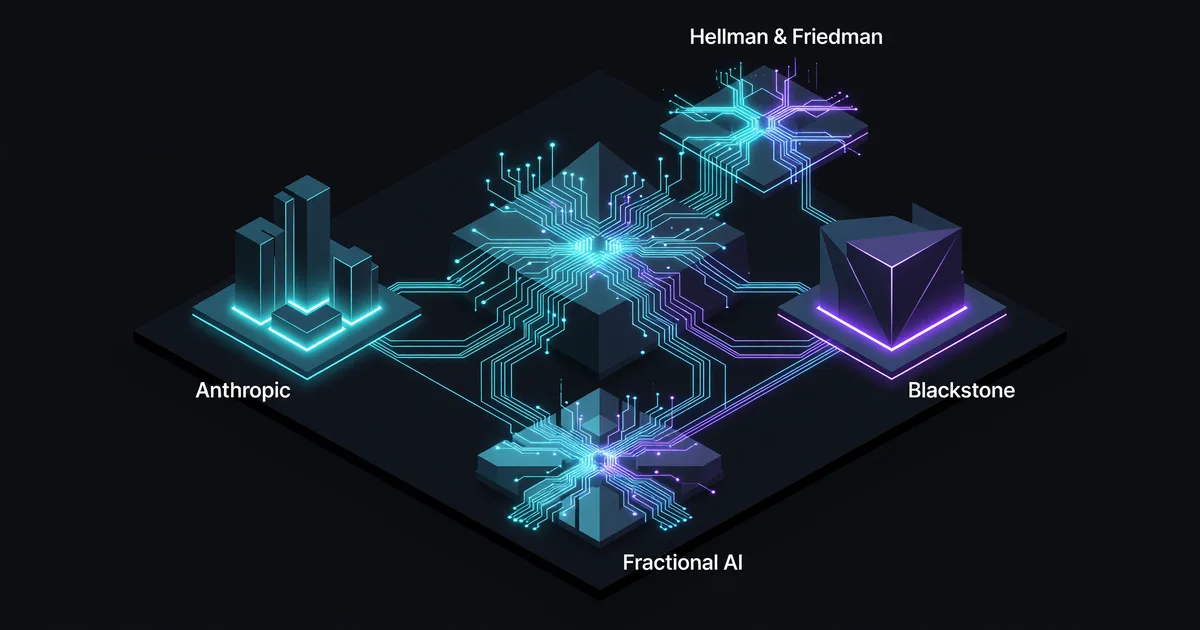
Anthropic, Blackstone, and Hellman & Friedman launched Ode with Anthropic, a $1.5B Claude-first services firm that just bought Fractional AI.
Anthropic, Blackstone, and Hellman & Friedman put a name and a brand on their joint venture on July 15, 2026: Ode with Anthropic, an enterprise AI services firm capitalized at roughly $1.5 billion, per the BusinessWire release announcing it. The venture was structured back in May. This week it got a logo, a leadership pitch, and confirmation of its first acquisition, Fractional AI, an implementation shop whose engineers will now sit inside client companies building on Claude.
Read the participant list again. Anthropic is the model lab. Blackstone and Hellman & Friedman are two of the largest private-equity firms on the planet. That combination tells you what Ode is for, and it has almost nothing to do with the next model release.
Ode sells the work of getting Claude into a company, not Claude itself
The thing Ode is selling is deployment. Not API access, not a fine-tune, but the human-and-integration labor of taking a frontier model and wiring it into one enterprise's data, workflows, compliance posture, and legacy stack. Anthropic already sells the model. What it hasn't owned is a channel that does the six-month engagement of making that model earn its keep inside a bank, an insurer, or a logistics company.
That gap is where consultancies live. Accenture, Deloitte, and the big systems integrators have booked huge AI-implementation revenue precisely because most companies can't do this work themselves. Ode is Anthropic building its own version of that channel, with the model vendor's incentives baked in from day one. The engineers Ode embeds are meant to be Claude-first, not model-agnostic consultants who happen to reach for whatever's cheapest that quarter.
TechCrunch framed the launch under a blunt headline: the next trillion-dollar AI business is implementation, not models. Whether or not you buy the trillion-dollar figure, the strategic read is sound. Raw model capability is converging. Gemini, GPT-5.6, Grok 4.5, and Claude trade the top of the benchmark tables month to month. The durable margin increasingly sits in the layer that turns a capable model into a working system a Fortune 500 will actually pay to keep running.
Fractional AI is the acquisition that makes the pitch real on day one
A services firm with no people is a slide deck. Buying Fractional AI is how Ode shows up on launch day with actual delivery capacity. Fractional AI's business was already embedding engineers into companies to ship AI features. Folding that team into Ode gives the new entity a bench of implementation engineers instead of a hiring plan.
This is the part I'd watch most closely. Consulting is a talent business. It scales at the speed you can recruit, train, and retain senior engineers who can walk into a client's messy codebase and be useful in week one. An acquisition buys you a starting roster. It does not solve the harder problem of growing that roster tenfold without the quality drifting. Ode's cap table gives it money to hire aggressively. Money has never been the bottleneck in consulting. People are.
Why the private-equity backers matter more than the dollar figure
Blackstone and Hellman & Friedman are not in this for a nice logo. Both firms own or control large portfolios of companies across finance, healthcare, software, and industrials. Those portfolio companies are a built-in, warm customer base for exactly the service Ode is selling. A PE firm that installs Claude-first AI across its holdings can argue it's raising the value of every asset before it sells.
So the structure is doing two jobs at once. It funds Ode, and it hands Ode a distribution list that most new consultancies would spend years building. That is the underappreciated piece of this deal. The backers aren't just capital. They're the first several quarters of pipeline.
Where this fits in Anthropic's recent pattern of moves
Ode doesn't appear out of nowhere. It lands in the middle of a run of Anthropic decisions that all point the same direction: own more of the stack between the model and the paying customer.
- Anthropic acquired Stainless, the SDK-builder that had been generating OpenAI's own client libraries, tightening its grip on the developer-tooling layer.
- It put $350 million into an AI economic push and struck a $200 million arrangement tied to the Gates Foundation, both aimed at deployment and adoption rather than pure research.
- On the compute side it locked in a SpaceX deal for 220K GPUs and a $1.8 billion Akamai arrangement, buying the capacity to serve enterprise-scale Claude workloads.
Put those together and Ode reads as the go-to-market end of a coherent plan. Secure compute, own the tooling, then build the services arm that puts engineers in the room with the customer. Each move reduces Anthropic's dependence on someone else sitting between Claude and the enterprise that pays for it.
The channel-conflict question nobody at the launch answered
Here's the tension. Anthropic sells Claude to Accenture, to Deloitte, to every integrator that builds on frontier models. Those partners now compete with a firm Anthropic co-owns. If you're a systems integrator who just watched your model vendor launch a rival implementation shop with private-equity muscle behind it, do you keep steering clients toward Claude, or do you quietly favor a model whose maker isn't also chasing your services revenue?
Anthropic will say Ode expands the market rather than cannibalizing partners, and there's a version of that which is true. Demand for implementation labor far outstrips supply right now. But the incentive question is real, and the launch materials don't resolve it. My read: this is the kind of friction that stays invisible while the market is growing fast and gets loud the moment it isn't.
Ode against the field it's actually entering
It helps to be precise about who Ode competes with, because it's not one group.
| Competitor type | Example | Ode's edge | Their edge |
|---|---|---|---|
| Global consultancies | Accenture, Deloitte | Model-vendor alignment, Claude-first depth | Scale, decades of enterprise relationships |
| AI-native services firms | The wave Fractional AI came from | Capital, PE distribution, brand | Speed, less bureaucracy |
| OpenAI's deployment arm | OpenAI's $4B consulting push | Focused single-model story | Larger install base of ChatGPT users |
That last row matters. OpenAI has already built out a consulting and deployment company of its own, reported around the $4 billion mark. So Ode isn't a novel idea so much as Anthropic matching a move OpenAI made first. The frontier labs have independently concluded that owning the deployment layer is worth billions, which is itself a strong signal about where they think the money goes next.
What the launch left unanswered
The announcement is heavy on positioning and light on the numbers that would let you judge it.
- Headcount and ramp. How many engineers does Ode have post-Fractional acquisition, and how fast can it credibly grow that number without diluting quality?
- Revenue model. Fixed-bid projects, time-and-materials, or outcome-based pricing tied to whatever Claude deployments deliver? The economics differ wildly.
- Exclusivity. Is Ode contractually Claude-only, or can it deploy a rival model if a client insists? The answer defines how much of a channel conflict this really is.
- Fractional's price. Terms of the acquisition weren't disclosed in the launch materials, so the actual size of the bet inside the $1.5 billion is unclear.
Until those land, the fair way to describe Ode is a well-funded, well-connected bet that the hardest part of enterprise AI is no longer the model. If that thesis holds, embedding Claude-first engineers inside companies is a smart place to sit. If capability stops converging and one lab pulls decisively ahead, the calculus shifts back toward whoever has the best model, and a single-vendor services firm is suddenly carrying more risk than edge.
For now the more interesting fact is that Anthropic, Blackstone, and Hellman & Friedman were willing to put $1.5 billion behind the first answer.
Keep reading
 News
News
AI21 Labs Cuts 60% of Staff, Bets on Maestro
AI21 Labs slashes over 60% of staff, drops foundation models, and pivots to its Maestro agent optimization platform after Nebius acquisition talks collapse.
 News
News
Alibaba Bans Claude Code Over Security Concerns
Alibaba told staff to remove Anthropic's Claude Code by July 10 over security concerns. Here's what triggered the ban and what it signals.
 News
News
Anthropic Acquires Stainless: What It Means for AI
Anthropic bought Stainless, the SDK generator behind OpenAI and Cloudflare's client libraries. Here's the strategic play for AI agents.