Why OpenAI Built a $4B Consulting Firm
OpenAI's Deployment Company and Tomoro acquisition signal a strategic pivot from model maker to enterprise integrator. Here's why it matters.
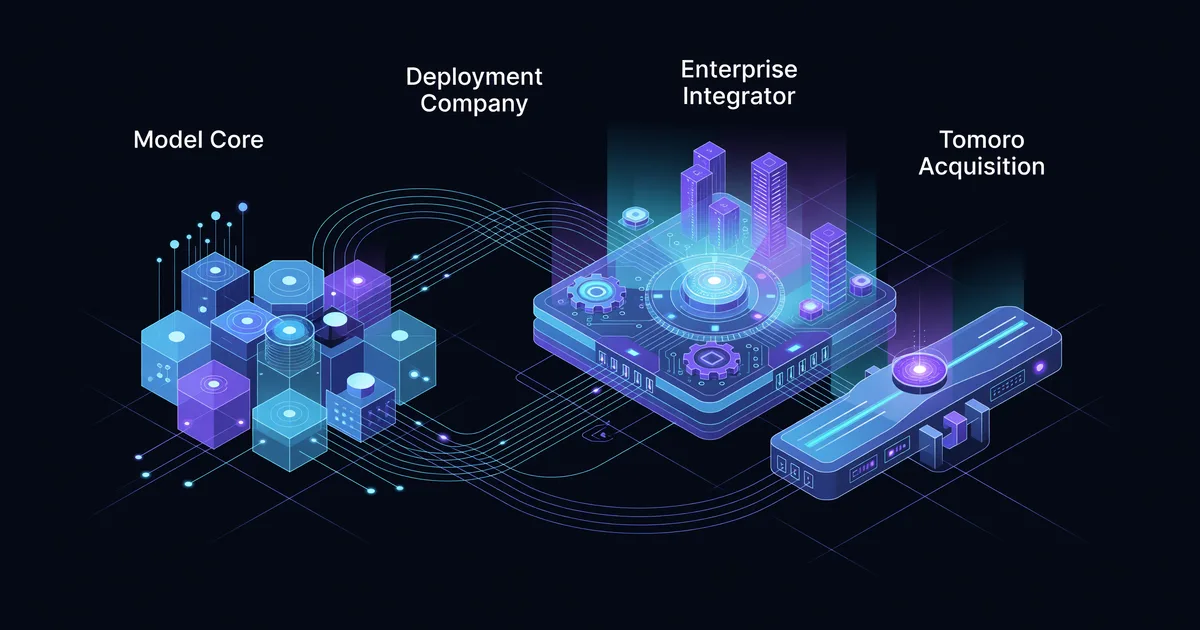
On May 11, OpenAI announced a dedicated enterprise consulting company capitalized at over $4 billion, whose entire job is helping corporations use AI rather than build or train it. Two years ago that would have read as a category error. Today it reads as OpenAI conceding something the enterprise software industry worked out decades ago: the product is roughly 20% of the sale, and the other 80% is integration, change management and hand-holding.
The OpenAI Deployment Company launched with backing from TPG, Bain Capital and Brookfield, alongside the acquisition of Tomoro, an AI consultancy with roughly 150 deployment specialists and a client roster including Mattel and Red Bull, per Tomoro's own announcement and Reuters reporting from May 11.
TPG, Bain and Brookfield do not fund research bets
The investor list carries more information than the headline number.
TPG manages over $220 billion in assets. Bain Capital sits north of $185 billion. Brookfield is one of the largest infrastructure investors on the planet. None of them is a frontier-AI-curious venture fund. They are private equity firms that buy businesses expected to produce predictable cash on a reasonable timeline, and they price accordingly.
Structuring the unit as a PE-backed entity says OpenAI wants it read as a revenue business rather than a research cost center. It also keeps the unit's economics cleanly separated from the $8 billion-plus in annual compute spend that funds model training. The Deployment Company raises its own capital, books its own revenue, and presumably carries its own P&L. That is a different financial architecture from selling API tokens and hoping enterprises work the rest out themselves.
Tomoro's 150 people do the unglamorous half of the work
Tomoro's deployment specialists are not researchers or prompt engineers. Per the company's own announcement, they map business processes, handle data governance, build integration layers, manage rollouts, and sit in the meetings where a CTO's skepticism collides with what a model can actually do.
OpenAI conspicuously lacked that skill set. ChatGPT and the GPT API are products developers and individuals adopt on their own initiative. A Fortune 500 company does not plug in an API key and declare victory. It needs custom data pipelines that reach internal systems without breaking compliance, security review and red-teaming against its own threat model, change management so employees actually use what was bought, KPIs concrete enough to defend the spend to a CFO, and continuous optimization as models and use cases move underneath everyone.
All of that is consulting work, and Tomoro's team has done it at companies like Mattel and Red Bull. OpenAI bought the playbook and the people who wrote it in the same transaction.
Cloud migration already ran this experiment
The closest historical parallel is cloud. AWS, Azure and GCP built the platforms; Accenture, Deloitte and Cognizant made billions moving enterprises onto them. By the mid-2010s Accenture alone was pulling over $3 billion annually from cloud services, more than several cloud providers earned directly from their smaller customers.
OpenAI is going after both halves at once, and the strategic logic holds up. Controlling deployment gives you direct signal on what enterprises actually need, which feeds product decisions that would otherwise be guesswork. It also produces lock-in of a much stickier kind. Swapping one LLM API for another is a weekend. Unwinding a deep integration built by the model provider's own engineers is a reorganization.
The endgame is to make leaving OpenAI an organizational decision rather than a technical one. Once OpenAI engineers are embedded in your workflows, moving to Claude or Gemini means ripping out considerably more than an API call.
Every major lab is solving deployment differently
The deployment gap is not a secret, and each of the large players is attacking it from a different starting position.
| Company | Deployment Strategy | Advantage | Gap |
|---|---|---|---|
| OpenAI | Dedicated $4B Deployment Company + Tomoro | Purpose-built, PE-funded, owns the model stack | No existing enterprise sales force |
| Microsoft | Copilot in M365 + Azure OpenAI Service | 400M+ existing Office users, massive sales org | Dependent on OpenAI's models |
| Gemini via Google Cloud + Workspace | Established cloud sales team, first-party models | Enterprise cloud market share trails AWS/Azure | |
| Anthropic | AWS Bedrock partnership + direct enterprise sales | Claude's safety reputation, Amazon distribution | No dedicated deployment arm |
| Big 4 consultancies | Model-agnostic AI transformation practices | Existing enterprise relationships at scale | Don't control the model layer |
Microsoft holds the strongest structural position. Copilot ships inside products enterprises already pay for, which is deployment by default rather than deployment as a project. Google has a credible cloud sales force but trails on enterprise AI mindshare. Anthropic has been putting its effort into compute infrastructure instead, with the $1.8 billion Akamai deal and the SpaceX Colossus lease, and has built no services arm.
The sharper collision is with Accenture, Deloitte and McKinsey. They have been building AI practices hard, but they are model-agnostic by design. OpenAI's Deployment Company hits them head-on while being vertically integrated with the model itself, which supports a pitch enterprise buyers have not heard before: we did not recommend this AI, we built it, and we will install it.
The Deployment Company routes around Microsoft
This part is getting less attention than it deserves. Microsoft has been OpenAI's primary route into enterprises through Azure OpenAI Service. Customers reach GPT models via Azure, pay Microsoft, and receive Microsoft's enterprise support.
A dedicated deployment arm disintermediates Microsoft on exactly the deals worth the most. If OpenAI's own specialists can embed directly, the reason to route a Fortune 500 engagement through Azure's enterprise team gets thin, and OpenAI keeps the relationship, the data feedback loop and presumably a better margin than the Azure revenue share leaves it.
Microsoft invested $13 billion in OpenAI substantially to be that enterprise distribution layer. OpenAI standing up its own distribution arm on $4 billion of non-Microsoft capital is a step toward independence, and Microsoft's enterprise organization has no reason to enjoy it.
Four things the announcement did not answer
Model exclusivity is the first. If the Deployment Company works only with OpenAI models, lock-in improves and the addressable market shrinks, since plenty of enterprises now run deliberate multi-model strategies and will not accept a single-vendor constraint.
Leadership is the second. A CEO genuinely independent of Sam Altman would indicate operational autonomy. A direct report indicates an OpenAI division wearing a corporate wrapper.
Pricing is the third. Consulting traditionally runs time-and-materials or fixed-fee. Outcome-based pricing, taking a percentage of measured efficiency gains, would be a real differentiator and considerably harder to structure.
Scope is the fourth, and it determines who the Deployment Company is actually competing with. Model integration alone leaves room to complement systems integrators. Full stack, meaning data infrastructure, MLOps, security and ongoing monitoring, puts it directly against them.
Where this could go wrong
This is likely the most strategically sound move OpenAI has made in 2026, because the industry's bottleneck has moved. Two years ago the binding constraint was model capability. Now it is deployment velocity, meaning how quickly an enterprise can get a capable model into production and keep it there.
OpenAI's API revenue reportedly crossed $5 billion in annualized run rate by late 2025, per Bloomberg, but that revenue skews heavily toward developers and small businesses who self-serve. The Fortune 500 engagements, the ones worth $10 million a year and up, need white-glove service the existing organization was never built to provide. Four billion dollars of PE money is well-matched capital for that specific problem, and Tomoro supplies credibility and execution capacity on day one.
Execution is the real risk. Consulting runs on utilization rates, project management and client relationships. Research runs on talent density, compute budgets and breakthrough timelines. Housing both, even in a separate entity, is genuinely difficult, and it is a large part of why Google Cloud spent years building a credible enterprise sales motion on top of world-class technology. If the Deployment Company starts pulling engineering talent or executive attention away from model work, it weakens OpenAI's core position precisely as Anthropic and Google close the capability gap.
For enterprise buyers the calculus is simpler and better. More competition in deployment services, a purpose-built option coming from the model provider itself, and $4 billion in capital signaling that OpenAI intends to make enterprise AI work in production rather than in a keynote.
Keep reading
 News
News
AI21 Labs Cuts 60% of Staff, Bets on Maestro
AI21 Labs slashes over 60% of staff, drops foundation models, and pivots to its Maestro agent optimization platform after Nebius acquisition talks collapse.
 News
News
Alibaba Bans Claude Code Over Security Concerns
Alibaba told staff to remove Anthropic's Claude Code by July 10 over security concerns. Here's what triggered the ban and what it signals.
 News
News
Anthropic Acquires Stainless: What It Means for AI
Anthropic bought Stainless, the SDK generator behind OpenAI and Cloudflare's client libraries. Here's the strategic play for AI agents.