Anthropic's $200M Gates Foundation Deal Explained
Anthropic committed $200M in grants and Claude credits to the Gates Foundation for global health and education. Here's the strategic calculus.
Anthropic Is Spending $200 Million on Global Health and Education
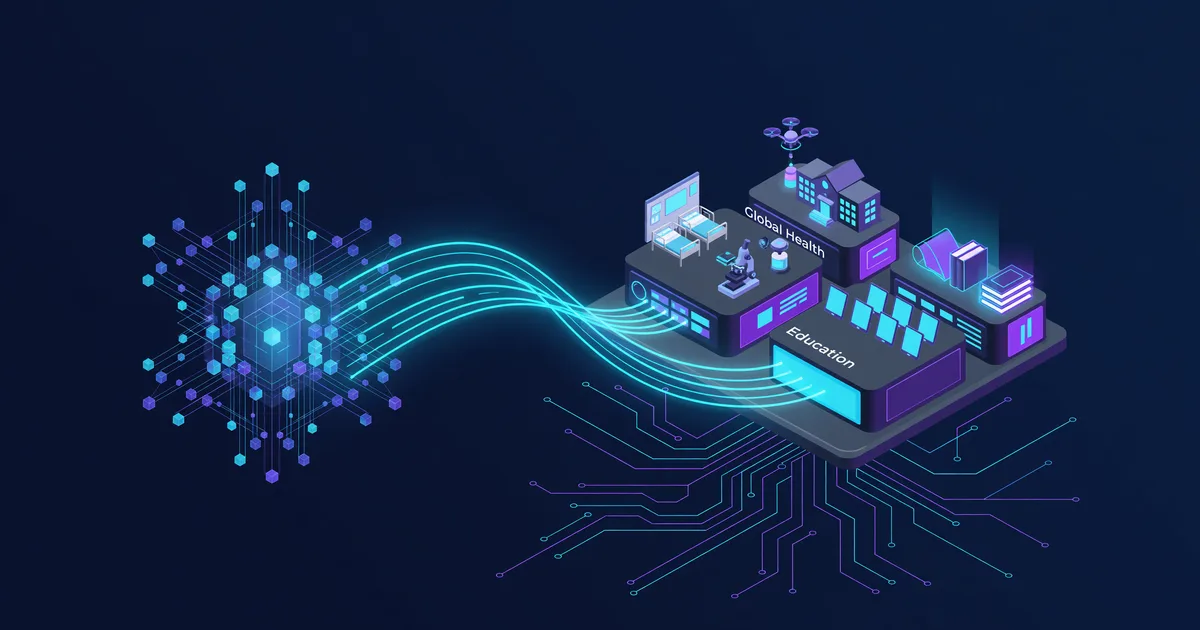
Anthropic and the Bill & Melinda Gates Foundation announced a $200 million partnership on May 14, 2026 (per Reuters and Anthropic's official blog). The deal covers grants, Claude API credits, and dedicated technical support — aimed at deploying AI across global health, education, agriculture, and economic mobility programs in low- and middle-income countries.
This isn't charity in the traditional sense. It's a calculated bet that positions Anthropic differently from every other frontier lab — and the timing tells you as much as the dollar amount.
What the $200M Actually Covers
Based on the official announcements from both Anthropic and the Gates Foundation, the partnership breaks down into three components:
- Direct grants — funding for Gates Foundation partners (NGOs, governments, research institutions) to build AI-powered tools in health diagnostics, agricultural advisory systems, and educational content delivery
- Claude API credits — free or subsidized access to Claude models for qualifying development projects within the Foundation's portfolio
- Technical support — Anthropic engineers embedded with Foundation teams to help adapt Claude for low-resource languages, offline-capable deployments, and domain-specific fine-tuning
The focus areas — health, education, agriculture, economic mobility — map directly to the Gates Foundation's existing program structure. This isn't Anthropic proposing new initiatives; it's Anthropic plugging its technology into the Foundation's established pipeline of active grants across 130+ countries.
Why This Is Strategic, Not Just Philanthropic
Let's be direct about what Anthropic gets from this deal beyond goodwill:
1. Real-world deployment data at scale. The Gates Foundation operates in environments that stress-test AI systems in ways Silicon Valley QA never could — intermittent connectivity, multilingual populations, low-literacy users, life-or-death accuracy requirements in health contexts. Every Claude deployment through this partnership generates feedback that makes the model better for everyone.
2. Regulatory goodwill. As AI regulation accelerates globally (the EU AI Act, proposed US frameworks, India's upcoming AI governance rules), having a visible track record of deploying AI for public benefit is worth more than any lobbying budget. Anthropic can point to measurable outcomes in maternal health or crop yield optimization when regulators ask "what good does this technology actually do?"
3. Distribution in emerging markets. The Gates Foundation's network spans governments, health ministries, and educational systems across Africa, South Asia, and Southeast Asia. Every integration built through this partnership creates switching costs. If a health worker in Kenya learns to use Claude for diagnostic support, that's a user who won't easily migrate to GPT or Gemini later.
My read: This is Anthropic's version of Google's "next billion users" strategy — except instead of giving away Android phones, they're embedding Claude into institutional infrastructure where it becomes load-bearing.
How This Fits Anthropic's Broader Pattern
In the past two weeks alone, Anthropic has announced:
- A lease on SpaceX's Colossus 1 cluster (220K+ GPUs for training)
- A $1.8 billion, seven-year cloud deal with Akamai (distributed inference)
- This $200M Gates Foundation partnership (social-impact deployment)
Each move addresses a different layer of the stack. Colossus 1 solves training compute. Akamai solves inference distribution. The Gates Foundation deal solves deployment reach and institutional trust. Together, they paint a picture of a company building a full-spectrum AI deployment capability — from raw compute all the way to end-user adoption in the hardest-to-reach populations.
Compare this to OpenAI's strategy: Microsoft provides both the compute and the enterprise distribution channel (via Copilot, Azure, Office 365). OpenAI's social-impact work exists but is comparatively small-scale.
| Company | Social Impact Investment | Primary Channel |
|---|---|---|
| Anthropic | $200M (Gates Foundation partnership) | Grants + credits + embedded engineering |
| OpenAI | Smaller-scale nonprofit access programs | Subsidized API credits |
| Google DeepMind | Undisclosed (various health AI projects) | Internal research teams |
| Meta AI | Open-source model releases | Llama downloads |
The scale difference is notable. $200M is a serious allocation for Anthropic at this stage, not a PR line item.
The Gates Foundation's AI Bet
From the Foundation's perspective, this partnership represents a significant shift in how it approaches technology deployment. The Gates Foundation has historically been cautious about AI — Bill Gates has spoken publicly about both its promise and risks. Choosing Anthropic specifically (rather than OpenAI, Google, or an open-source approach) signals a few things:
- Safety emphasis matters to the Foundation. Anthropic's Constitutional AI approach and its public commitment to responsible scaling likely influenced the decision. When you're deploying health diagnostics tools in low-resource settings, the cost of a hallucinated medical recommendation is measured in lives, not customer support tickets.
- The Foundation wants a dedicated partner, not an API vendor. The "embedded technical support" component suggests deep integration — Anthropic engineers working directly with Foundation program teams, not just providing documentation and a billing portal.
- Multi-year commitment horizon. The Gates Foundation typically structures partnerships in 3-5 year cycles aligned with their strategy reviews. This isn't a one-year pilot.
What We Don't Know Yet
Several important details remain undisclosed:
- The funding split. How much is direct grants vs. Claude credits vs. engineering time? The economics differ enormously — $100M in API credits costs Anthropic far less than $100M in cash grants (the marginal cost of API calls is mostly compute, which they're buying at wholesale via Akamai and Colossus anyway).
- Exclusivity. Can Gates Foundation partners also use GPT, Gemini, or open-source models? Or does this partnership create a Claude-only environment within certain programs?
- Measurement framework. How will success be measured? The Foundation is rigorous about impact evaluation — they'll presumably apply the same standards to AI deployments as to vaccine programs or agricultural interventions.
- Data governance. Health data from low-income countries flowing through a US AI company's systems raises legitimate sovereignty concerns. Neither announcement addressed this directly.
I think the data governance question is the sleeper issue here. If Claude processes patient health records or agricultural data from African nations, the legal and ethical frameworks governing that data flow are genuinely complex and largely unsettled.
The Honest Take
This is a smart deal for both parties. Anthropic gets real-world deployment scale, regulatory credibility, and emerging-market distribution at a cost that's partially denominated in API credits (which have high face value but lower marginal cost). The Gates Foundation gets a dedicated AI partner with arguably the strongest safety credentials in the industry, plus engineering resources they couldn't hire independently at any price.
The risk is execution. Deploying AI in low-resource settings is genuinely hard — not "hard like scaling to millions of paying subscribers" hard, but "hard like making a language model useful for a farmer who speaks Hausa and has intermittent 2G connectivity" hard. If the outputs don't work reliably in those conditions, the partnership becomes an expensive press release.
But if it works? Anthropic will have done something no other AI lab has managed: built a credible claim that frontier AI isn't just a product for wealthy knowledge workers in rich countries. That narrative has regulatory, commercial, and moral value that far exceeds $200M.
Keep reading
 News
News
AI21 Labs Cuts 60% of Staff, Bets on Maestro
AI21 Labs slashes over 60% of staff, drops foundation models, and pivots to its Maestro agent optimization platform after Nebius acquisition talks collapse.
 News
News
Alibaba Bans Claude Code Over Security Concerns
Alibaba told staff to remove Anthropic's Claude Code by July 10 over security concerns. Here's what triggered the ban and what it signals.
 News
News
Anthropic Acquires Stainless: What It Means for AI
Anthropic bought Stainless, the SDK generator behind OpenAI and Cloudflare's client libraries. Here's the strategic play for AI agents.