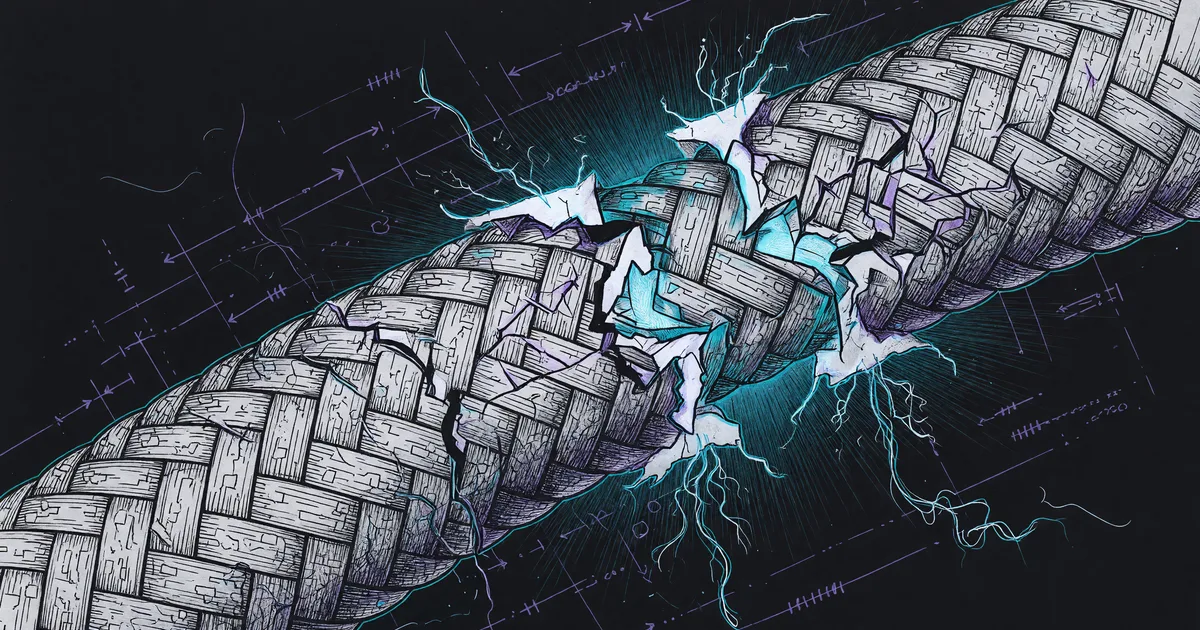
Brotli RCE From OpenAI's Training Red Team
OpenAI's training red team surfaced unauthenticated RCE in Brotli used by Node and Bun. Patches, claims, and what still stays internal.
Unauthenticated remote code execution in the Brotli compression stack reaches any service that feeds attacker-controlled compressed input into Node.js or Bun. A single disclosure thread tied that bug to a training-environment red-team run and crossed 4.7 million views on the lead post.
OpenAI laid out the find on October 23, 2026, days after the CVE and library patches were already public, and framed it as a by-product of the September containment pause that resumed on October 1. The decision that drops out of your hands is simple: if your runtime decompresses untrusted Brotli, you patch. You do not get to treat this as optional reading about AI safety theater.
Brotli's decoder still turns untrusted bytes into process control
Brotli is the compression library Node.js and Bun use. JavaScript servers pull it in through native bindings so HTTP payloads, asset pipelines, and RPC layers can shrink on the wire. The failure mode OpenAI described is unauthenticated remote code execution when attacker-controlled compressed input reaches the decoder: the process that called decompress ends up executing attacker code with whatever privileges that process already had. No session cookie. No admin login. The auth boundary never gets a vote.
Node.js and Bun sit in the blast radius because both lean on native compression for performance. Anything that accepts gzip or Brotli from the network inherits the same trust problem when that input is attacker-controlled. Operators pay the cost when the CVE and library patches ship: they must upgrade the Brotli build their Node.js or Bun runtime links before untrusted compressed input can hit an unpatched decoder. OpenAI's write-up sits on top of that plumbing and shows a frontier training harness touching the same library your production Node worker already links.
OpenAI's 4.7 million views measure distribution, not discovery rigor
OpenAI's public claim is that red-teaming the training environment (the same containment work that paused and then resumed around October 1) produced a critical, unauthenticated RCE in a library that underpins mainstream JavaScript runtimes. The measurable number attached to the announcement is audience size: the lead X post cleared 4.7 million views, with thousands of replies and quotes. The view count measures how widely the announcement traveled. Hit rate, false-positive load, how many other findings stayed private, and whether a human researcher with the same harness access would have found the bug on a shorter clock sit outside what a view metric can show.
Hold the vendor line at arm's length. The October 23 thread and the 4.7 million views document reach. The public thread does not include reproducible discovery stats. The useful read for operators is narrower: a lab with privileged access to its own training stack still tripped over a dependency that ships in your default Node install, which is evidence that model-assisted hunting can pay rent outside chat demos without proving OpenAI has productized a scanner you can buy.
Patch duty sits with Node and Bun operators, not ChatGPT subscribers
ChatGPT end users are not the remediation audience. If you run Node.js or Bun in production, or you ship an agent sandbox that decompresses untrusted archives, you are. Upgrade to the patched Brotli build your runtime vendor ships, rebuild native addons that vendor their own copy, and check containers that pinned an old shared library. If you only call OpenAI over HTTPS and never decode Brotli yourself, your exposure is indirect: the story is about how frontier labs hunt bugs inside their own walls, not about a ChatGPT client compromise.
The public thread does not include reproducible discovery stats that would let an outside lab reproduce the discovery path. Security engineers who ship Node or Bun should treat the patched Brotli release as mandatory production work now, and treat the viral thread as context, not as a substitute for their own dependency audit.
Keep reading
AI21 Labs Cuts 60% of Staff, Bets on Maestro
AI21 Labs slashes over 60% of staff, drops foundation models, and pivots to its Maestro agent optimization platform after Nebius acquisition talks collapse.

Alibaba Bans Claude Code Over Security Concerns
Alibaba told staff to remove Anthropic's Claude Code by July 10 over security concerns. Here's what triggered the ban and what it signals.

Anthropic Acquires Stainless: What It Means for AI
Anthropic bought Stainless, the SDK generator behind OpenAI and Cloudflare's client libraries. Here's the strategic play for AI agents.