Nvidia-Hyundai Physical AI Deal: What It Means
Nvidia and Hyundai expand their partnership into physical AI, robotics, and AI factories. Here's what the Seoul agreements signal.
The Deal at a Glance
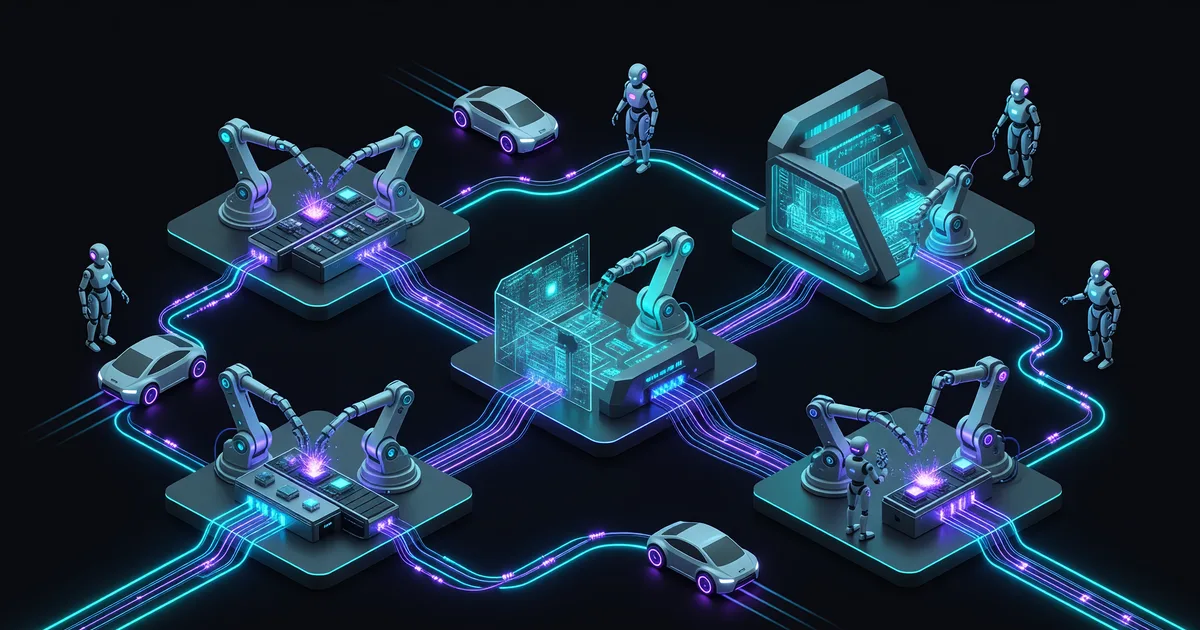
Nvidia and Hyundai Motor Group just expanded their partnership with a set of new agreements signed in Seoul, announced June 8-9, 2026. The scope: physical AI, robotics, autonomous mobility, and what Nvidia calls "AI factories" — GPU-dense data centers purpose-built to train and run models that control machines in the real world.
This isn't a brand-new relationship. Nvidia and Hyundai have worked together on autonomous driving through the NVIDIA DRIVE platform for years. What's changed is the ambition. The expanded partnership pulls in robotics, industrial simulation, and the full stack of Nvidia's physical AI platforms — Isaac for robotics, Omniverse for digital twins, Cosmos for world foundation models, and likely the GR00T humanoid framework. For Hyundai, the owner of Boston Dynamics and one of the world's largest automakers, this is a signal that physical AI has moved from R&D curiosity to boardroom priority.
Why Physical AI Is Nvidia's Next Big Bet
Jensen Huang has been saying "physical AI" in every keynote for the past two years, but the business case is finally catching up to the rhetoric. Software AI — chatbots, copilots, image generators — runs on the same GPUs Nvidia already sells. Physical AI requires something more: simulation environments to train robots before they touch real hardware, foundation models that understand physics and spatial reasoning, and edge compute that can run inference in real time on a factory floor or inside a vehicle.
That's a much larger addressable market than chatbot inference. Nvidia's pitch is that every robot, every autonomous vehicle, every automated warehouse will need:
- Training infrastructure — GPU clusters running simulation at scale (the "AI factory" concept)
- Simulation platforms — Omniverse for building digital twins of factories, cities, and warehouses
- Foundation models — Cosmos (world models that understand physics) and GR00T (humanoid robot foundation model)
- Edge deployment — Jetson Thor and DRIVE platforms for on-device inference
Hyundai checks every box as a partner. They build cars (autonomous mobility), own Boston Dynamics (humanoid and quadruped robots), operate massive manufacturing facilities (factory automation), and have the capital to deploy at scale.
What Hyundai Gets Out of This
Hyundai Motor Group isn't just a car company anymore. Since acquiring Boston Dynamics in 2021 and folding it into a broader robotics division, Hyundai has been positioning itself as a mobility-and-robotics conglomerate. The problem: building the AI software stack for physical systems is brutally hard, and Hyundai doesn't have the in-house AI infrastructure that a Google or Tesla does.
Nvidia's platform essentially lets Hyundai skip the hardest part. Instead of building simulation environments, training pipelines, and foundation models from scratch, they can build on top of Nvidia's stack:
- Autonomous vehicles: NVIDIA DRIVE provides the compute platform and software for self-driving. Hyundai's been using it, and the expanded deal likely deepens integration across more vehicle lines.
- Boston Dynamics robots: NVIDIA Isaac and GR00T give Boston Dynamics a path to make Atlas and Spot more autonomous — less teleoperated, more capable of learning and adapting in unstructured environments.
- Smart manufacturing: Omniverse digital twins let Hyundai simulate entire production lines before reconfiguring physical factories. This is where the near-term ROI likely lives — optimizing existing operations, not building humanoid robots for consumers.
- AI factories: Hyundai building or leasing GPU-dense data centers specifically for training physical AI models. This is the infrastructure layer that makes everything else possible.
The Competitive Landscape
Nvidia isn't the only company chasing physical AI, but they're building the picks-and-shovels layer that everyone else needs. Here's how the major players stack up:
| Company | Physical AI Approach | Key Asset |
|---|---|---|
| Nvidia | Platform provider (hardware + simulation + models) | Isaac, Omniverse, Cosmos, GR00T, DRIVE |
| Tesla | Vertically integrated (builds robots + cars + trains models) | Optimus, FSD, Dojo |
| Google DeepMind | Research-first (RT-2, Gemini Robotics) | Gemini multimodal models, Everyday Robots heritage |
| Meta | Open research (releasing robotics models) | Open-source foundation models |
| Hyundai/Boston Dynamics | Hardware-first (best-in-class robots, adding AI) | Atlas, Spot, manufacturing scale |
My read: Nvidia's position is uniquely strong because they don't compete with their customers. Tesla builds its own robots and cars — it's not going to license the platform to Toyota. Google DeepMind publishes research but doesn't sell a turnkey robotics stack. Nvidia sells to everyone, which is exactly the playbook that made them dominant in AI training.
The Hyundai deal matters because it validates the platform approach. If one of the world's largest automakers — one that also owns the most advanced robotics company on the planet — decides to build on Nvidia's stack rather than build their own, that's a strong signal about where the industry is headed.
AI Factories: The Concept Worth Watching
The "AI factory" framing is worth unpacking because it's central to how Nvidia thinks about physical AI infrastructure. Traditional data centers run software workloads — web servers, databases, SaaS apps. AI factories are purpose-built to produce intelligence: they take in data (sensor feeds, simulation runs, video) and output trained models.
For physical AI specifically, the compute requirements are staggering. Training a robot to navigate a warehouse requires running millions of simulated episodes. Training an autonomous vehicle requires processing petabytes of driving data. Each of these workloads needs clusters of GPUs running for weeks or months.
Nvidia has been signing infrastructure deals at a remarkable clip this year. We've covered their $3.2 billion Corning investment for optical interconnects, the IREN deal worth $3.4 billion for AI cloud capacity, and Anthropic's lease of SpaceX's Colossus cluster with 220K+ NVIDIA GPUs. The Hyundai partnership adds another dimension: instead of just selling GPUs to cloud providers and AI labs, Nvidia is now embedding its full stack inside the operations of a major industrial conglomerate.
That's the real strategic shift. Nvidia goes from "we sell chips to companies that train chatbots" to "we provide the intelligence layer for companies that build physical things."
What We Don't Know Yet
The Seoul agreements are light on specifics that would let us gauge the financial scale. A few open questions:
- Dollar value: Neither company has disclosed the financial terms of the expanded partnership. Given Nvidia's recent deals in the billions, the investment could be substantial — but we don't have numbers to cite.
- Timeline: When do the first products of this partnership ship? Autonomous vehicles and factory robots have notoriously long development cycles. A 2027-2028 deployment window for initial use cases seems plausible, but that's speculation.
- Boston Dynamics integration: The most exciting possibility — Atlas running on Nvidia's GR00T foundation model — hasn't been confirmed. Boston Dynamics has historically built its own control software. Whether they adopt Nvidia's stack or just use pieces of it will tell us a lot about how open the partnership really is.
- Exclusivity: Is Hyundai committing exclusively to Nvidia's platform, or hedging with other providers? Most automakers work with multiple chip suppliers. An exclusive deal would be a much stronger signal.
The honest take: partnership announcements between massive companies often sound bigger than they are. "Deepened collaboration" can mean anything from a multi-billion-dollar joint venture to a slightly expanded licensing agreement. The Seoul ceremony and executive presence suggest this is on the more serious end, but we'll need to see actual product announcements to judge the real impact.
Why This Matters Beyond Nvidia and Hyundai
Physical AI is where the AI industry's next trillion dollars lives. Software AI is already a huge market, but it's fundamentally bounded by how much text, code, and images humans need generated. Physical AI touches transportation, manufacturing, logistics, construction, agriculture — sectors that collectively represent a much larger share of global GDP.
The Nvidia-Hyundai deal is a leading indicator of a broader pattern: traditional industrial companies partnering with AI platform providers to bring intelligence into physical operations. Expect similar announcements from other automakers, manufacturers, and logistics companies throughout 2026.
For developers and engineers, the signal is clear: if you're thinking about where AI skills will be most valuable in the next five years, physical AI — robotics, simulation, sensor fusion, real-time inference — is worth paying attention to. The models are getting capable enough, the compute is getting cheap enough, and the industrial partners are now writing checks large enough to make it real.
The shift from "AI that writes code" to "AI that moves atoms" is the defining transition of the next decade. Nvidia is betting its platform strategy on it, and Hyundai just validated that bet.
Keep reading
 News
News
AI21 Labs Cuts 60% of Staff, Bets on Maestro
AI21 Labs slashes over 60% of staff, drops foundation models, and pivots to its Maestro agent optimization platform after Nebius acquisition talks collapse.
 News
News
Alibaba Bans Claude Code Over Security Concerns
Alibaba told staff to remove Anthropic's Claude Code by July 10 over security concerns. Here's what triggered the ban and what it signals.
 News
News
Anthropic Acquires Stainless: What It Means for AI
Anthropic bought Stainless, the SDK generator behind OpenAI and Cloudflare's client libraries. Here's the strategic play for AI agents.