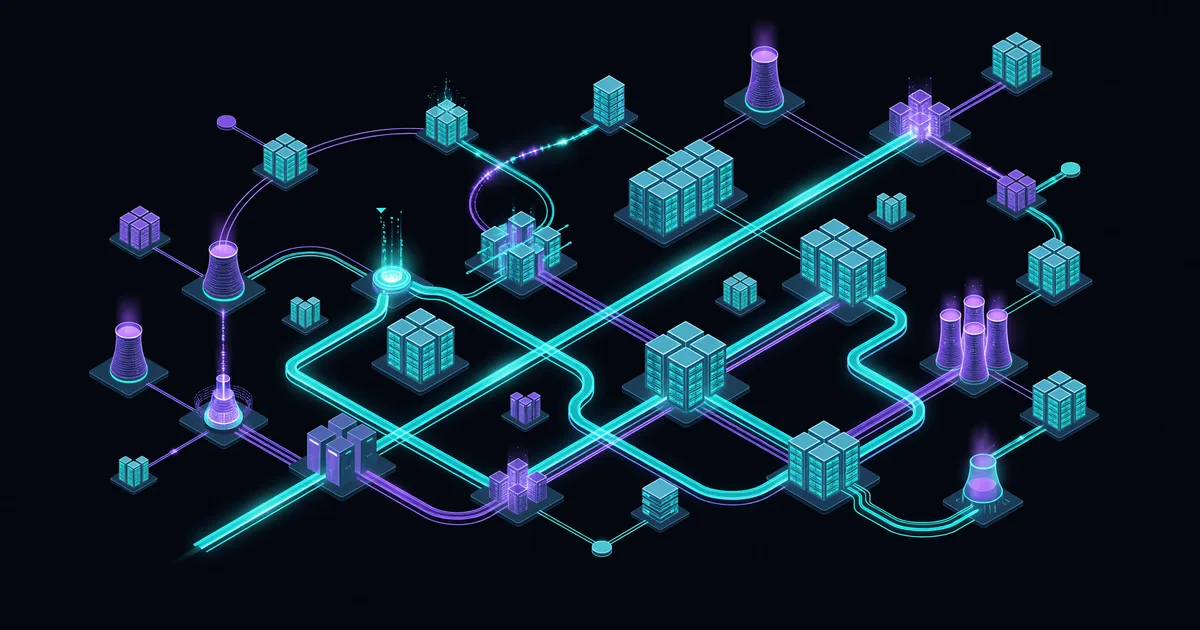
KKR's $10B Helix: AI Infra's Biggest Bet Yet
KKR, NVIDIA, Vistra, and Kuwait launch Helix Digital Infrastructure with $10B+ to build AI data centers and power systems.
Private Equity Just Built an AI Infrastructure Company From Scratch
KKR announced the launch of Helix Digital Infrastructure on June 11, 2026 — a new standalone company backed by over $10 billion in committed capital, purpose-built to finance and deliver AI data centers, power generation, and connectivity (per KKR's official press release via BusinessWire). The founding partners are KKR, NVIDIA, Vistra (one of the largest US power generators), and the Kuwait Investment Authority.
This isn't a fund. It's not a joint venture buried inside an existing company. It's a new, independent operating entity designed to be a single point of contact for hyperscalers who need power, land, networking, and GPU-ready facilities — all at once, at scale. That distinction matters more than the dollar figure.
Who's in the Room and Why It Matters
The partner composition tells you exactly what problem Helix is designed to solve. Each player brings a piece that the others can't easily replicate:
| Partner | What They Bring | Why They're Here |
|---|---|---|
| KKR | $10B+ capital, infrastructure deal expertise | Orchestrator and financial engine — KKR has deployed over $80B in infrastructure globally |
| NVIDIA | GPU supply relationships, technical specifications | Ensures facilities are designed around its hardware from day one |
| Vistra | Power generation fleet (~41 GW capacity) | Solves the binding constraint: electricity at scale, on schedule |
| Kuwait Investment Authority | Sovereign capital, long time horizon | Patient money that doesn't need quarterly returns — ideal for infrastructure |
The combination is deliberate. The biggest complaint from hyperscalers building AI infrastructure isn't about GPUs anymore — it's about power. Getting grid connections, generation capacity, and permits aligned with a data center build timeline can take 3–5 years. Having Vistra — which operates one of the largest competitive power generation fleets in the US — as a founding partner collapses that timeline significantly.
NVIDIA's involvement follows the same pattern it established with IREN's $3.4B deal (announced May 2026) and its CoreWeave investment: embed itself in the infrastructure layer so that new capacity comes online pre-configured for NVIDIA silicon. Every Helix facility will almost certainly be designed around NVIDIA's latest GPU architectures, not retrofitted for them after the fact.
The $10B Number in Context
$10 billion sounds massive. In AI infrastructure terms, it's a serious but not unprecedented commitment. Here's how it stacks up against recent AI infrastructure deals (all figures from public announcements):
| Deal | Capital | Date | Type |
|---|---|---|---|
| KKR Helix Digital Infrastructure | $10B+ | June 2026 | New operating company |
| Anthropic–SpaceX Colossus 1 lease | Undisclosed (220K+ GPUs) | May 2026 | Compute lease |
| Anthropic–Akamai deal | $1.8B | May 2026 | Infrastructure partnership |
| IREN–NVIDIA contract | $3.4B over 5 years | May 2026 | Cloud compute contract |
| Microsoft Stargate (with OpenAI) | $100B planned | 2025–ongoing | Joint data center program |
The $10B figure is committed capital — meaning it's already secured from the partners, not a fundraising target. That's a significant distinction in infrastructure, where many announced "plans" never fully materialize. KKR's track record in infrastructure investing (the firm manages one of the largest infrastructure portfolios in private equity) gives the number real credibility.
That said, $10B is a starting point. A single large-scale AI data center campus can cost $3–5B when you include power infrastructure, cooling, and networking. Helix might build two or three major facilities with the initial capital before needing to raise more — which, given KKR's fundraising apparatus, is presumably the plan.
Why a Standalone Company, Not a Fund
This is the most interesting structural decision. KKR could have raised an infrastructure fund, invested in existing data center operators, or done one-off project finance deals. Instead, it created a new operating entity.
My read: this is about speed and control. An infrastructure fund invests in other companies and waits for returns. An operating company hires engineers, breaks ground, and controls the construction timeline. When your customers (hyperscalers running AI training jobs) are telling you they need capacity now, not in 2029, you can't afford the overhead of a fund-of-funds approach.
The standalone structure also solves the coordination problem. Right now, if a hyperscaler wants to build an AI data center, it has to separately negotiate with:
- A land developer for the site
- A power utility for grid connection and generation
- A construction firm for the physical build
- A networking provider for fiber connectivity
- An equipment supplier for GPUs, switches, and cooling
Each of those negotiations happens on a different timeline with different counterparties. Helix's pitch is: come to us, and we handle all of it. One contract, one counterparty, one timeline. For a hyperscaler burning billions on AI training and racing competitors to the next model generation, that simplification has real dollar value.
Vistra Is the Underappreciated Piece
Most coverage of this deal will focus on KKR and NVIDIA. The strategically interesting partner is Vistra.
Vistra operates approximately 41 GW of power generation capacity across the US (per the company's public filings), making it one of the largest competitive power producers in the country. Its fleet includes natural gas, nuclear, solar, and battery storage. Having Vistra as a founding partner means Helix doesn't need to negotiate power purchase agreements with third-party utilities — it can potentially co-locate data centers near Vistra's own generation assets.
This is the same logic driving Crusoe Energy's data center strategy (co-locating with stranded gas) and the reason Microsoft signed a deal to restart the Three Mile Island nuclear plant for AI power. The difference is scale: Vistra's existing fleet dwarfs what any startup energy company can deliver.
The AI infrastructure bottleneck has shifted from "can we get GPUs?" to "can we get power?" Helix is built around that reality.
There's a policy dimension here too. US data center construction is increasingly running into grid capacity constraints and local opposition. Having a major power generator as a partner gives Helix both the physical infrastructure and the regulatory relationships to navigate permitting faster than a pure tech company could.
Kuwait's Sovereign Wealth Play
The Kuwait Investment Authority (KIA) is one of the world's oldest sovereign wealth funds, managing an estimated $900B+ in assets. Its involvement signals two things.
First, sovereign wealth funds are now treating AI infrastructure as a core asset class, not a speculative bet. KIA joins Abu Dhabi's MGX (which has invested in multiple AI infrastructure plays) and Saudi Arabia's PIF in making significant AI infrastructure commitments. The Gulf sovereign funds have the patient capital profile that infrastructure demands — they can wait 10–15 years for returns in a way that venture funds cannot.
Second, KIA's participation likely helps with the capital structure. Infrastructure projects are typically financed with a mix of equity and debt. Having a sovereign wealth fund as an anchor investor makes it significantly easier to raise the debt component at favorable rates — lenders see a creditworthy, long-term-committed equity base and price the debt accordingly.
What Helix Means for the Broader AI Buildout
Helix represents a structural shift in how AI infrastructure gets financed and built. The first wave (2023–2025) was dominated by hyperscalers building their own data centers and neoclouds like CoreWeave raising venture capital. The second wave — which Helix exemplifies — brings private equity and sovereign capital into the mix, with purpose-built entities that combine capital, power, and technology partnerships under one roof.
This matters for a few reasons:
It validates the demand signal. KKR doesn't commit $10B+ to a new company on speculation. The firm's infrastructure team would have done extensive due diligence on customer demand, power pricing, and competitive dynamics. The fact that they're launching Helix tells you that hyperscaler demand for AI infrastructure is real, large, and durable enough to justify a standalone company.
It changes the competitive dynamics for neoclouds. Companies like CoreWeave and Lambda have been building GPU clouds largely with venture capital and project finance. Helix enters with significantly more capital, a built-in power partner, and NVIDIA's strategic backing. That's a formidable combination. Smaller neoclouds may find themselves competing for the same customers with fewer structural advantages.
It could accelerate the AI buildout timeline. The biggest constraint on AI infrastructure expansion isn't money — it's the speed at which power, permits, and construction can be coordinated. A vertically integrated entity with a power company, a GPU supplier, and deep-pocketed financiers all at the table from day one should, in theory, be able to move faster than the traditional disaggregated approach.
Open Questions
Several things we don't know yet:
- Where will Helix build? No specific site announcements have been made. The likely targets are locations near Vistra's existing power generation assets in Texas, the Midwest, and the Mid-Atlantic — but that's inference, not confirmed.
- Who are the initial customers? NVIDIA is a partner, but it's unclear whether NVIDIA will also be an anchor tenant (as it is with IREN) or purely a technology/equity partner. The hyperscaler customers haven't been named.
- What's the leadership team? A standalone company needs a CEO, a CTO, and an operational team. KKR hasn't announced who will run Helix day-to-day.
- How does this interact with KKR's existing data center portfolio? KKR already has significant data center investments through its infrastructure funds. Whether Helix competes with, complements, or absorbs those assets remains to be seen.
The Bottom Line
Helix Digital Infrastructure is the clearest sign yet that AI infrastructure has become too large and too complex for any single player — even the hyperscalers — to build alone. It takes a chipmaker, a power company, a sovereign wealth fund, and one of the world's largest PE firms, all working through a dedicated operating entity, to deliver what the AI buildout now demands.
The honest take: this is a smart structural play from KKR. Rather than investing in someone else's data center company, they've built their own — with the exact partners needed to solve the power, capital, and technology problems simultaneously. Whether Helix can actually execute at the speed the AI market demands is the question that $10B is now betting on.
Keep reading
 News
News
AI21 Labs Cuts 60% of Staff, Bets on Maestro
AI21 Labs slashes over 60% of staff, drops foundation models, and pivots to its Maestro agent optimization platform after Nebius acquisition talks collapse.
 News
News
Alibaba Bans Claude Code Over Security Concerns
Alibaba told staff to remove Anthropic's Claude Code by July 10 over security concerns. Here's what triggered the ban and what it signals.
 News
News
Anthropic Acquires Stainless: What It Means for AI
Anthropic bought Stainless, the SDK generator behind OpenAI and Cloudflare's client libraries. Here's the strategic play for AI agents.