Gemini Spark & Antigravity 2.0: Google's Agent Play
Google I/O 2026 launched Gemini Spark, an always-on AI agent, and Antigravity 2.0 with desktop and CLI tools. Here's the strategic breakdown.
Google Just Shipped Its Agent Stack
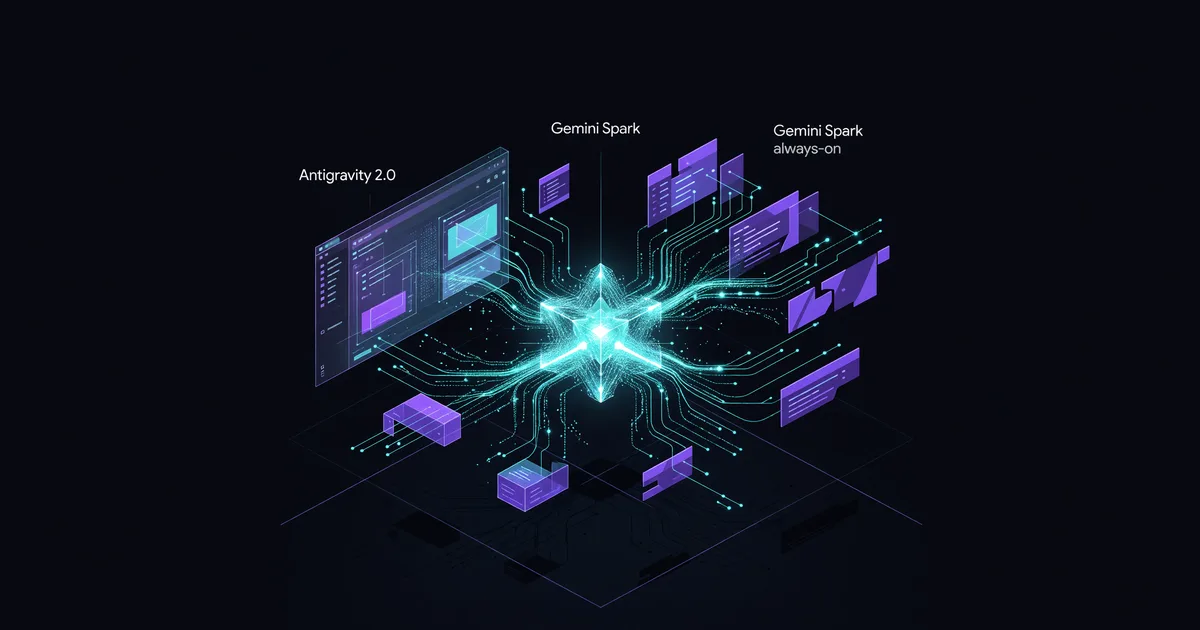
Google I/O 2026 dropped a lot of announcements, but two matter more than the rest: Gemini Spark, an always-on AI agent that lives inside your Google account, and Antigravity 2.0, a rebuilt developer platform with a native desktop app and CLI. Together, they represent Google's clearest statement yet that the future of AI isn't chat — it's agents that do things on your behalf.
We already covered the Gemini 3.5 Flash and Omni model launches separately. This post focuses on the product and platform layer — where Google's structural advantages actually show up.
Gemini Spark: The Always-On Agent
Gemini Spark is Google's answer to a question every AI company is now asking: what happens when the model doesn't wait for you to open a chat window?
Per Google's I/O 2026 developer keynote, Spark is an always-on agent that runs persistently within your Google account. It monitors context from Gmail, Calendar, Drive, and other Google services, and can proactively surface actions — rescheduling a meeting when it detects a conflict, drafting a reply when an urgent email arrives, or flagging a document that needs your review before tomorrow's deadline.
The "always-on" framing is the key differentiator. Current AI assistants — ChatGPT, Claude, Gemini's existing chat interface — are reactive. You ask, they answer. Spark is designed to be proactive. It watches, it infers, it acts (with your permission, according to Google's announcement).
How Spark Compares to Other Agent Products
The AI agent space has gotten crowded in 2026, and Spark enters a field with real competition:
| Product | Company | Approach | Availability |
|---|---|---|---|
| Gemini Spark | Always-on, proactive, Google services integration | Rolling out (per I/O keynote) | |
| OpenAI Workspace Agents | OpenAI | Task-specific agents in ChatGPT Teams/Enterprise | Available now |
| Claude Computer Use | Anthropic | Desktop control via screenshot + action loop | API access |
| Microsoft Copilot Agents | Microsoft | M365-integrated agents (via Copilot Studio) | GA in M365 E3/E5 |
My read: Spark's biggest advantage isn't the AI — it's the data. Google has your email, calendar, documents, search history, location, and contacts. No other AI company has that breadth of personal context. The question is whether users will trust Google with an always-on agent that has access to all of it. Google's track record on privacy perception is... mixed.
The Permission Model Matters
Google's announcement emphasized user control — Spark asks before acting, and you can configure what it's allowed to do autonomously versus what requires approval. This is the right call. An always-on agent that sends emails without asking is a liability nightmare. But the details of this permission system — how granular it is, whether it defaults to permissive or restrictive, whether enterprise admins can enforce policies — haven't been fully documented yet.
I think the permission model will make or break Spark more than any model capability. An agent that asks permission for everything is just a notification system with extra steps. An agent that acts without guardrails will generate horror stories within a week. The sweet spot is narrow, and Google hasn't shown us exactly where they've landed.
Antigravity 2.0: The Developer Platform
If Spark is the consumer-facing agent, Antigravity 2.0 is the developer-facing platform for building your own. Google launched the first version of Antigravity quietly alongside earlier Gemini releases. Version 2.0, announced at I/O 2026, is a significant upgrade with two additions that matter: a native desktop application and a CLI tool (per TechCrunch's coverage of the launch).
Desktop App
The Antigravity desktop app gives developers a local environment for building, testing, and debugging agent workflows. This is notable because most agent development today happens either in web-based IDEs (like Google's own AI Studio) or through raw API calls. A native desktop app suggests Google wants Antigravity to feel like a proper development tool — something you keep open alongside your code editor, not a browser tab you occasionally check.
The competitive parallel is obvious: Anthropic has the Claude desktop app with MCP (Model Context Protocol) integrations, and OpenAI has ChatGPT desktop with its plugin ecosystem. But Antigravity's desktop app is aimed at developers building agents, not end-users chatting with one. It's closer to a Postman for AI agents than a ChatGPT wrapper.
CLI Tool
The CLI is arguably the more important addition for serious developers. Command-line access to Antigravity means you can script agent deployments, integrate them into CI/CD pipelines, and automate testing — all things that are painful or impossible through a web UI.
This puts Google in direct competition with tools like:
- Grok Build CLI — xAI's recently launched terminal coding agent
- Claude Code — Anthropic's CLI for agentic coding workflows
- OpenAI Codex CLI — OpenAI's terminal-based agent
The difference is scope. Those tools are primarily coding agents — they write and edit code. Antigravity's CLI is for orchestrating general-purpose agents that can interact with any Google service. You could build an agent that monitors a shared Drive folder, summarizes new documents, and posts updates to a Google Chat space — all deployed and managed from the command line.
What Antigravity 2.0 Gives Developers
Based on Google's developer blog post announcing the I/O 2026 highlights, Antigravity 2.0 includes:
- Native tool integrations — pre-built connectors to Gmail, Calendar, Drive, Maps, Search, and other Google services
- Agent-to-agent communication — multiple agents can coordinate on complex tasks
- Safety and compliance controls — enterprise-grade guardrails for what agents can access and do
- Gemini 3.5 Flash as the default reasoning engine — optimized for the multi-step, tool-using workflows agents require
The agent-to-agent piece is worth flagging. Multi-agent systems — where specialized agents collaborate rather than one monolithic agent doing everything — are where most of the serious agent research is heading. Google shipping this as a platform feature rather than leaving it to third-party frameworks is a signal of where they think the market is going.
The Strategic Picture
Zoom out from the individual products and Google's I/O 2026 AI strategy becomes clear. They're building a vertically integrated agent stack:
- Model layer: Gemini 3.5 Flash (agentic reasoning), Gemini 2.5 Pro (complex thinking), Gemini Omni (multimodal generation)
- Platform layer: Antigravity 2.0 (orchestration, tools, safety) with desktop app + CLI
- Product layer: Gemini Spark (consumer-facing always-on agent)
- Distribution layer: Google Search, Android, Chrome, Gmail, Workspace — billions of existing users
No other company has this full stack. OpenAI has strong models and a growing consumer app but no services ecosystem. Anthropic has excellent models and an API-first approach but no consumer distribution. Microsoft has the distribution (Office, Windows) but relies on OpenAI's models. Google owns every layer.
The honest take: owning every layer is an advantage on paper. In practice, Google has a history of launching ambitious platform plays and then fragmenting them across competing internal teams. Google Assistant, Google Now, Duplex, Bard — the AI graveyard is full of Google products that had structural advantages and still lost to more focused competitors. The question isn't whether Google can build this. It's whether they'll stick with it long enough for it to matter.
What We Don't Know Yet
Being honest about the gaps in what's been announced:
- Spark availability timeline: "Rolling out" could mean anything from days to months. Google hasn't published a specific date or waitlist.
- Antigravity 2.0 pricing: The original Antigravity had a free tier for experimentation. Whether 2.0 maintains that, and what the production pricing looks like, hasn't been disclosed.
- Spark's proactive capabilities at launch: The keynote demo showed impressive autonomous behavior. How much of that works on day one versus "coming soon" is unclear — I/O demos have a history of being aspirational.
- Third-party integrations: Spark works with Google services natively. Whether it can connect to Slack, Notion, GitHub, or other non-Google tools at launch — or ever — will determine whether it's useful for people who don't live entirely in Google's ecosystem.
- Enterprise controls: Google Workspace admins will want to know exactly what Spark can see and do within their organization's data. The announcement mentioned enterprise compliance features but didn't detail them.
Who Should Care
If you're a developer building agents: Antigravity 2.0 deserves a serious look, especially if your use case involves Google services. The desktop app and CLI lower the friction of agent development compared to web-only tools. But evaluate lock-in carefully — building on Antigravity means building on Google's platform, and portability to other providers isn't guaranteed.
If you're a Google Workspace user: Spark is the most interesting announcement for you. An always-on agent with native access to your email, calendar, and documents could genuinely change how you manage your workday. But start with restrictive permissions and expand gradually. Don't let an AI agent draft emails on your behalf until you've verified it understands your tone and judgment.
If you're watching the competitive landscape: This is Google throwing its full weight behind agents. The combination of Spark (consumer), Antigravity 2.0 (developer), and Gemini 3.5 Flash (model) is the most complete agent stack any company has announced. Whether execution matches ambition is the open question — but the strategic intent is now unmistakable.
Google has been accused of being slow to ship AI products while competitors moved faster. I/O 2026 is their answer: not one product, but an entire stack. The next few months will show whether that stack actually works as advertised, or whether it joins the long list of Google platforms that launched with ambition and faded with neglect.
Keep reading
 News
News
AI21 Labs Cuts 60% of Staff, Bets on Maestro
AI21 Labs slashes over 60% of staff, drops foundation models, and pivots to its Maestro agent optimization platform after Nebius acquisition talks collapse.
 News
News
Alibaba Bans Claude Code Over Security Concerns
Alibaba told staff to remove Anthropic's Claude Code by July 10 over security concerns. Here's what triggered the ban and what it signals.
 News
News
Anthropic Acquires Stainless: What It Means for AI
Anthropic bought Stainless, the SDK generator behind OpenAI and Cloudflare's client libraries. Here's the strategic play for AI agents.