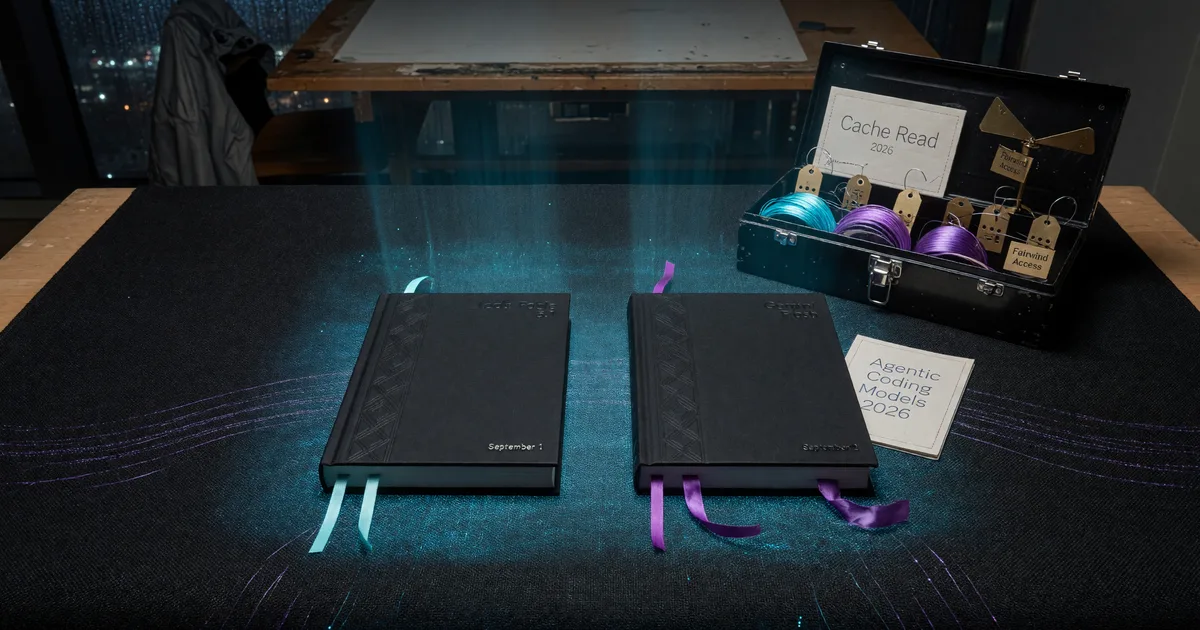
Claude Fable 5.1 versus Gemini 3.8 Flash access split
Anthropic released Claude Fable 5.1 on September 1. Google announced both Gemini 3.8 Flash variants on September 2. Cache read pricing and Fairwind access
Persistent agent threads
Anthropic released Claude Fable 5.1 on September 1, 2026. Google announced Gemini 3.8 Flash and Gemini 3.8 Flash Cyber on September 2 in the post at blog.google. The releases target long-horizon coding and agentic workflows at different price and access points.
The split that matters is thread persistence versus restricted cyber access. Scoreboard coverage skips this axis because one side ships with per-message effort controls and readable progress updates between tool calls while the other routes its strongest variant through an approval program.
Source 2 lists the additive changes in Claude Fable 5.1 as per-message effort in beta, turn-scoped system messages, and readable progress updates between tool calls. These features keep long-running agent sessions coherent without forcing a full context reload on every step. The model carries a 1M-token context window and 128K-token max output, with model ID claude-fable-5-1 on the Claude API, Amazon Bedrock, Google Cloud Vertex AI, and Microsoft Foundry. It defaults to high effort inside Claude Code and medium effort inside Claude Cowork and on Claude.ai.
The same source notes that thinking blocks tie to the model that produced them. Editing earlier turns now invalidates those blocks, a breaking change from prior Claude Fable releases. Forced tool use also returns an error. Cache reads drop to $0.25 per million tokens, one quarter of the prior base input price.
Gemini 3.8 Flash instead emphasizes iterative tool calls inside long-horizon loops. Source 3 states that the model works harder on complex tasks by executing extra reasoning steps and calling tools recursively. On DeepSWE v1.1 it outperforms most larger frontier models in end-to-end engineering problems. It reaches 54.9 percent on HLE-Verified for multi-step reasoning across STEM, humanities, and professional fields.
Cyber access tiers
Claude Fable 5.1 remains generally available through the Claude API, Amazon Bedrock, Google Cloud Vertex AI, and Microsoft Foundry. Cache reads cost $0.25 per million tokens. Input runs $10 per million tokens and output $50 per million tokens. Source 1 states that Claude Mythos 5.1 is the same model but with different levels of safeguards and routes only through Project Glasswing for cybersecurity and life-sciences work. Batch API requests receive a 50 percent discount on both input and output. Eligible customers can use Fable 5.1 with zero data retention until Enterprise Frontier Safeguards arrive later this fall.
Gemini 3.8 Flash lists at $0.75 input and $3.75 output per million tokens. Gemini 3.8 Flash Cyber requires Fairwind Program approval limited to national cyber authorities, healthcare or energy operators, and software maintainers. Source 3 reports that the cyber variant reaches 47.2 percent pass@1 on CWE-Bench while on the Pareto frontier for cost. Source 1 records Claude Fable 5.1 at 55.8 percent on Terminal-Bench 4.0 at high effort and 52.6 percent on Terminal-Bench-Science 0.1. The announcement notes standard error of ±3.5–4.5 points per model on Terminal-Bench-Science 0.1.
Source 1 also records Claude Fable 5.1 at 60.9 percent on Humanity’s Last Exam with tools and 73.4 percent on CursorBench 3.2.0. Additional figures include 1853 on GDPval-AA v2, 41.7 percent strict and 77.9 percent partial on OSWorld 2.0, and 31.4 percent on AutomationBench. Source 3 adds that Gemini 3.8 Flash Cyber exceeds 70 percent success on an internal benchmark spanning 20 programming languages and reaches frontier-level results on CyberGym for autonomous vulnerability discovery.
| Dimension | Claude Fable 5.1 | Gemini 3.8 Flash |
|---|---|---|
| Release date | September 1, 2026 | September 2, 2026 |
| Context window | 1M tokens | Not stated in announcement |
| Input price | $10 / MTok | $0.75 / MTok |
| Output price | $50 / MTok | $3.75 / MTok |
| Cache read | $0.25 / MTok | Not stated |
| Terminal-Bench 4.0 | 55.8% | Not reported |
| CyberGym | Not reported | Frontier level |
| CWE-Bench pass@1 | Not reported | 47.2% |
| Availability | Public API | Fairwind Program for Cyber variant |
Source 2 confirms that prompt caching reads now cost one quarter of the base input price on Claude Fable 5.1. The Chrome Security team found Gemini 3.8 Flash Cyber produced 2.6 times more correct patches to vulnerabilities in Chrome than the best commercial models that are much larger. Wiz recorded +7.5-9.7 percent higher recall on its internal penetration testing benchmark at 2.3-5.2 times lower cost. Google’s Cloud Vulnerability Research team used the model to find a critical foundational vulnerability in less than 2 hours.
Target buyer profiles
Source 1 states that eligible customers will be able to use Fable 5.1 with zero data retention until Enterprise Frontier Safeguards arrive later this fall. The Jane Street Capital quote in the same announcement reads: “In internal benchmarks, Claude Fable 5.1 solves more of our coding problems than Fable 5 or Opus 5, and achieves state of the art on trading intuition. While prior models became hard to follow the longer they worked, Fable 5.1 remains readable over long, multi-step tasks.”
Source 3 states that the Chrome Security team found Gemini 3.8 Flash Cyber produced 2.6 times more correct patches to vulnerabilities in Chrome than the best commercial models that are much larger. Trusted defenders who qualify for the Fairwind Program receive the variant through that channel. The announcement lists three groups for prioritized access: national cyber authorities, operators of healthcare or energy networks, and software maintainers.
Claude Fable 5.1 Terminal-Bench-Science 0.1 score stands at 52.6 percent. Public API access makes it the default choice for teams that need persistent agent threads today without an approval step. Gemini 3.8 Flash Cyber suits only those organizations already inside the Fairwind Program or able to meet its eligibility criteria. The public announcement does not disclose the exact approval timeline or the number of current participants in the Fairwind Program.
Teams that run long-horizon coding sessions without cyber restrictions therefore default to the generally available model. Organizations that require frontier-level vulnerability discovery and patching inside approved environments route to the restricted variant. Source 1 notes that Fable 5.1 can discover software vulnerabilities but not develop exploits for them, while Gemini 3.8 Flash Cyber prioritizes patching over offensive capabilities.
Until the Fairwind Program publishes its next eligibility update in October, the split between the two releases stays fixed by access rules rather than raw benchmark numbers.
Keep reading
 Comparisons
GitHub Copilot vs Cursor vs Windsurf: Which Wins?
Compare GitHub Copilot, Cursor, and Windsurf. Which AI coding assistant is best for your development workflow? Features, pricing, and performance analysis.
 Comparisons
DeepSeek V4-Flash vs GPT-5.6 Sol: $0.14 Against $5
DeepSeek's V4-Flash beta lists $0.14 and $0.28 per million tokens against GPT-5.6 Sol's $5 and $30. The cache line and the agent wire format decide the bill.
 Comparisons
GPT-5.6-Cyber vs GPT-5.6 Sol: The Daybreak Split
OpenAI's GPT-5.6-Cyber is gated on authorized cybersecurity work. The Daybreak Blue and Red tiers, the 95% claim, and who each model is meant for.