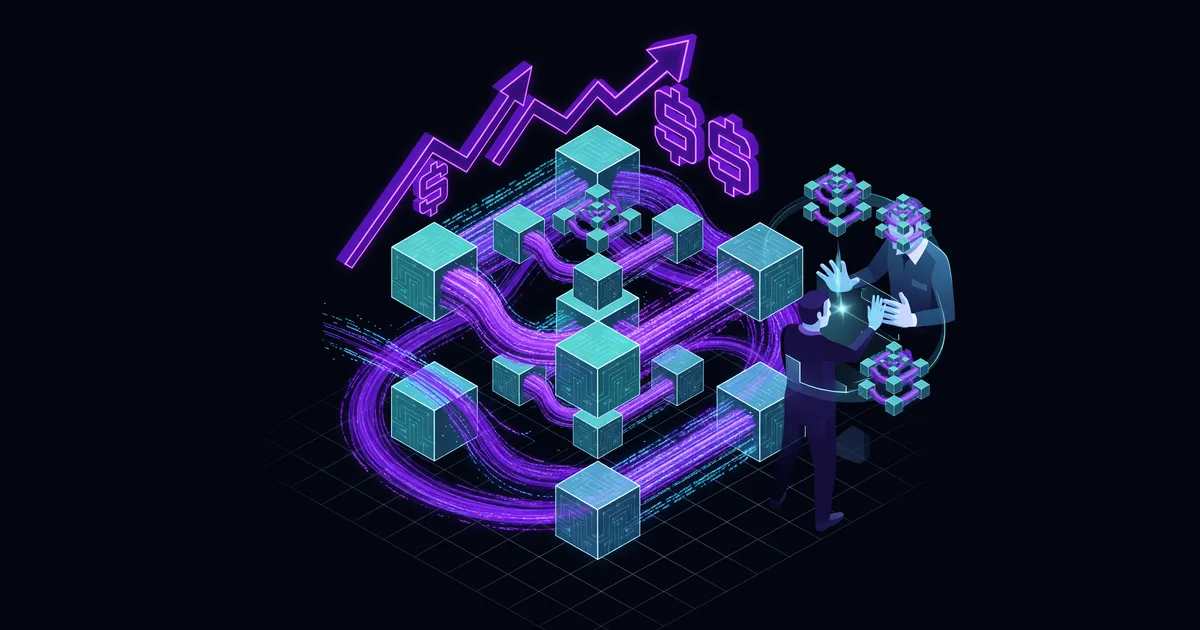
Recursive AI's $650M Raise: Self-Improving AI
Recursive Superintelligence just raised $650M at a $4.65B valuation. Here's what Richard Socher's self-improving AI startup is building and why it matters.
Recursive Superintelligence Inc. emerged from stealth with $650 million in funding and a $4.65 billion valuation, one of the largest AI debut rounds on record. The company, founded by Richard Socher, is building systems designed to autonomously discover and advance knowledge through recursive self-improvement: AI that gets better at solving problems on its own rather than only solving the problems put in front of it.
The raise was reported across tech media and X on May 16, 2026, and the argument started the same day. Either recursive self-improvement is the logical step past current foundation models, or it is an expensive bet on capabilities that remain largely theoretical. Nothing disclosed so far settles which. What the funding does establish is that the market will price philosophical ambition at four and a half billion dollars before a single paper ships.
Richard Socher's track record before this
Socher is not a first-time founder chasing AI hype. He holds a Stanford PhD in NLP, and his research on recursive neural networks and sentiment analysis, including the widely used GloVe word embeddings, has been cited tens of thousands of times. He then ran AI research as Chief Scientist at Salesforce, one of the largest enterprise software companies in the world, overseeing the development of Salesforce Einstein. After that he founded and led You.com, the AI-powered search engine that was among the first to integrate LLMs directly into search results.
The name "Recursive Superintelligence" signals exactly where he is aiming. Systems that recursively improve their own capabilities have been discussed in AI safety literature for over a decade, but rarely as the explicit product vision of a well-funded company.
What recursive self-improvement means precisely
The term gets thrown around loosely, so it is worth pinning down. In AI, a recursively self-improving system evaluates its own performance and identifies where it fails, hallucinates or produces suboptimal outputs. It then generates improvements to itself by modifying its own training data, architecture, prompts or reasoning strategies. It applies those improvements autonomously, without human engineers retraining or fine-tuning the model each cycle. And it repeats the loop, with each improved version becoming the baseline for the next round of self-evaluation.
Current AI labs do something closer to human-directed improvement: researchers run evaluations, identify weaknesses, collect better training data and retrain models. That loop takes months and enormous human effort. A genuinely recursive system would compress it dramatically.
The specifics of Recursive Superintelligence's technical approach remain unknown. The company has not published papers or detailed its architecture publicly, and what exists is the announcement framing: systems that "autonomously discover and advance knowledge." A vision statement is not a technical specification, and the distance between the two is where healthy skepticism belongs.
The $4.65B valuation against 2026 comparables
A $4.65 billion valuation at launch is enormous, and it fits the pattern of 2026 AI funding rather than breaking it.
| Company | Round | Valuation | Stage |
|---|---|---|---|
| Recursive Superintelligence | $650M | $4.65B | Stealth launch |
| Sierra | $950M | $15B | Growth (enterprise AI agents) |
| Isomorphic Labs | $2.1B | Undisclosed | Growth (AI drug design) |
| xAI (2024) | $6B | $24B | Series B |
Investors are writing checks on founder pedigree and vision, often well before products reach market. Socher's record of peer-reviewed research plus two companies puts him squarely in the bet-on-the-founder category that VCs love. Whether the bet pays off depends entirely on execution nobody outside the company can observe yet.
What the company's existence signals
The dollar amount is the least interesting part of this. What carries more weight is what a company like this says about where the industry expects the next breakthrough to come from.
The current model scaling wall
There is growing evidence that simply making models bigger and training them on more data is hitting diminishing returns. OpenAI, Anthropic and Google DeepMind have all shifted emphasis toward reasoning, agentic capabilities and tool use rather than raw parameter counts. Recursive self-improvement represents a different thesis entirely: instead of humans engineering each capability jump, build systems that engineer their own improvements.
The safety question
Recursive self-improvement is precisely the scenario that AI safety researchers have been warning about, and studying, for years. A system that improves itself without human oversight raises control questions with no settled answers. How do you ensure the improvements stay aligned with human values, and how do you maintain a kill switch on a system designed to autonomously modify itself?
Socher's academic background includes significant work in interpretable AI, which suggests the questions are at least on his radar. Thinking about safety and solving safety remain very different achievements, and the AI safety community will rightly scrutinize any company that puts recursive improvement at the center of its pitch.
The competitive pressure it creates
If Recursive Superintelligence makes meaningful progress, every other AI lab feels it. OpenAI, Anthropic and Google DeepMind are all working on forms of self-improvement, since RLHF, constitutional AI and self-play are each partial versions of the concept, but none have made it their core product thesis. A well-funded competitor explicitly targeting recursive improvement could pull timelines forward across the industry, for better or worse.
The disclosure gaps
What exists publicly is an announcement, a dollar figure and a founder bio. The critical unknowns are substantial.
The technical approach is undisclosed, so nobody outside the company knows whether this is built on top of existing foundation models, a novel architecture or some hybrid. There are no papers, no demos and no technical blog posts. The investor list matters too, because strategic investors such as compute providers or cloud platforms signal something different from pure financial VCs. Timeline to product is open, since stealth exits do not always mean a product is imminent and some companies announce funding years before shipping anything usable. The phrase "autonomously discover knowledge" could cover anything from automated ML research, impressive but narrow, to artificial general intelligence, ambitious but unproven, and the framing is deliberately broad. On safety governance there is nothing public at all: no frameworks, no oversight boards, no responsible deployment policies.
The biggest risk for outside observers is pattern-matching this to either extreme, dismissing it as vaporware or treating it as the dawn of superintelligence. Neither response is warranted by what has been disclosed so far.
Self-improvement approaches already shipping
Recursive Superintelligence is not operating in a vacuum. Several approaches to AI self-improvement are already in production or active research.
Reinforcement learning from human feedback, used by OpenAI, Anthropic and others, keeps a human in the loop and is not fully autonomous, but it is a form of iterative improvement. Constitutional AI, Anthropic's approach where models critique and revise their own outputs against a set of principles, sits closer to self-improvement, though the constitution itself is human-defined. Self-play and synthetic data have been used extensively by Google DeepMind in AlphaGo and AlphaFold, with models generating training data for themselves in a primitive form of recursive improvement. And agentic coding loops in tools like OpenAI Codex and Claude Code already run multi-step cycles where the AI evaluates its own output, runs tests and iterates, which is recursive improvement applied narrowly to software engineering tasks.
What Socher appears to be proposing is generalizing these narrow loops into a unified system that can improve itself across domains. Generalizing them is a meaningful technical leap, not an incremental step.
Signals that would separate evidence from vision
Four things will say more over the coming months than any further funding news.
Technical publications come first, because research showing measurable self-improvement, whether benchmarks, papers or demos, would move this from vision to evidence. Safety commitments come second, and specific auditable frameworks matter more than vague promises, so partnerships with safety organizations or independent oversight structures are what to look for. Hiring patterns are third: who the team recruits, and from which labs, reveals the actual technical direction better than any press release. Competitive responses are fourth. If OpenAI, Anthropic or DeepMind start explicitly branding their own work as recursive self-improvement, they have concluded it is a real competitive threat.
Raising money on a bold vision is clearly achievable; the company has already done it. The open test is whether recursive self-improvement can be made to work reliably, safely and at scale, which is a research problem rather than a fundraising problem.
Where this leaves the $4.65B bet
The $650M stealth launch is significant for two reasons. The founder has genuine technical credibility, and the company is explicitly targeting a capability, autonomous self-improvement, that most labs treat as a long-term research goal rather than a near-term product. At $4.65 billion, investors are pricing in a belief that Socher can get there faster than the incumbents.
Whether that belief is justified is genuinely unknown. Recursive self-improvement has been discussed in AI theory for decades, and nobody has demonstrated it working at scale in practice. Recursive Superintelligence is either the company that changes that, or a very expensive lesson in the gap between vision and execution. The next 12 to 18 months of technical output will tell us which.
Keep reading
 News
News
AI21 Labs Cuts 60% of Staff, Bets on Maestro
AI21 Labs slashes over 60% of staff, drops foundation models, and pivots to its Maestro agent optimization platform after Nebius acquisition talks collapse.
 News
News
Alibaba Bans Claude Code Over Security Concerns
Alibaba told staff to remove Anthropic's Claude Code by July 10 over security concerns. Here's what triggered the ban and what it signals.
 News
News
Anthropic Acquires Stainless: What It Means for AI
Anthropic bought Stainless, the SDK generator behind OpenAI and Cloudflare's client libraries. Here's the strategic play for AI agents.