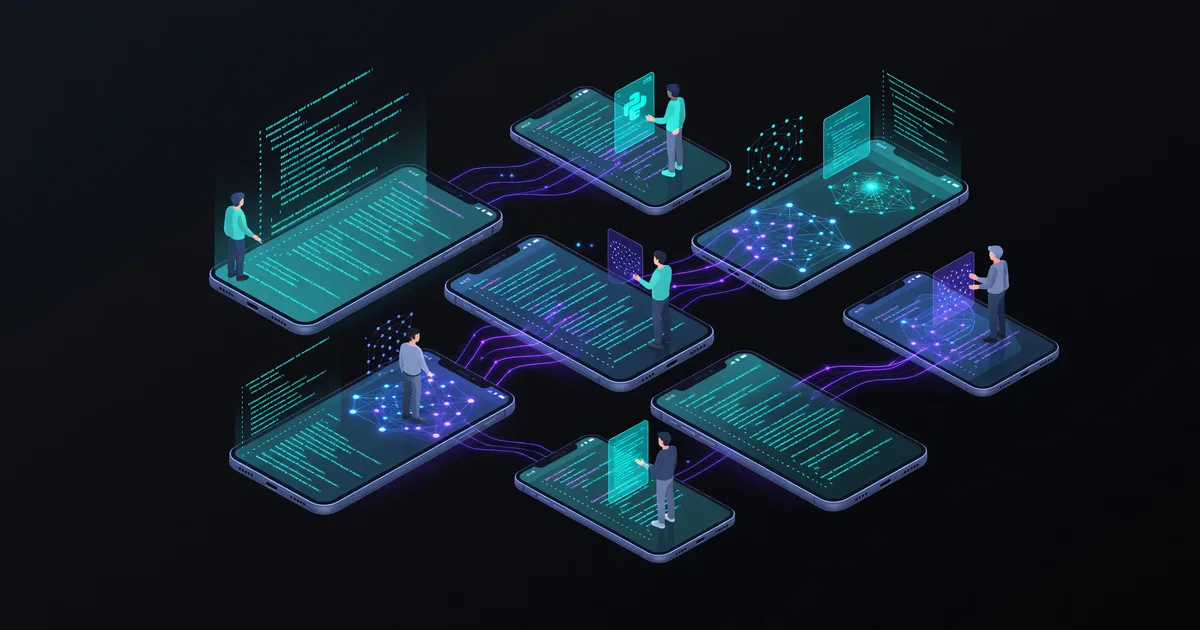
OpenAI Codex Goes Mobile: ChatGPT App Preview
OpenAI added Codex to the ChatGPT mobile app on May 14, letting developers start and steer coding agents from iOS and Android across all plans.
Your Coding Agent Now Fits in Your Pocket
OpenAI shipped Codex integration inside the ChatGPT mobile app on May 14, 2026 (per OpenAI's announcement). The update lets developers start, review, steer, and approve coding tasks from their phone while Codex runs on a desktop environment like Mac. The announcement pulled 3.2 million views on X within the first day — a signal that remote agent control is something developers actually want.
The big surprise: it's available on all plans, including Free. OpenAI isn't gating mobile Codex behind Pro or Team subscriptions. That's a sharp contrast to how most AI labs handle their most capable developer features.
What Codex Mobile Actually Does
To be clear about what this is and isn't: Codex mobile doesn't run coding agents locally on your iPhone. Your phone is the remote control, not the compute. Codex still executes in a cloud-connected desktop environment (Mac today, Windows coming soon per the announcement). The mobile app gives you a way to interact with those running tasks when you're away from your desk.
Based on OpenAI's announcement, the mobile integration supports four core workflows:
- Start tasks remotely — Kick off a coding job from your phone. You're on the train, you remember that refactor needs to happen before the morning standup, you tell Codex to start it. The agent begins working on your desktop environment.
- Review progress — Check what Codex has done so far, see the diffs, read its reasoning about the changes it made. This is the "check on your agent" use case.
- Steer mid-task — Redirect the agent if it's going down the wrong path. "Don't refactor that module, focus on the API layer instead." Course correction without needing to sit down at your computer.
- Approve or reject changes — The final gate. Codex proposes changes, you review them on mobile, and you approve the commit or send it back for revision.
This is a human-in-the-loop pattern applied to mobile. The agent does the heavy lifting; you retain control from wherever you are.
Why Free Tier Access Matters
The most strategically interesting part of this announcement isn't the mobile interface — it's the pricing decision. OpenAI is making Codex mobile available across all ChatGPT plans, including Free.
Compare this to the competition. Claude Code requires a Max subscription ($100/month as of the most recent Anthropic pricing page) or API credits. xAI's Grok Build CLI, which launched in early beta on the same day (May 14), is locked behind SuperGrok Heavy. GitHub Copilot's agent features require at minimum an Individual subscription.
OpenAI is making a volume play. They're betting that getting Codex into the hands of every ChatGPT user — including students, hobbyists, and developers in markets where $20/month is a serious expense — will build the kind of usage data and habit formation that converts free users into paid ones later.
My read: Free-tier Codex access almost certainly comes with meaningful usage limits — rate caps, task complexity ceilings, or queue priority behind paid users. OpenAI hasn't detailed those constraints yet. But even a rate-limited version of an agentic coding tool at zero cost is a significant move in this market.
The Remote Agent Control Problem
This launch speaks to a friction point that the entire agentic coding space has been dancing around: what happens when an agent is working and you're not at your computer?
Today's coding agents — Claude Code, Cursor's agent mode, Copilot's workspace agents — are all designed around the assumption that you're sitting at your desk watching the agent work. You see the plan, you approve the changes, you intervene when things go sideways. That works fine for a 10-minute task. It breaks down for longer-running work.
If you kick off a complex refactoring job that takes 30 minutes of agent time, you either sit and watch (wasting your time) or walk away and hope it does the right thing (risky). Mobile control is the obvious middle ground: let the agent work, get a notification when it needs input, review and respond from your phone.
No other major coding agent has shipped this workflow yet. Anthropic's Claude Code is terminal-native and has no mobile companion. Cursor and Windsurf are IDE-bound. GitHub Copilot's mobile presence is limited to the GitHub app, not a full agent control surface. OpenAI is first to market here.
Platform Status and Roadmap
The current state of Codex platform support, per the announcement:
| Platform | Codex Desktop | Codex Mobile Control |
|---|---|---|
| macOS | Available now | N/A (desktop is the agent host) |
| Windows | Coming soon | N/A |
| iOS | N/A | Available now (preview) |
| Android | N/A | Available now (preview) |
The Windows gap is worth noting. A significant chunk of professional developers — especially in enterprise environments, game development, and .NET shops — work on Windows. Until Codex desktop support lands there, those developers can't use the mobile control flow even if they have the ChatGPT app installed. OpenAI says it's coming soon, but no specific date.
How This Compares to the Competition
The agentic coding tool market is moving fast. Here's where mobile Codex fits relative to the other major players:
| Feature | OpenAI Codex | Claude Code | Grok Build CLI | GitHub Copilot |
|---|---|---|---|---|
| Mobile control | Yes (iOS + Android) | No | No | Limited (GitHub app) |
| Free tier access | Yes | No (Max or API) | No (SuperGrok Heavy) | No (paid plans only) |
| Agentic execution | Yes | Yes | Yes (beta) | Yes (agent mode) |
| Interface | ChatGPT app + desktop | Terminal | Terminal | IDE + CLI |
OpenAI's advantage is distribution. ChatGPT has the largest user base of any AI product — hundreds of millions of users across mobile and desktop. By embedding Codex into that existing app rather than shipping a standalone developer tool, OpenAI sidesteps the "install another CLI" friction that Claude Code and Grok Build both face.
The disadvantage is depth. Terminal-native tools like Claude Code give developers fine-grained control: shell access, MCP integrations, custom tool configurations, direct file system interaction. A mobile chat interface is inherently more constrained. The question is whether the convenience of mobile control outweighs the loss of granularity for enough developers to matter.
What OpenAI Hasn't Said Yet
Several important details are missing from the announcement:
- Usage limits on Free tier — How many Codex tasks can a free user run per day? Per month? What's the maximum task complexity? Without these numbers, "available on all plans" is hard to evaluate.
- Which model powers Codex tasks? — OpenAI has multiple models in the o-series and GPT family. Whether Free users get the same model as Pro users (unlikely) or a lighter variant matters for output quality.
- Latency and notification behavior — When a Codex task needs human input, how fast does the mobile notification arrive? A 30-second delay in a push notification can mean the difference between a useful remote control and an annoying one.
- Offline queuing — Can you queue up a task from mobile when your desktop is asleep or offline, with Codex picking it up when the desktop reconnects? That would be genuinely useful. The announcement doesn't address it.
- Security model — Codex has access to your codebase. How does mobile authentication work? Is there a separate approval step before a mobile-initiated task can touch your local files? Enterprise security teams will want answers here.
These aren't nitpicks — they're the details that determine whether mobile Codex is a daily workflow tool or a demo-worthy novelty.
The Bigger Strategic Picture
This launch is part of a pattern. Over the past month, OpenAI has announced the $4B Deployment Company (with TPG, Bain, and Brookfield), shipped Workspace Agents for Slack and Gmail integration, launched the MRC protocol for massive GPU clusters, and released GPT-Realtime-2 with reasoning for voice agents. Codex mobile is another piece of a clear strategy: make OpenAI's AI the default tool across every surface where work happens.
The timing is also notable. xAI launched Grok Build CLI on the same day — May 14. Anthropic has been pushing Claude Code hard, with recent additions like creative tool connectors for Blender and Adobe. Google's Gemini 2.5 is competitive on coding benchmarks. The agentic coding market is in a land-grab phase, and OpenAI is using distribution (ChatGPT's install base) and accessibility (free tier) as their wedge.
I think the mobile angle is underappreciated by people focused on benchmark scores and model capabilities. The best coding agent isn't necessarily the one with the highest SWE-bench score — it's the one developers actually use throughout their day. Making that possible from a phone, during a commute or a lunch break, changes the surface area of when coding agents get used. That's a product insight, not a model insight.
Who Should Care
If you're a developer who already uses ChatGPT and has been curious about Codex, the mobile preview removes the last friction barrier. It's free, it's on your phone, and it's in preview — meaning OpenAI is actively looking for feedback to shape the product.
If you're deep into Claude Code or Cursor and happy with your workflow, this probably isn't a reason to switch. Mobile control is nice but not essential if your current tool handles everything you need at your desk.
If you're evaluating agentic coding tools for a team, mobile Codex introduces a new dimension to the comparison: asynchronous agent management. The ability for a team lead to review and approve AI-generated changes from their phone — without context-switching to a laptop — could be a genuine productivity gain for distributed teams.
The real question isn't whether mobile coding agents are useful. It's whether OpenAI can make the mobile interface good enough that developers trust it for approval decisions. Reviewing a 200-line diff on a 6-inch screen is a different challenge than reviewing it in VS Code. If OpenAI nails that UX, they've built something nobody else has. If they don't, it's a notification center with extra steps.
Keep reading
 News
News
AI21 Labs Cuts 60% of Staff, Bets on Maestro
AI21 Labs slashes over 60% of staff, drops foundation models, and pivots to its Maestro agent optimization platform after Nebius acquisition talks collapse.
 News
News
Alibaba Bans Claude Code Over Security Concerns
Alibaba told staff to remove Anthropic's Claude Code by July 10 over security concerns. Here's what triggered the ban and what it signals.
 News
News
Anthropic Acquires Stainless: What It Means for AI
Anthropic bought Stainless, the SDK generator behind OpenAI and Cloudflare's client libraries. Here's the strategic play for AI agents.