AI Agents Explained: What They Do and Why It Matters
Understand what AI agents are, how they work, and why they're transforming workflows. Learn about autonomous AI agents like Devin, Manus, and Claude Code.
If you've been paying attention to the AI space lately, you've probably heard the term "AI agents" thrown around constantly. It's become the hot topic that everyone from tech founders to enterprise executives is obsessing over. But what exactly are AI agents, and why is everyone so excited about them?
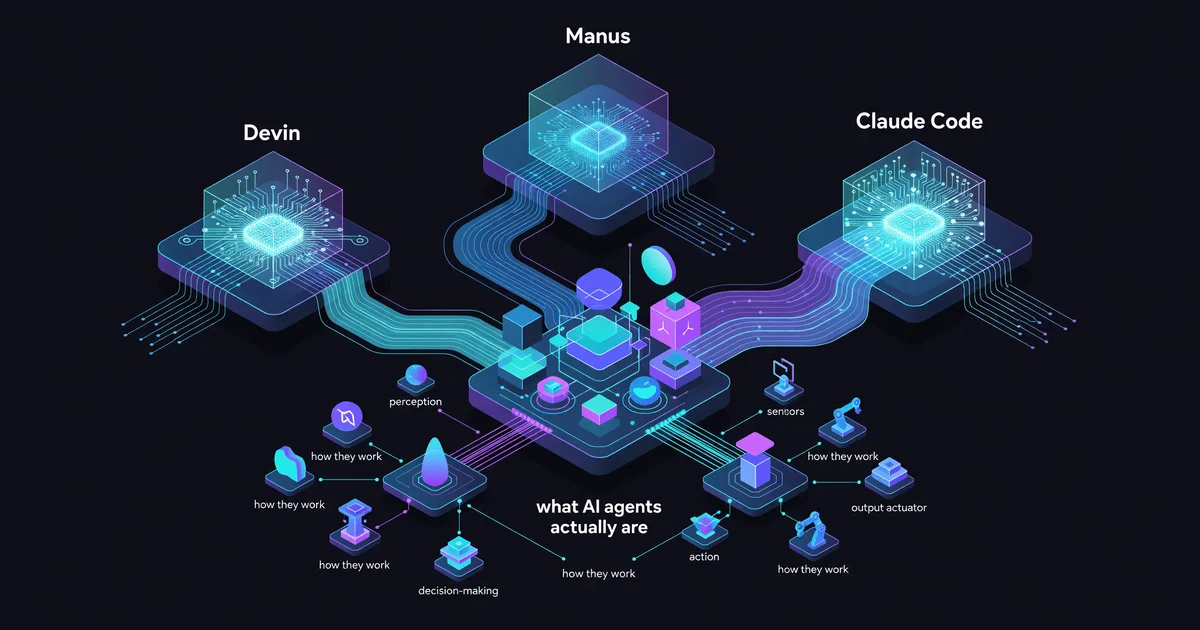
The simple answer: AI agents are software systems that can perceive their environment, make decisions, and take actions autonomously to achieve specific goals. But the real story is much more interesting and has significant implications for how we'll work and build in the future.
Understanding AI Agents: The Fundamentals
At their core, AI agents are different from the chatbots and language models you might already be familiar with. While ChatGPT responds to prompts and generates text, an AI agent is designed to operate with minimal human intervention, working toward an objective over an extended period.
Think of it this way: if ChatGPT is like a consultant you ask questions to, an AI agent is more like hiring an employee who can identify what needs to be done, plan the approach, execute the work, and report back on progress.
The Core Components of an AI Agent
Every AI agent typically consists of several key elements:
- Perception: The ability to observe the current state of the environment. For a coding agent, this might be reading a repository structure or understanding error messages.
- Decision-making: The reasoning engine that determines what action to take next. This leverages language models but with added planning and reasoning capabilities.
- Action execution: The ability to interact with external tools and systems. This could include writing code, calling APIs, creating files, or running commands.
- Memory and learning: Retaining context about what's been attempted and what worked, allowing for improved decision-making over time.
Real-World AI Agent Examples
Let's look at some concrete examples of AI agents that are reshaping how people work:
Devin: The AI Software Engineer
Devin represents one of the most significant breakthroughs in AI agents for development. Released as an AI software engineer, Devin can autonomously handle engineering tasks like debugging complex codebases, deploying applications, and even contributing to open-source projects. What makes Devin remarkable is its ability to understand error messages, research solutions, and implement fixes without constant human guidance.
The impressive part? Devin doesn't just suggest solutions—it actually writes code, runs tests, and iterates based on failures. It's moving AI from the "assistant" category to the "collaborator" category.
Claude Code and Other IDE Agents
Claude Code brings AI agent capabilities directly into your development workflow. Unlike basic code autocomplete, Claude Code can understand your entire project context, identify patterns, and handle multi-file refactoring tasks. It can spawn terminal windows, execute code, see output, and adjust based on results.
This represents a fundamental shift: instead of asking an AI for help with a coding problem, the AI is integrated into your workflow and actively participates in problem-solving.
Manus: The Enterprise Automation Agent
Manus focuses on enterprise automation and computer vision. It can autonomously interact with computer interfaces, understand what's displayed on screen, and execute complex multi-application workflows. Imagine automating processes that currently require humans to log into multiple systems, copy data, make decisions, and execute actions—that's what Manus does at scale.
How AI Agents Differ from Traditional AI Systems
Understanding the distinction is crucial. Traditional AI systems are reactive—you give them input, they produce output, and the interaction ends. The system has no agency.
AI agents are proactive. They have goals. They take initiative. They can run for hours or days, making independent decisions, adapting to failures, and working toward completion without waiting for your instructions.
Why AI Agents Matter (And Why Everyone's Excited)
The excitement around AI agents isn't hype—it's justified. Here's why:
Dramatically Increased Productivity
AI agents can handle tasks that currently consume significant human effort. A developer who used to spend 4 hours debugging and refactoring code can now have an AI agent handle it while they focus on architecture and strategy. That's not a small productivity increase—that's potentially 50% or more of engineer time redirected to higher-value work.
Solving Complex, Multi-Step Problems
Many real-world problems aren't simple. They involve multiple systems, tools, and decision points. AI agents excel at these because they can maintain context, make trade-offs, and adapt when one approach doesn't work.
Enabling New Possibilities
Tasks that were previously impossible to automate become viable. Complex research workflows, end-to-end project execution, cross-system integration—these become achievable with AI agents handling the coordination.
Reducing Context Switching
For knowledge workers, context switching is a massive productivity killer. AI agents can handle the "back and forth" that usually breaks your flow. You set the objective, and the agent manages the execution.
The Technical Reality: How They Work
Behind the impressive capabilities are some elegant technical solutions. Most modern AI agents use what's called a "reasoning loop":
- Observe: The agent examines the current state of its environment.
- Think: Using a language model's reasoning capabilities, the agent plans its next move.
- Act: The agent executes an action (write code, call an API, run a command, etc.).
- Reflect: The agent observes the results and determines if it achieved its goal or needs to adjust.
- Iterate: It repeats this loop until the task is complete.
This cycle, sometimes called "tool use" or "function calling," is what distinguishes agents from simple chatbots. The agent isn't just predicting text—it's actively interacting with systems and observing outcomes.
Challenges and Limitations
It's important to be realistic. AI agents aren't magic. Current limitations include:
- Limited planning horizon: Agents struggle with very complex, long-term planning that requires understanding multiple dependencies.
- Cost: Running agents, especially with advanced reasoning models, can be expensive for large-scale operations.
- Safety concerns: Giving agents autonomous execution capabilities raises important questions about control and unintended consequences.
- Debugging difficulty: When an agent fails, understanding why can be challenging since the reasoning process is opaque.
The Future of AI Agents
We're still in the very early stages. As AI agents evolve, we can expect:
Specialization: Just as we have specialized agents for coding (Devin), UI interaction (Manus), and general assistance (Claude), we'll see agents optimized for specific domains—legal research, medical diagnosis, financial analysis, and more.
Better reasoning: Newer reasoning models are improving how agents plan multi-step tasks, reducing the number of failed attempts and improving reliability.
Integration into workflows: Rather than standalone tools, AI agents will be deeply integrated into existing software. You won't launch "the agent app"—agents will be embedded in your IDE, your productivity tools, and your business applications.
Collaborative systems: The most powerful applications won't be fully autonomous agents—they'll be systems where humans and AI agents collaborate, each playing to their strengths.
What This Means for You
Whether you're a software engineer, business analyst, researcher, or knowledge worker, AI agents will impact your work. The question isn't if, but how quickly and in what ways.
The smartest move right now is to experiment with available AI agents in your field. If you're a developer, try exploring the available AI tools on our tools page. Understand their strengths and limitations. Think about which parts of your workflow could benefit from agent automation.
The AI revolution isn't about AI replacing humans—it's about humans and AI agents working together to achieve more than either could alone.
"The future of work isn't about AI vs humans—it's about humans enhanced by AI agents that handle the complex, repetitive, and multi-step tasks that currently consume our attention."
Keep reading
 Guides
Claude Riemann Hypothesis Result: 41.6% to 67.2%
Anthropic says an unreleased Claude raised the proven fraction of Riemann zeta zeros on the critical line from 41.6% to 67.2%. Here is what that means.
 Guides
Gemini Robotics 2 and Whole-Body Intelligence
Google DeepMind's Gemini Robotics 2 claims whole-body control of a humanoid. What that means, and how NVIDIA, Physical Intelligence and Mistral compare.
 Guides
Google Gemini 2.5: Everything You Need to Know
Complete guide to Google Gemini 2.5. Learn what's new, key features, how it compares to previous versions, pricing, and who it's best for.