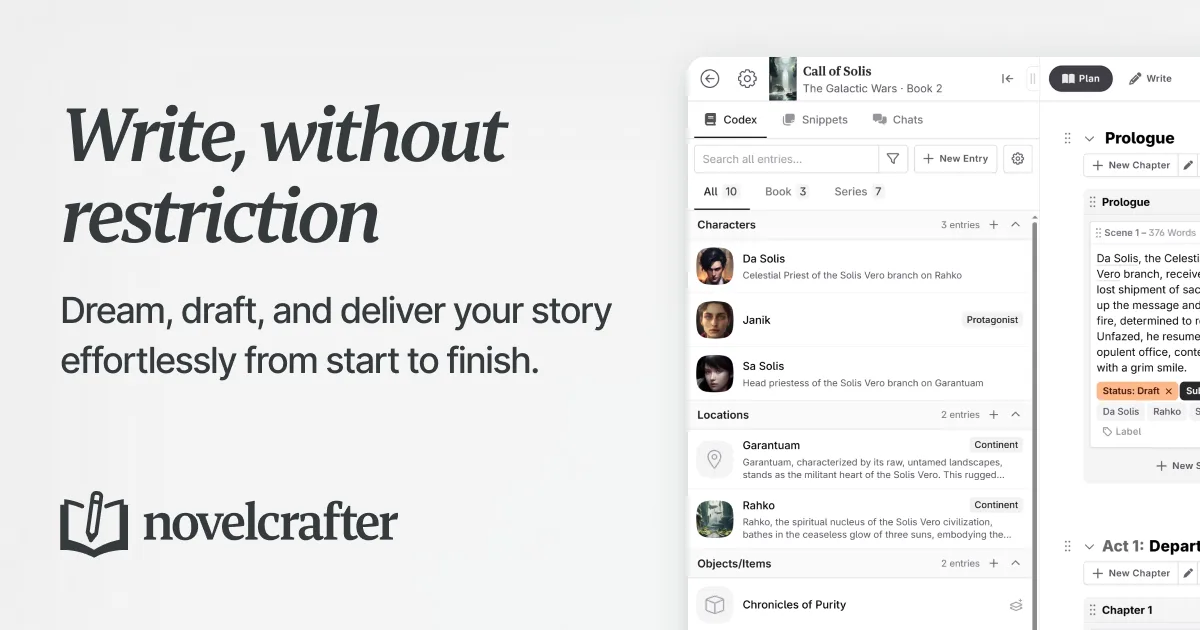
NovelCrafter
Browser-based fiction-writing studio with a Codex worldbuilding wiki, scene-based planning, and bring-your-own-key AI across GPT, Claude, Gemini, and local models.
Updated 2026-06-27
No. NovelCrafter has no free tier on record.
Listed pricing: 21-day free trial + paid from $4/mo (AI costs billed separately via BYOK).
Overview
NovelCrafter is a browser-based workstation for writing long-form fiction, built around three pillars: a Codex wiki for tracking characters, locations, and lore; a scene-based manuscript editor with grid and timeline planning views; and a bring-your-own-key (BYOK) AI layer that you wire up to whichever model you prefer. Rather than bundling its own credits, it connects to OpenAI, Anthropic, Google Gemini, Mistral, OpenRouter (which exposes 300+ models), or local runtimes like Ollama and LM Studio.
It's aimed at serious novelists and worldbuilders — people writing 80,000-word manuscripts and series, not blog posts or marketing copy. The Codex is the differentiator: as your story grows, you build a structured wiki of entities, and NovelCrafter can feed the relevant entries to the model as context so the AI stays consistent with your established canon. The scene/grid/timeline planning tools let you outline at the chapter and beat level and reorder the manuscript without losing the thread.
The closest tool in this directory is Sudowrite, but the two take opposite approaches. Sudowrite bundles AI inference into its subscription and leans on guided features like Story Engine; NovelCrafter hands you the raw model connection and a deeper organizational system, trading hand-holding for control. Reviewers at Kindlepreneur, SelfPublishing.com, and DreamGen repeatedly call it the gold standard for power users — while flagging a real learning curve that casual writers may find steep.
Is NovelCrafter free?
No. NovelCrafter has no free tier on record.
What the entry records: 21-day free trial, no credit card required. There is no permanent free tier — paid subscription is required after the trial, and AI usage is billed separately through your own model provider keys.
Listed pricing: 21-day free trial + paid from $4/mo (AI costs billed separately via BYOK).
Pricing on this page has not been re-verified. The entry was last edited on , and no separate pricing check has been run since. Treat the figures as a record of what was published then and confirm on the official site.
NovelCrafter pricing
| Plan | Price | What's included |
|---|---|---|
| Scribe | $4/mo | Entry tier for core writing and organization features. |
| Hobbyist | $8/mo | Step up from Scribe with more capacity for regular writers. |
| Artisan | $14/mo | Mid-tier plan aimed at committed novelists. |
| Specialist | $20/mo | Top tier with the fullest feature set. Note: all plans require your own AI API keys; inference costs are paid to the model provider on top of the subscription. |
Entry tier for core writing and organization features.
Step up from Scribe with more capacity for regular writers.
Mid-tier plan aimed at committed novelists.
Top tier with the fullest feature set. Note: all plans require your own AI API keys; inference costs are paid to the model provider on top of the subscription.
Pricing on this page has not been re-verified. The entry was last edited on , and no separate pricing check has been run since. Treat the figures as a record of what was published then and confirm on the official site.
Is NovelCrafter worth it?
Worth it for Novelists and worldbuilders writing long manuscripts or series who want deep organizational tools and control over which AI model they use.
There is no free tier to test it on, so the plans above are the entry cost. The recorded trade-offs are listed below, and any one of them can settle the question on its own.
The 8/10 AI Score is an editorial read of published capability, price and shipping pace. Nobody here has hands-on hours with NovelCrafter. How we verify.
Worth it if
The strengths recorded against this entry.
- Codex wiki keeps long manuscripts and series internally consistent by feeding canon to the AI
- BYOK model means no lock-in — switch between GPT, Claude, Gemini, Mistral, or 300+ models via OpenRouter
- Supports local models (Ollama/LM Studio) so drafts can stay off third-party servers
- Subscription is cheap ($4–$20/mo) since you're not paying for bundled AI credits
- Genuine planning tools (scene/grid/timeline) built for structured, long-form fiction
Not worth it if
Any one of these blocks your use case.
- Steep learning curve — reviewers consistently note it's overwhelming for casual or first-time writers
- BYOK means AI costs are separate and variable; total spend is harder to predict than a bundled plan
- No permanent free tier — only a 21-day trial before a subscription is required
- Browser-only and fiction-focused, so it's a poor fit for non-novelists or anyone wanting an all-in-one bundled AI
What sets NovelCrafter apart
- Codex wiki feeds established canon back into AI prompts for consistency
- Bring-your-own-key access to GPT, Claude, Gemini, Mistral, or 300+ models via OpenRouter
- Scene-based grid and timeline views for outlining at chapter and beat level
- Local model support (Ollama/LM Studio) keeps unpublished drafts off third-party servers
Key features
Codex Worldbuilding Wiki
A structured database of characters, locations, items, and lore that doubles as AI context — relevant entries can be injected into prompts so the model writes in line with your established canon across a long manuscript.
Bring-Your-Own-Key AI
Connect your own API keys for OpenAI, Anthropic, Gemini, Mistral, OpenRouter (300+ models), or local Ollama/LM Studio. You pay inference costs directly to the provider instead of buying bundled credits, and you're never locked to one model.
Scene-Based Planning
Write and reorganize your book as discrete scenes, with grid and timeline views for outlining at the beat and chapter level — useful for plotting multi-thread narratives and series.
Local & Offline Model Support
Point it at LM Studio or Ollama to run open-weight models on your own hardware, keeping unpublished manuscripts off third-party servers — a meaningful option for privacy-conscious authors.
How it compares
| Tool | Best for | Pricing | Score |
|---|---|---|---|
| NovelCrafter | Novelists and worldbuilders writing long manuscripts or series who want deep organizational tools and control over which AI model they use. | 21-day free trial + paid from $4/mo (AI costs billed separately via BYOK) | 8/10 |
| Grammarly vs Grammarly → | Writers and teams who want real-time grammar checking, tone adjustment, and AI rewriting across every site and app via a browser extension. | Freemium | 9/10 |
| DeepL vs DeepL → | Businesses and individuals translating text and documents across European languages who need natural phrasing and consistent brand terminology. | Freemium — Free tier + Starter €8.74/mo | 9/10 |
| Writer | Enterprise content and marketing teams needing on-brand, compliance-governed content plus no-code AI agent workflows. | From $18/user/mo, Enterprise custom | 8.7/10 |


Compare head-to-head
Comparison explorer Put NovelCrafter up against any three tools Opens with NovelCrafter already loaded. Add up to three more from the full index and read pricing, features, pros and cons in one table. →Related reading
GPT-Live's one stream vs Gemini 3.8 Live
OpenAI's GPT-Live listens and speaks on one WebSocket. Google's Gemini 3.8 Live reasons while talking. Specs, prices, and who each model is for.
ChatGPT Finances Experian Soft Credit Check: What Shipped
U.S. Plus/Pro ChatGPT Finances can connect Experian for a soft-pull VantageScore 3.0. What OpenAI's Help Center says about setup, monthly updates, and what not to paste in chat.

Anthropic Traced More Than 23 Million Exchanges
Anthropic attributed more than 23 million exchanges to Moonshot between May and July in its September 2026 threat intelligence report.
Ready to try NovelCrafter?
Head to the official site to start with NovelCrafter — pricing and plans are listed above.
Visit NovelCrafter