
MiniMax M3
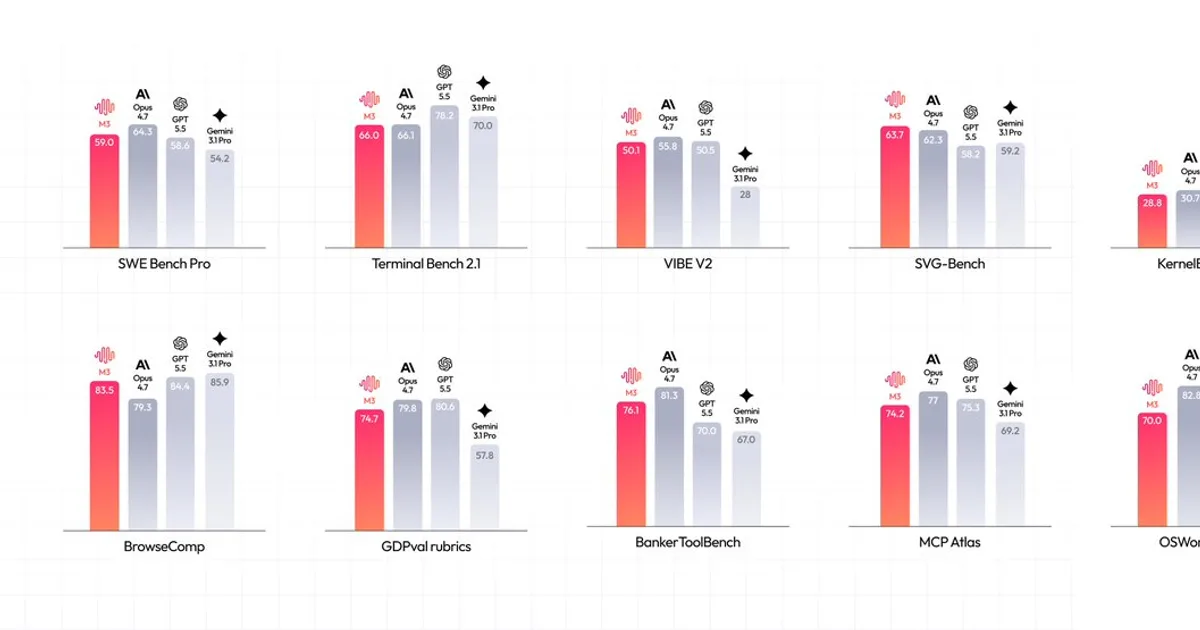
Open-weights multimodal model with 1M token context that matches frontier coding benchmarks at 5-10% of GPT-5.5 pricing.
Updated 2026-06-09
Yes, within limits. MiniMax M3 runs a free tier with paid plans above it.
Listed pricing: Freemium — Plus $20/mo, API $0.30/M input / $1.20/M output.
Overview
MiniMax M3 is an open-weights multimodal model from Chinese AI lab MiniMax, released on June 1, 2026. It competes directly with frontier models like GPT-5.5 and Gemini 3.1 Pro on coding and agentic benchmarks — the key difference being that it does so at roughly 5-10% of the cost. The model supports a 1M token context window natively, handles text, image, and code inputs, and is designed from the ground up for agentic workflows where the model needs to plan, use tools, and execute multi-step tasks.
What makes M3 genuinely interesting for developers is the combination of price and capability. API pricing sits at $0.30 per million input tokens and $1.20 per million output tokens during the current promotional period — dramatically cheaper than comparable closed models. The 1M context window is large enough to ingest entire codebases, long document chains, or extended conversation histories without chunking. Open weights mean you can self-host, fine-tune, and inspect the model, which matters for teams with data sovereignty requirements or specialized use cases.
The main caveats are ecosystem maturity and geographic origin. MiniMax's developer platform and tooling are less polished than OpenAI's or Anthropic's, and third-party integrations (IDE plugins, agent frameworks) are still catching up. As with DeepSeek, the Chinese company origin may raise compliance questions for some enterprise buyers. But on raw price-performance for coding and agentic tasks, M3 is hard to ignore — it's already available on OpenRouter and other inference providers, which lowers the adoption barrier considerably.
Is MiniMax M3 free?
Yes, within limits. MiniMax M3 runs a free tier with paid plans above it.
What the free tier covers: Free API tier available for evaluation. Check platform.minimax.io for current limits.
Listed pricing: Freemium — Plus $20/mo, API $0.30/M input / $1.20/M output.
Pricing on this page has not been re-verified. The entry was last edited on , and no separate pricing check has been run since. Treat the figures as a record of what was published then and confirm on the official site.
What the free tier leaves out
Read straight off the plan list below. Vendors move features between tiers, so check the current split before you pay.
- Plus $20/mo Approximately 1.7B tokens per month, priority access
- API — M3 $0.30/M input, $1.20/M output Promotional pricing. 1M context window, multimodal input, tool use
MiniMax M3 pricing
| Plan | Price | What's included |
|---|---|---|
| Free Tier | Free | Limited API access for evaluation and testing |
| Plus | $20/mo | Approximately 1.7B tokens per month, priority access |
| API — M3 | $0.30/M input, $1.20/M output | Promotional pricing. 1M context window, multimodal input, tool use |
Limited API access for evaluation and testing
Approximately 1.7B tokens per month, priority access
Promotional pricing. 1M context window, multimodal input, tool use
Pricing on this page has not been re-verified. The entry was last edited on , and no separate pricing check has been run since. Treat the figures as a record of what was published then and confirm on the official site.
Is MiniMax M3 worth it?
Worth it for Developers and teams who need frontier-level coding and agentic model performance without frontier pricing.
You can test that on the free tier before paying anything. The recorded trade-offs are listed below, and any one of them can settle the question on its own.
The 8.5/10 AI Score is an editorial read of published capability, price and shipping pace. Nobody here has hands-on hours with MiniMax M3. How we verify.
Worth it if
The strengths recorded against this entry.
- Frontier-level coding and agentic performance at 5-10% of GPT-5.5 or Gemini 3.1 Pro pricing
- 1M token context window handles entire codebases without chunking
- Open weights allow self-hosting, fine-tuning, and full model inspection
- Available on OpenRouter and third-party providers, not locked to a single platform
Not worth it if
Any one of these blocks your use case.
- Developer platform and tooling less mature than OpenAI or Anthropic ecosystems
- Limited native IDE integrations — mostly accessed via API or third-party providers
- Chinese company origin may raise data governance concerns for some enterprise buyers
- Promotional API pricing may increase once the introductory period ends
What sets MiniMax M3 apart
- Matches frontier coding and agentic benchmarks at roughly 5-10% of GPT-5.5 or Gemini 3.1 Pro pricing
- 1M token context window ingests entire codebases without chunking
- Open weights allow self-hosting, fine-tuning, and full model inspection
- Available on OpenRouter and other third-party providers rather than locked to one platform
Key features
1M Context Window
Supports up to 1 million tokens of context natively, allowing ingestion of entire codebases, long document chains, or extended multi-turn conversations without chunking or summarization.
Code Gen
Scores at or near frontier level on major coding benchmarks. Handles code generation, debugging, refactoring, and code review across popular languages with strong multi-file awareness.
Multimodal
Processes text, image, and code inputs natively within a single model. Useful for tasks like reading diagrams, understanding UI screenshots, or analyzing visual data alongside code.
Agentic
Built for agentic workflows with strong tool-use, planning, and multi-step execution capabilities. Designed to operate autonomously in chains where the model must reason about next actions.
How it compares
| Tool | Best for | Pricing | Score |
|---|---|---|---|
| MiniMax M3 | Developers and teams who need frontier-level coding and agentic model performance without frontier pricing. | Freemium — Plus $20/mo, API $0.30/M input / $1.20/M output | 8.5/10 |
| Cursor vs Cursor → | Professional developers handling complex, multi-file refactors who want AI built into a familiar VS Code-based editor. | Free Hobby + Individual $20/mo + Teams $40/user/mo + Enterprise Custom | 9.5/10 |
| GPT-5.5 vs GPT-5.5 → | Developers and teams needing a frontier reasoning model for agentic coding workflows and large-codebase context handling. | API: $5/$30 per 1M tokens (in/out). ChatGPT Plus $20/mo, Pro $200/mo | 9.4/10 |
| Claude Code vs Claude Code → | Developers who want an agent that works inside an existing repo and toolchain rather than in a hosted editor, and who already pay for a Claude plan. | Included with Claude Pro $17/mo, Max 5x $100/mo, Max 20x $200/mo, Team and Enterprise plans | 9.3/10 |


Compare head-to-head
Related reading

Kimi K3.1 Pro vs Opus 5.5 on Scores and Access
Moonshot’s Kimi K3.1 Pro hits 65.7% on Terminal-Bench 4.0 against Claude Opus 5.5 at 66.4%, with live API access and open weights dated November 4.

Meta's $35B Class C Raise Buys Compute, Not Votes
Meta's October 2026 Class C equity raise funds AI data centers while preserving founder control and lifting the compute bar for smaller labs.

Brotli Unauthenticated RCE Claim, Audited
Security digests keep repeating Brotli RCE with “no account needed.” Here is what that claim measures, skips, and when it fails for your stack.
Ready to try MiniMax M3?
Head to the official site to start with MiniMax M3 — pricing and plans are listed above.
Visit MiniMax M3