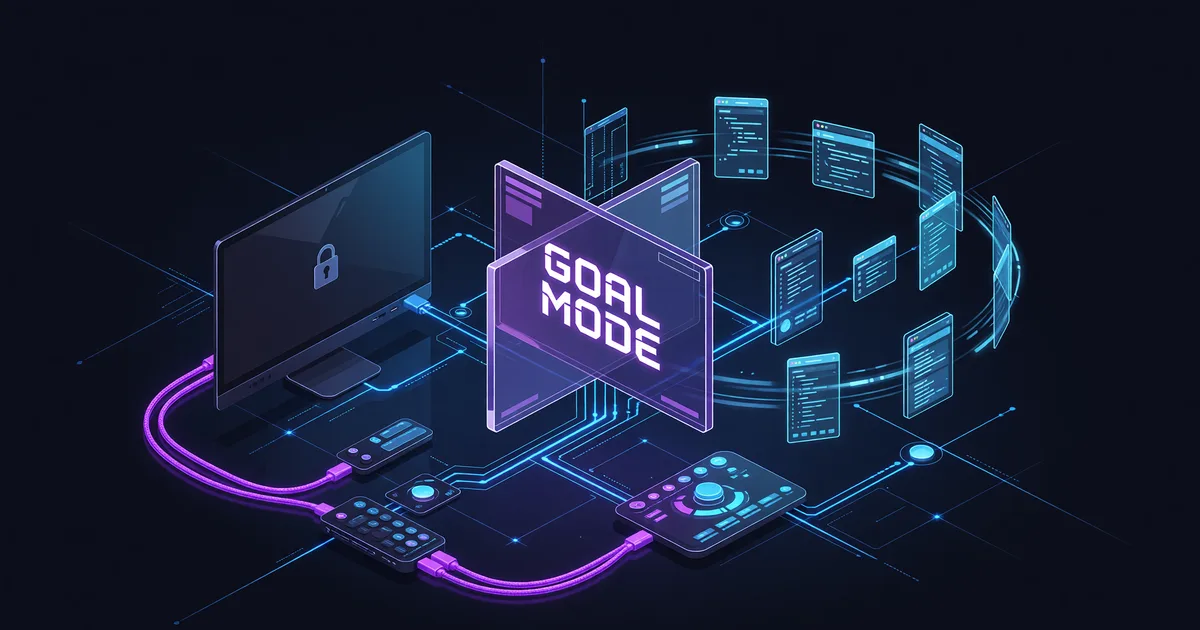
OpenAI Codex Thursday: Goal Mode & Appshots
OpenAI's May 22 Codex update adds always-on Goal mode, Appshots for instant app context, and remote Mac control while locked.
Three Features That Push Codex Closer to Autonomous Coding
OpenAI's "Codex Thursday" drop on May 22, 2026 shipped three features that collectively move the product from "AI pair programmer" toward something closer to an autonomous software engineer. The headline additions: an always-on Goal mode, a new primitive called Appshots for visual app context, and the ability to control your Mac remotely — even when it's locked.
The announcement landed via OpenAI's official X account (per the thread at @OpenAI, May 22) and the ChatGPT release notes, pulling 190k+ views within hours. Here's what each feature actually does and why it matters for the agentic coding race.
Goal Mode: Persistent Intent, Not Just Prompts
Goal mode is Codex's shift from reactive chat to proactive execution. Instead of responding to individual prompts and stopping, Codex now maintains a persistent goal state — it tracks what you're trying to accomplish across multiple steps and keeps working toward that objective without requiring you to re-prompt at every juncture.
The practical difference: previously, if you asked Codex to "refactor this module to use dependency injection," it would make changes, stop, and wait. With Goal mode always on, Codex continues pursuing the stated goal — running tests, identifying follow-up issues introduced by the refactor, fixing those, and iterating until the goal is met or it hits a decision point that requires your input.
My read: This is OpenAI's answer to the "agent loop" pattern that Claude Code, Cursor, and Devin have been iterating on. The distinction is that Goal mode is framed as a persistent state rather than an opt-in agent session. It's always tracking intent, not just executing instructions.
The key question is how well Codex handles goal ambiguity. A goal like "make the app faster" has infinite interpretations. The release notes indicate Codex will surface clarifying questions when the goal is underspecified, but the real test is whether it asks at the right moments versus either over-asking (annoying) or under-asking (dangerous).
Why this matters for the market
Every serious coding agent is converging on some version of persistent goal tracking. Devin maintains task state across sessions. Claude Code has its agentic loop with tool use. GitHub Copilot Workspace builds execution plans. OpenAI making Goal mode the default — not an opt-in — signals they believe users are ready for agents that don't stop after one turn.
Appshots: Visual Context Without the Overhead
Appshots give Codex instant visual understanding of your application's current state. Think of it as a lightweight screenshot-plus-metadata capture that Codex can reference while making changes — it sees what your app actually looks like, not just what the code says it should look like.
This solves a real problem. Code-only context means the agent is working blind to visual regressions, layout bugs, and UI state issues. If you tell Codex "the sidebar is overlapping the main content," it previously had to infer the problem from CSS alone. With Appshots, it can see the overlap directly.
The "instant" framing suggests these are lightweight captures rather than full browser automation sessions — Codex isn't spinning up a headless browser and navigating your app. It's grabbing the current visual state as a reference artifact that informs its code changes.
How Appshots compare to existing approaches
| Approach | Context type | Overhead | Use case |
|---|---|---|---|
| Appshots (Codex) | Visual snapshot + metadata | Low — instant capture | UI-aware code changes |
| Browser automation (Devin) | Full interactive browser | High — spins up environment | End-to-end testing |
| Screenshot tool use (Claude) | On-demand screenshots | Medium — requires tool call | Verification steps |
| Preview URLs (Copilot Workspace) | Live preview link | Medium — needs running app | Visual review |
The lightweight approach has clear tradeoffs. Appshots likely can't interact with the UI — they're read-only context. But for the majority of coding tasks where you need the agent to understand visual state without full browser automation overhead, this hits a practical sweet spot.
Remote Computer Use: Codex Works While Your Mac Sleeps
The third feature is arguably the most ambitious: Codex can now control your Mac remotely, including when the machine is locked. This extends OpenAI's computer use capabilities (first previewed with the operator/CUA model) into the coding workflow specifically.
The scenario this enables: you assign Codex a goal before stepping away from your desk. Your Mac locks after the screen timeout. Codex keeps working — running your local dev server, executing tests, making commits, interacting with your IDE — without needing the screen to stay unlocked.
The security question
Remote control of a locked machine is a feature that immediately raises security concerns, and OpenAI appears to have anticipated this. The announcement references safeguards, though the specific implementation details matter enormously here:
- Scope limitations — What can Codex access on the locked machine? If it's sandboxed to dev tools and terminal, that's reasonable. If it has full desktop access, that's a different risk profile.
- Action transparency — Can you review what Codex did while the machine was locked? An audit log of actions taken during unattended sessions is table-stakes for trust.
- Kill switch — Can you remotely halt Codex's session from your phone or another device if something goes wrong?
- Authentication boundary — How does Codex authenticate to maintain the session through a lock? This likely requires a persistent daemon or background agent process.
I think this feature will divide developers into two camps. Power users who already trust their CI/CD to run arbitrary code on their behalf will see locked-Mac support as a natural extension. Developers who are more security-conscious will want to see the full threat model before enabling it.
The Bigger Picture: Codex's Competitive Position
These three features together tell a coherent story about where OpenAI is taking Codex. The product thesis is: coding agents should be persistent (Goal mode), context-aware beyond just code (Appshots), and capable of working independently of your physical presence (remote use).
That's a more aggressive vision than most competitors are shipping today. Claude Code is powerful but session-based. GitHub Copilot Workspace plans work but requires you to review before execution. Cursor is fast but tightly coupled to the editor window being active.
Codex is positioning as the agent that works while you don't — which is either the future of development tooling or a trust problem that hasn't been solved yet. Probably both.
What we don't know yet
Several important details remain unclear from the announcement:
- Pricing impact — Goal mode presumably uses more tokens per task since it iterates autonomously. OpenAI hasn't clarified whether this changes Codex's cost structure.
- Model underneath — Whether Goal mode runs on the same model or escalates to a more capable (and expensive) reasoning model for complex goals.
- Platform support — Remote use is explicitly Mac-focused in this release. Windows and Linux support timelines aren't mentioned.
- Rollout scope — Whether these features are available to all Codex users or gated behind Plus/Pro/Team tiers.
What This Means for Developers Right Now
If you're already using Codex, Goal mode being always-on means your workflow changes immediately — you'll need to be more precise about stating objectives upfront, because Codex will keep pursuing them. Vague prompts become riskier when the agent doesn't stop after one turn.
If you're evaluating coding agents, this release makes the comparison landscape messier in a good way. The question is no longer just "which agent writes better code" but "which agent's autonomy model matches how I actually work." Some developers want an agent that proposes and waits. Others want one that executes and reports back. Codex is betting heavily on the latter.
The Codex Thursday cadence itself is worth noting — OpenAI is shipping weekly feature drops for this product, which suggests significant internal investment and a team that's iterating fast. For competitors, the pressure to match this pace is real.
The honest take: Goal mode and Appshots are solid, incremental advances on ideas the whole industry is exploring. Remote locked-Mac control is the genuinely novel bet — and the one most likely to either define Codex's identity or become a cautionary tale about agent autonomy. The safeguards will determine which.
Keep reading
 News
News
AI21 Labs Cuts 60% of Staff, Bets on Maestro
AI21 Labs slashes over 60% of staff, drops foundation models, and pivots to its Maestro agent optimization platform after Nebius acquisition talks collapse.
 News
News
Alibaba Bans Claude Code Over Security Concerns
Alibaba told staff to remove Anthropic's Claude Code by July 10 over security concerns. Here's what triggered the ban and what it signals.
 News
News
Anthropic Acquires Stainless: What It Means for AI
Anthropic bought Stainless, the SDK generator behind OpenAI and Cloudflare's client libraries. Here's the strategic play for AI agents.