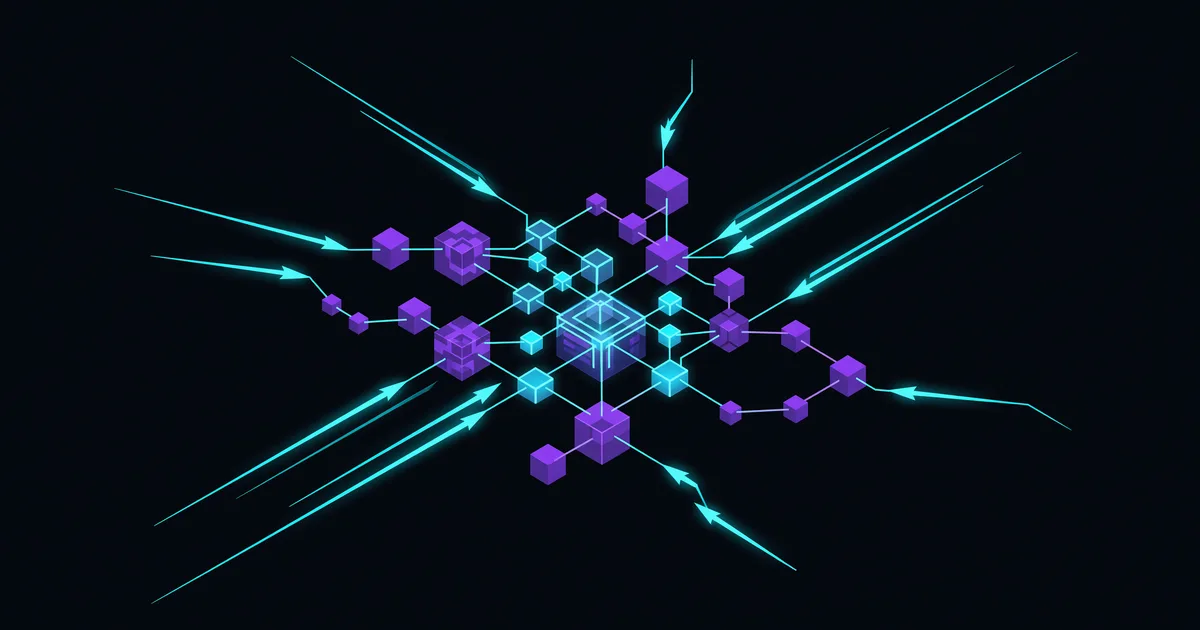
Isomorphic Labs Raises $2.1B for AI Drug Design
Isomorphic Labs just raised $2.1B in Series B funding led by Thrive Capital. Here's what IsoDDE means for AI drug discovery.
Isomorphic Labs, the drug discovery company spun out of Google DeepMind, closed a $2.1 billion Series B led by Thrive Capital. The round, announced May 12, 2026, makes it the most heavily funded AI-native drug design operation in the world. Demis Hassabis, Nobel laureate, DeepMind co-founder and Isomorphic's chairman, posted the news on X, where it quickly passed a million views.
The thesis behind the money is specific: that the same deep learning breakthroughs behind AlphaFold can be extended to design entirely new drugs rather than only predict protein structures. The $2.1B is meant to scale that thesis into clinical reality, which is a longer and less forgiving path than a benchmark chart.
What Isomorphic Labs is building
The core technology is IsoDDE, the Isomorphic Drug Design Engine. AlphaFold solved protein structure prediction, a problem biologists had chased for 50 years. IsoDDE aims at the harder downstream challenge of designing molecules that interact with those proteins in therapeutically useful ways.
The distinction matters. Knowing a protein's 3D shape is step one. Designing a small molecule that binds to the right pocket, with the right affinity, without toxic off-target effects, and that survives the gauntlet of absorption, metabolism and excretion is the part that costs pharma companies billions and takes a decade per drug. Isomorphic's bet is that AI models trained on massive molecular datasets can compress that timeline dramatically.
The company has been relatively quiet about IsoDDE's technical specifics compared with the open-science approach that made AlphaFold famous. What its public communications describe is a system that goes beyond structure prediction into molecular generation, binding prediction and ADMET modeling, covering absorption, distribution, metabolism, excretion and toxicity. The ambition, as Hassabis described it, is to solve all of disease, a statement that reads as visionary or hubristic depending on how the next five years play out.
The investor mix says patient capital
Thrive Capital led the round. Josh Kushner's fund has become one of the most active AI investors in the current cycle and was also part of OpenAI's massive round. The broader investor list reportedly includes sovereign wealth funds, which signals something specific: this is patient capital. Sovereign funds do not need a three-year exit and are comfortable with the seven-to-ten-year timelines drug development demands.
The investor profile carries more information than the dollar amount. AI drug discovery companies have a credibility problem, since the hype cycle has been running since at least 2020 and clinical results across the industry have been mixed. Backers who understand biotech timelines, rather than software VCs expecting SaaS-style growth, give Isomorphic room to actually run the experiments.
The AlphaFold lineage cuts both ways
Isomorphic's biggest advantage is also its biggest source of pressure. AlphaFold 2 was arguably the most impressive scientific AI result ever produced, and AlphaFold 3 extended it to protein-ligand complexes, nucleic acids and more. Isomorphic inherits that credibility plus direct access to DeepMind's talent and infrastructure through its relationship with Google.
AlphaFold also solved a well-defined prediction problem with clear ground truth data in the form of experimental protein structures. Drug design is messier. The feedback loops run longer, because you do not know whether a designed molecule works until you synthesize it and test it, which takes months even in the best case. The success criteria are fuzzier. And the regulatory path adds years that no amount of compute can skip.
The AlphaFold connection gets Isomorphic in the door with investors and pharma partners. The drug design problem is sufficiently different that past success does not guarantee future results, and the team clearly knows it. Building IsoDDE as a distinct platform rather than bolting drug design onto AlphaFold suggests they understand the problem requires new approaches.
Where $2.1B goes in AI drug discovery
A $2.1B raise for a company that does not manufacture physical products looks excessive until you price biotech.
Compute infrastructure comes first, because training and running large molecular models requires serious GPU clusters. Isomorphic likely has preferred access to Google Cloud infrastructure, and scaling to production drug design workflows across thousands of targets is still expensive.
Wet lab validation is next. AI-designed molecules have to be synthesized and tested in physical labs, and Isomorphic has been building out lab capacity. Automated synthesis platforms, high-throughput screening and animal studies are all capital-intensive.
The clinical pipeline is where costs escalate fastest. If any AI-designed candidate reaches clinical trials, a single Phase II trial can run $20 to $50 million and Phase III can run into the hundreds of millions.
Talent closes the list. The intersection of world-class ML researchers and experienced drug hunters is one of the smallest talent pools in tech, those people are expensive, and Isomorphic is competing with every major pharma company and AI lab for them.
Together the $2.1B buys enough runway to take AI-designed molecules from computational prediction through clinical proof-of-concept without raising again at a desperate moment. Biotech companies that run low on cash get terrible deal terms, so the size of the round is itself a strategic choice.
The competitive field around IsoDDE
Isomorphic is not the only player here, though the $2.1B raise puts significant distance between it and most competitors.
| Company | Approach | Notable Backing |
|---|---|---|
| Isomorphic Labs | End-to-end AI drug design (IsoDDE) | Google/Alphabet, Thrive Capital |
| Recursion Pharmaceuticals | Phenomics + ML for drug discovery | Public (RXRX), NVIDIA partnership |
| Insilico Medicine | Generative AI for target discovery + molecular design | Multiple VCs, first AI-designed drug in Phase II |
| Relay Therapeutics | Motion-based drug design (dynamics simulation) | Public (RLAY) |
| Xaira Therapeutics | Large-scale bio AI models | $1B+ from ARCH, Foresite |
The key differentiator is the DeepMind lineage. No other AI drug discovery company has a direct pipeline to the team that solved protein folding. Whether that translates into better drugs remains unproven, and it is a genuine structural advantage in model development and scientific talent recruitment.
What Isomorphic has not disclosed
The company has been notably opaque about several things that matter.
Pipeline specifics are the largest gap: which therapeutic areas are being targeted, and what stage the most advanced programs have reached. Isomorphic has pharma partnerships, with announced deals with Eli Lilly and Novartis in prior years, but detailed pipeline disclosures have been minimal.
IsoDDE benchmarks are the second. Unlike AlphaFold, which published extensively in Nature and released code, IsoDDE's capabilities have not been subjected to public peer review, so the technology's power rests on the company's word.
Valuation is the third. The post-money valuation on this round has not been publicly confirmed. Given the $2.1B raise size and Series B stage, estimates likely place it well north of $5B, and that remains speculation until confirmed.
The revenue model is the fourth. Whether Isomorphic is building its own drug pipeline, licensing AI-designed candidates to pharma, or selling the platform as a service is unclear, and the pharma partnerships suggest a hybrid without settling the long-term structure.
The missing public benchmarking for IsoDDE is the most significant of those gaps. AlphaFold earned its reputation through transparent, reproducible results in CASP competitions. If Isomorphic wants the same credibility for drug design, it will eventually need to show its work rather than announce partnerships and funding rounds.
Three reasons the round matters outside biotech
It validates AI-for-science as a standalone investment thesis. Most AI funding in 2025 and 2026 has gone to foundation model companies such as OpenAI, Anthropic and xAI, or to infrastructure players like NVIDIA and the cloud providers. Isomorphic's raise shows investors see a path to returns from applying AI to specific scientific domains rather than building general-purpose chatbots.
It tests the DeepMind spinout model. Google has historically struggled to commercialize its research breakthroughs, and Isomorphic is an experiment in whether a semi-independent company with DeepMind's scientific DNA and startup-like focus can ship products, which here means drugs. If it works, expect more DeepMind spinouts.
It raises the stakes for the whole field. With $2.1B in fresh capital and the AlphaFold brand behind it, Isomorphic will face intense scrutiny. Failed clinical trials for its AI-designed molecules would set back the entire AI drug discovery narrative, not just one company. Success could make it the most consequential application of AI this decade.
Credibility is not clinical data
The $2.1B Series B is the largest pure AI drug discovery raise to date, and it arrives with genuine scientific credibility via the AlphaFold lineage. IsoDDE represents a real attempt to move AI beyond protein structure prediction into the much harder problem of actual drug design.
The company still has to show that AI-designed molecules survive the brutal gauntlet of drug development: synthesis, animal models, human safety trials, efficacy studies. That takes years rather than quarters, and the $2.1B buys the runway to try. Whether the science delivers is the question that matters, and no amount of funding guarantees it.
For anyone tracking the intersection of AI and healthcare, this is the company to watch, less because the hype is loudest and more because the scientific foundation is the strongest and the bet is now big enough that we will get a definitive answer about whether AI can reinvent how drugs are made.
Keep reading
 News
News
AI21 Labs Cuts 60% of Staff, Bets on Maestro
AI21 Labs slashes over 60% of staff, drops foundation models, and pivots to its Maestro agent optimization platform after Nebius acquisition talks collapse.
 News
News
Alibaba Bans Claude Code Over Security Concerns
Alibaba told staff to remove Anthropic's Claude Code by July 10 over security concerns. Here's what triggered the ban and what it signals.
 News
News
Anthropic Acquires Stainless: What It Means for AI
Anthropic bought Stainless, the SDK generator behind OpenAI and Cloudflare's client libraries. Here's the strategic play for AI agents.