Kits AI
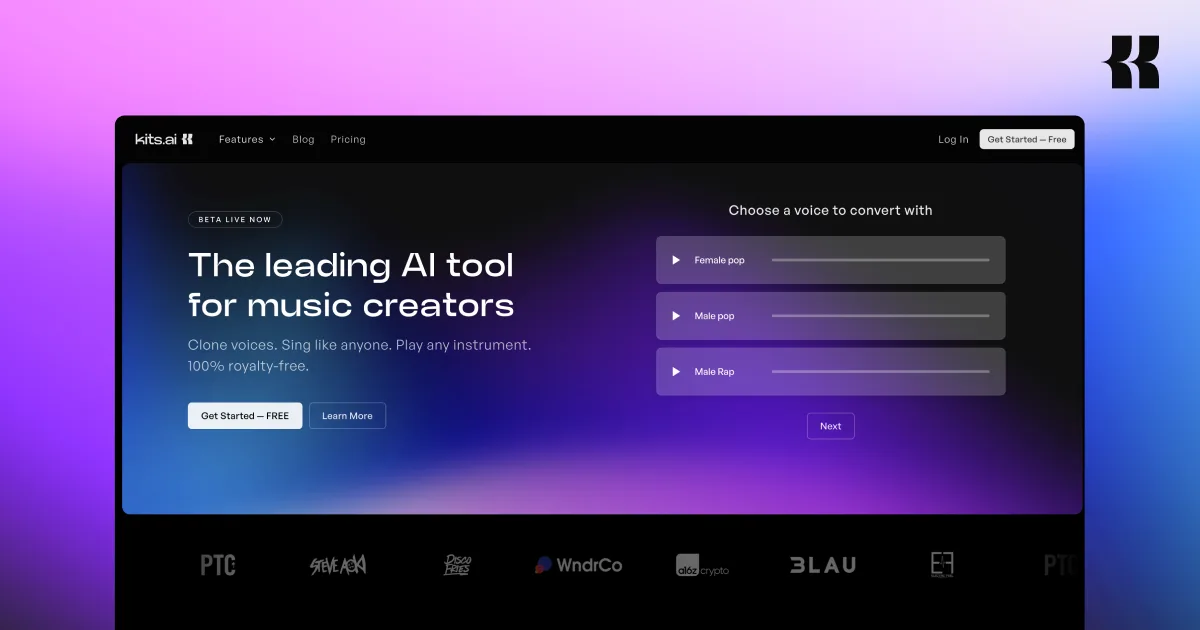
Browser-based AI vocal studio with licensed singing-voice models, custom voice cloning, stem separation, pitch correction and AI mastering.
Updated 2026-06-27
Yes, within limits. Kits AI runs a free tier with paid plans above it.
Listed pricing: Free tier + paid from ~$10/mo.
Overview
Kits AI is a browser-based vocal and audio toolkit built for musicians and producers. Its core trick is AI voice conversion: you sing or upload a vocal take and remap it onto a library of pre-trained singing-voice models, or onto a custom model you train from your own recordings. Around that sit a handful of supporting utilities — vocal and instrumental stem separation, pitch correction, and an AI mastering pass — so a rough idea can move toward a finished-sounding stem without leaving the tab.
What separates it from generative music tools like Suno or Udio is that Kits AI doesn't write songs. You bring the performance; it changes the voice. The closest comparisons on the toolkit side are LALAL.AI for stem separation and ElevenLabs for voice, but Kits is squarely aimed at sung vocals and vocal-conversion workflows rather than speech or full-track generation. Founded by songwriter-producers Evan Bogart and Jesse Frasure, the company leans hard on an ethical angle: its featured voice models are pitched as licensed and royalty-free, which matters if you intend to release commercially.
It's a genuinely useful niche tool, but reception is mixed. Independent reviews and roundups regularly flag robotic or artifact-heavy output on harder source material, and the pricing skews paywall-heavy once you move past the free tier — one review aggregate sits as low as 1.4 stars. Treat it as a capable vocal-conversion sketchpad rather than a finished-vocal guarantee.
Is Kits AI free?
Yes, within limits. Kits AI runs a free tier with paid plans above it.
What the free tier covers: Free tier with no credit card required; limited usage.
Listed pricing: Free tier + paid from ~$10/mo.
Pricing on this page has not been re-verified. The entry was last edited on , and no separate pricing check has been run since. Treat the figures as a record of what was published then and confirm on the official site.
What the free tier leaves out
Read straight off the plan list below. Vendors move features between tiers, so check the current split before you pay.
- Paid plans From ~$10/mo Credit/usage-tiered; higher tiers add more conversion minutes and access to additional/pro voice models. Check website for current pricing.
Kits AI pricing
| Plan | Price | What's included |
|---|---|---|
| Free | $0 | No credit card required; limited conversion minutes and access to core voice tools to evaluate the studio. |
| Paid plans | From ~$10/mo | Credit/usage-tiered; higher tiers add more conversion minutes and access to additional/pro voice models. Check website for current pricing. |
No credit card required; limited conversion minutes and access to core voice tools to evaluate the studio.
Credit/usage-tiered; higher tiers add more conversion minutes and access to additional/pro voice models. Check website for current pricing.
Pricing on this page has not been re-verified. The entry was last edited on , and no separate pricing check has been run since. Treat the figures as a record of what was published then and confirm on the official site.
Is Kits AI worth it?
Worth it for Musicians and producers who want to convert vocal takes onto licensed or custom-cloned singing voices and finish a stem in-browser.
You can test that on the free tier before paying anything. The recorded trade-offs are listed below, and any one of them can settle the question on its own.
The 7/10 AI Score is an editorial read of published capability, price and shipping pace. Nobody here has hands-on hours with Kits AI. How we verify.
Worth it if
The strengths recorded against this entry.
- Licensed, royalty-free voice models reduce the legal risk of releasing AI-converted vocals
- Custom voice cloning from your own recordings
- Bundles conversion, stem separation, pitch correction and mastering in one browser app
- Genuine free tier with no credit card required
- Founded by working songwriter-producers, with a clear commercial-use focus
Not worth it if
Any one of these blocks your use case.
- Output quality is inconsistent — reviewers report robotic or artifact-heavy results on difficult source vocals
- Pricing is paywall-heavy once you exceed the free tier's limited minutes
- Notably mixed third-party reception, including a 1.4-star aggregate on one review platform
- Doesn't generate songs or lyrics — you must supply the performance yourself
What sets Kits AI apart
- Licensed, royalty-free voice models built for commercial release
- Custom voice cloning trained from your own recordings
- Bundles conversion, stem separation, pitch correction, and mastering
- Founded by working songwriter-producers Evan Bogart and Jesse Frasure
Key features
Licensed voice models
A library of pre-trained singing-voice models marketed as ethically licensed and royalty-free, which is the practical differentiator if you plan to release the output commercially rather than just experiment.
Custom voice cloning
Train a personal voice model from your own recordings and convert any vocal take into it, useful for maintaining a consistent vocal identity across demos.
Stem & vocal separation
Split a mix into vocal and instrumental stems, overlapping with dedicated tools like LALAL.AI but bundled alongside the conversion workflow so you can isolate a vocal before remapping it.
Pitch correction & AI mastering
Built-in tuning plus a one-pass AI master let you tighten and finish a converted vocal in the browser instead of bouncing out to a separate DAW or mastering service.
How it compares
| Tool | Best for | Pricing | Score |
|---|---|---|---|
| Kits AI | Musicians and producers who want to convert vocal takes onto licensed or custom-cloned singing voices and finish a stem in-browser. | Free tier + paid from ~$10/mo | 7/10 |
| Suno AI | Content creators, podcasters, and indie artists who need original full songs with vocals and lyrics without studio production. | Free tier + Pro $8/mo + Premier $24/mo | 9.2/10 |
| ElevenLabs vs ElevenLabs → | Creators, publishers, and developers who need realistic TTS or cloning, and teams that want Claude or Claude Code to manage ElevenLabs agents over hosted OAuth. | Free $0 (10k credits) + Starter $6/mo (30k) + Creator $22/mo (121k, first month $11) + Pro $99/mo (600k) + Scale $299/mo (1.8M) + Business $990/mo (6M) + Enterprise custom. Credits are shared across products. Annual is 10 months prepaid. | 9.2/10 |
| Udio | Music producers and enthusiasts who want radio-ready tracks with precise genre reproduction and detailed control over lyrics and structure. | Freemium | 8.8/10 |



Learn to use Kits AI
Step-by-step, each one stamped with the date it was last checked against the docs.
Compare head-to-head
Comparison explorer Put Kits AI up against any three tools Opens with Kits AI already loaded. Add up to three more from the full index and read pricing, features, pros and cons in one table. →Related reading
GPT-Live's one stream vs Gemini 3.8 Live
OpenAI's GPT-Live listens and speaks on one WebSocket. Google's Gemini 3.8 Live reasons while talking. Specs, prices, and who each model is for.
ChatGPT Finances Experian Soft Credit Check: What Shipped
U.S. Plus/Pro ChatGPT Finances can connect Experian for a soft-pull VantageScore 3.0. What OpenAI's Help Center says about setup, monthly updates, and what not to paste in chat.

Anthropic Traced More Than 23 Million Exchanges
Anthropic attributed more than 23 million exchanges to Moonshot between May and July in its September 2026 threat intelligence report.
Ready to try Kits AI?
Head to the official site to start with Kits AI — pricing and plans are listed above.
Visit Kits AI