xAI Folds Into SpaceX: What SpaceXAI Means for AI
Musk dissolved xAI into SpaceX, then leased its 220K-GPU Colossus 1 supercluster to rival Anthropic. Here is why that matters.
Two things happened within hours of each other on May 6, 2026. Elon Musk confirmed that xAI, his standalone AI company, no longer exists as a separate entity, having been fully absorbed into SpaceX under the brand SpaceXAI. Then SpaceXAI announced it is leasing the entirety of its Colossus 1 supercluster to Anthropic, the company behind Claude.
Musk built one of the largest GPU clusters on Earth for his own AI lab, dissolved the lab into his rocket company, and handed the cluster to a competitor, all in the same week. The sequence only makes sense if the economics of AI infrastructure are moving faster than the product race, and if compute rather than models has become the thing worth owning.
The xAI dissolution, in Musk's own words
xAI launched in July 2023 with a mission to build AI that understands the universe. It produced Grok, which went from Twitter chatbot novelty to a genuinely competitive model family, and Grok 4.3 shipped days before this announcement having topped multiple agentic benchmarks.
Musk has now folded the whole thing into SpaceX. His phrasing: "It will just be SpaceXAI, the AI products from SpaceX." Grok survives as a SpaceX product, and the team, the models and the research all move under the SpaceX corporate umbrella.
Dissolving a company that was performing well has three plausible motivations. Corporate simplification is the shallowest: Musk already runs Tesla, SpaceX, Neuralink, The Boring Company and X, and folding xAI into SpaceX removes a board, a leadership structure and a set of investor relationships from his calendar. Treating compute as infrastructure is the more substantive one, since SpaceX already operates enormous ground infrastructure in launch pads, Starlink ground stations and mission control, and adding GPU clusters turns it into a dual-purpose infrastructure company selling connectivity and processing. The third is Starship. SpaceXAI has publicly floated multi-gigawatt orbital AI data centers launched on Starship, and that idea is incoherent unless the AI division and the launch vehicle division answer to the same parent.
Colossus 1 by the numbers
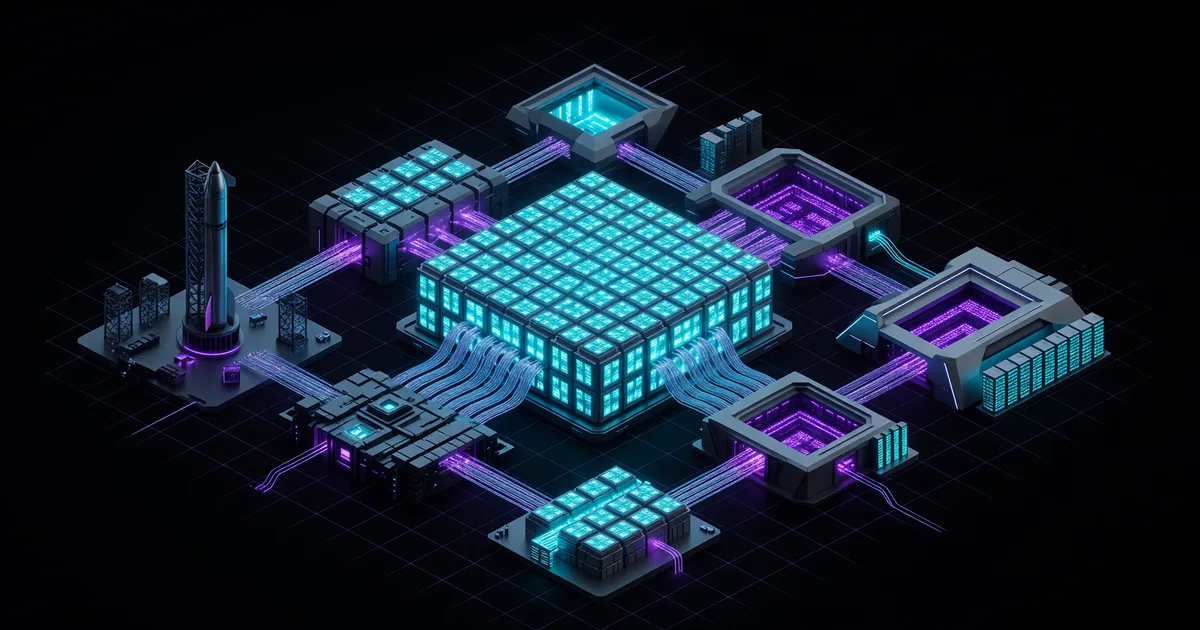
Colossus 1 sits in Memphis, Tennessee, and the specifications sounded absurd when Musk first announced them. They still do: over 220,000 NVIDIA GPUs across a mix of H100, H200 and newer GB200 chips, 300 megawatts of power, roughly what 200,000 homes draw, with full capacity online by the end of May 2026.
Most frontier labs train flagship models on clusters of 10,000 to 30,000 GPUs. Colossus 1 runs seven to twenty-two times larger than a typical training cluster. It was built for a scale of training that arguably does not exist yet, which is the detail that explains the lease.
Musk being willing to hand the entire cluster to another company says the cluster was underutilized for xAI's own work. Building compute has turned out to be easier than generating enough workload to saturate it.
With xAI's training moved onto the newer Colossus 2, Colossus 1 became a stranded asset: enormous, expensive to maintain and producing no revenue. Leasing it to Anthropic converts a cost center into a profit center without moving a rack.
Anthropic had the demand and none of the GPUs
Anthropic has been capacity-constrained for months. Claude Pro and Max subscribers have absorbed peak-hour throttling, reduced limits during busy periods and API rate caps that frustrated anyone building seriously on Claude. The demand existed; the hardware did not.
Per Anthropic's announcement, the Colossus 1 capacity delivers three immediate changes: doubled Claude Code five-hour limits across Pro, Max, Team and Enterprise tiers, removal of peak-hour reductions so US business hours stop degrading service, and raised Claude Opus API rate caps giving developers real headroom.
For Claude users this is the most tangible improvement in months, and it arrives without a new model or a new feature attached. Sometimes the upgrade that matters is not having to queue.
The reclaim clause
One detail from the deal stands out. Reports indicate Musk personally met the Anthropic team before approving the lease, and that the agreement carries a reclaim clause letting SpaceXAI pull Colossus 1 access if Anthropic's AI work is deemed harmful to humanity.
Whether that clause is legally enforceable or mostly theater is genuinely arguable, and no public version of the contract exists to settle it. What is not arguable is that Musk, who has criticized Anthropic and its co-founders publicly and repeatedly, did the deal anyway. The compute shortage is severe enough to convert stated enemies into counterparties.
SpaceX now controls both the network and the processing
The deal crystallizes a trend that has been building for over a year. Companies that control GPU clusters accumulate power regardless of whether their own models win anything.
| Asset | Purpose | Revenue Model |
|---|---|---|
| Colossus 1 (Memphis) | Leased to Anthropic | Compute rental income |
| Colossus 2 (undisclosed) | Grok model training | Grok API + X integration |
| Starlink | Global connectivity | Subscriptions + backhaul |
| Starship | Launch vehicle | Launch contracts + orbital infra |
SpaceX was already the most vertically integrated space company in history. Bolting compute infrastructure onto that stack produces something without a precedent: a single company holding both the physical network that moves data and the processing power that AI companies cannot get enough of.
The orbital data center angle
Both SpaceXAI and Anthropic have expressed interest in multi-gigawatt orbital AI compute delivered by Starship. It sounds like science fiction and the logic is mundane. Terrestrial data centers are running into power and land constraints, and permits alone for a 300MW facility can take years. In orbit, power comes from the sun, cooling is free, and nobody files a noise complaint.
The engineering problems are severe: radiation hardening, latency, maintenance access, launch cost per rack. Nobody is putting a GPU cluster in orbit next year. But the company that builds both the rockets and the clusters is the one with the least implausible path to trying it inside a decade.
Treat it as a long-horizon bet rather than a roadmap item. The near-term story stays terrestrial: Anthropic needed GPUs, SpaceXAI had idle ones, and the deal closed.
What changes for Grok users
If you use Grok through X, through the API, or through one of the growing number of apps built on it, today changes nothing. Grok 4.3 is still available, the API still works, the voice features still function.
The trajectory is what shifts. Grok development now happens inside SpaceX, which brings tighter integration with Starlink and Tesla, so expect Grok to surface in more Musk products across vehicle interfaces, satellite operations and manufacturing optimization. It also moves compute allocation decisions up to the SpaceX level, meaning Starship flight simulations and Starlink routing optimization now compete directly with Grok training for the same hardware. And the investor dynamics change, since xAI had its own investors and its own valuation while Grok's value is now bundled into SpaceX's, which affects both funding and internal resource allocation.
The risk for Grok users is that AI becomes a secondary priority inside a company whose stated mission is making humanity multiplanetary. The upside is that Grok inherits SpaceX's engineering talent and operational discipline, which is not a small inheritance.
What changes for Anthropic and Claude users
In the short term this is straightforwardly good. More compute means faster responses, higher rate limits and fewer capacity errors, and anyone who has been fighting Claude throttling at peak hours should notice the difference once Colossus 1 capacity comes fully online later this month.
The longer-term issue is dependency. Anthropic is now running on infrastructure owned by a competitor's parent company, which has explicitly reserved the right to revoke access. That is an uncomfortable place to stand even with a signed contract, because the leverage is asymmetric in exactly one direction.
Anthropic is almost certainly treating Colossus 1 as supplementary capacity rather than a foundation. In the immediate term it solves the problem that was actually hurting: the company needed GPUs yesterday, and 220,000 of them were sitting idle in Memphis.
Three things this deal establishes
The company that wins AI may not be the one with the best model. SpaceXAI is positioned to profit whether Grok, Claude, GPT or Gemini ends up on top, because controlling the compute means getting paid either way. That is the NVIDIA playbook run one layer down the stack.
Alliances in this industry are now purely transactional. Musk has sued OpenAI, feuded publicly with Anthropic's founders, and built xAI's identity around being the anti-establishment option. None of it prevented a massive compute deal the moment both sides had something to gain, which tells you where ideology ranks against GPU access.
And the compute bottleneck is reshaping corporate structure itself. xAI did not fold into SpaceX because the models were failing, since Grok 4.3 competes with the best available. It folded because building and operating GPU clusters now carries more strategic value than building the models that run on them, which inverts how the industry has been reasoning about AI companies for three years.
Model builders remain important. The companies controlling the power, the chips and the data centers those models run on may end up more important, and SpaceXAI has placed its bet accordingly. Against the current GPU shortage, that looks like the right read.
Claude users should see the extra capacity land in their rate limits within weeks. Grok users lose nothing today and should watch how SpaceX ranks AI against its core aerospace mission over the next year. And anyone building on an AI platform should register the direction of travel, because power in this industry is moving from the model layer to the infrastructure layer and this deal accelerated it.
Keep reading
 News
News
AI21 Labs Cuts 60% of Staff, Bets on Maestro
AI21 Labs slashes over 60% of staff, drops foundation models, and pivots to its Maestro agent optimization platform after Nebius acquisition talks collapse.
 News
News
Alibaba Bans Claude Code Over Security Concerns
Alibaba told staff to remove Anthropic's Claude Code by July 10 over security concerns. Here's what triggered the ban and what it signals.
 News
News
Anthropic Acquires Stainless: What It Means for AI
Anthropic bought Stainless, the SDK generator behind OpenAI and Cloudflare's client libraries. Here's the strategic play for AI agents.